


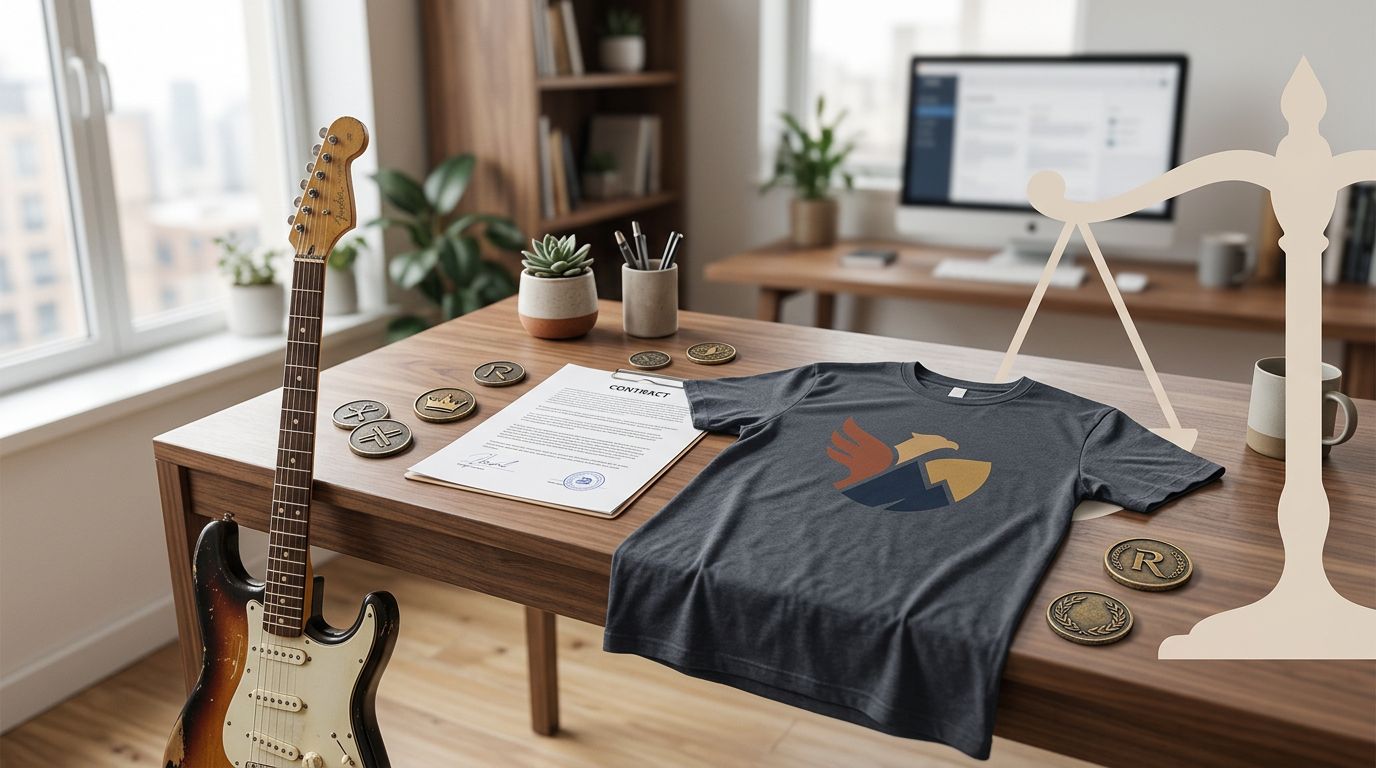
Merch Agreement Terms Artists Should Negotiate
A merch deal can look harmless on day one and still shape your income for years. One bad clause can hand over too much control of your name, logo, art, or online store before you notice what happened.
That is why artists need to negotiate merch agreement terms before the first shirt gets printed. The strongest deals spell out rights, money, approval power, and a clean exit, so the business side supports the career instead of boxing it in.
Table of Contents
ToggleWhy a merchandise contract deserves real attention
Many artists treat merch as a side business until the numbers say otherwise. A good catalog, strong tour sales, or one viral design can turn merch into one of your most stable revenue streams.
Because of that, the contract matters as much as the design. Recent artist guidance in 2026 keeps circling back to the same problems: broad exclusivity, vague royalty math, auto-renewals, weak sell-off language, and no audit right. Those traps are common because they hide in ordinary-looking clauses.
A merch company also has different goals than the artist. It wants room to produce, price, promote, and recoup. You want cash flow, brand control, and the freedom to grow beyond one partner. The gap between those goals is where negotiation starts.
General contract advice from the Independent Society of Musicians’ negotiation guide fits here too. Read slowly, mark vague language, and ask how each clause works when sales are strong, weak, or disputed.
This is also where experienced counsel helps. Chase Lawyers is a boutique firm with offices in Miami and New York City, and its practice centers on entertainment, media, sports, arts, and intellectual property matters. For musicians, managers, and creators, that means practical contract review tied to the real issues at stake: who controls the rights, who gets paid, and what happens when the relationship sours.
Start with the rights you are licensing
Name, likeness, logos, and artwork are separate assets
A merch agreement should list every asset the company may use. Your stage name is one asset. Your logo is another. Album art, photographs, tour marks, slogans, and commissioned designs may all carry different rights.
If the draft says the company can use “all intellectual property and publicity rights” connected to you, narrow it. Broad phrases create room for misuse. You want a schedule that names the exact rights and approved marks.
This matters under US law. Copyright, trademark, and publicity rights do not work the same way. A logo may function as a trademark under the Lanham Act. Album art may be protected by copyright. Your face and name may trigger state right of publicity laws. In Florida, for example, section 540.08 restricts unauthorized commercial use of a person’s name or likeness. If the company wants to sell goods with your image, the contract should say so in plain terms.
License the rights you need, not your whole catalog
Most artists should start from a license, not an assignment. A license lets the company use defined rights for defined products and sales channels. An assignment transfers ownership. That is a much bigger give.
Watch for words like “exclusive,” “perpetual,” and “irrevocable.” Those words can turn a short merch relationship into a long loss of control. If exclusivity is on the table, tie it to a narrow lane, such as tour-only apparel in North America, not every possible product worldwide.
New designs need their own treatment too. If the company creates original graphics using your branding, decide who owns those designs after the term ends. Some artists let the company own production art but keep the right to use any artist-related branding in future campaigns. Others require an assignment back after payment.
The Copyright Act adds another reason to write clearly. Under section 204(a), a copyright transfer or exclusive license generally must be in a signed writing. If the paper is vague, a later fight gets expensive fast.
Money terms decide whether the deal is good or just sounds good
“Net sales” can hide a lot of bad math
Artists often focus on the royalty percentage first. That number matters, but the base matters more. Ten percent of a loose “net” can be worse than five percent of a tight, well-defined base.
Ask the company to define gross sales, net sales, returns, discounts, bundles, taxes, shipping, payment processor fees, venue commissions, and chargebacks. If you sell on tour, say whether hall fees or promoter deductions come out before your royalty. If you sell online, say which platform costs are deductible and cap them where possible.
A short chart makes the pressure points easier to spot.
| Clause | Better artist position | Why it matters |
|---|---|---|
| Royalty base | Percentage of gross receipts or tightly defined net | Vague net language can shrink payouts |
| Deductions | Limit to actual third-party costs, listed in the contract | Hidden overhead can wipe out profit |
| Advance | Keep it realistic and tied to sales history | Large advances often delay future income |
| Recoupment | Recoup only from the merch line that got the advance | Cross-collateral rules can swallow earnings |
| Statements and audits | Quarterly statements and a clear audit right | You need a way to test the numbers |
Reserves deserve attention too. Some companies hold back a reserve for returns or disputed charges. That can be fair, but the reserve should have a cap and release date. Open-ended reserves become a slow-motion nonpayment problem.
If the royalty formula cannot be explained in one plain sentence, keep negotiating.
Advances feel good up front, but recoupment controls the back end
An advance is not free money. In most deals, the company recoups that amount before you see more royalties. That is normal, yet the details still matter.
First, ask whether the advance is tied to minimum release activity, tour dates, or delivery deadlines. Second, check whether the company recoups only from your share of the merch covered by the deal. If losses on one product line can eat royalties from another, you may wait far longer for real income.
Third, look for a minimum guarantee. If the company wants exclusivity, it should commit to doing something with it. A guaranteed minimum royalty, a production spend, or sales milestones can keep the partner honest.
Statements should arrive on a set schedule, usually monthly for active tour sales or quarterly for standard retail. Audit rights should let you inspect books through a CPA or other representative, with a decent look-back period. If an audit finds a meaningful shortfall, the company should pay the deficiency and the audit cost.
Across creative contracts, the same themes keep coming up, as shown in AxisLC’s negotiation tips for creators. Rights, term, payment, and reversion usually decide who wins the deal over time.
Limit the term, territory, and sales channels
Short terms beat broad promises
A short contract with clear renewal rules is usually safer than a long contract built on optimism. Many artists sign a one-year or two-year deal with renewal options tied to real numbers, not vague “satisfactory performance.”
Auto-renewal clauses need close review. A short term can quietly become a long one if the notice period is awkward or the renewal trigger is easy to meet. Ask for written notice well before renewal, and keep the right to decline the next term.
Territory matters just as much. If your current fan base is mostly in the US and Canada, do not grant worldwide rights without a reason. You may want a different partner in Europe, or you may want to keep foreign e-commerce in house until demand grows.
Sales channels also need tight lines. A company may ask for exclusive rights across live events, your website, third-party marketplaces, social commerce, retail stores, and brand collaborations. That is often too broad. Many artists keep direct-to-fan sales, limited drops, VIP bundles, charity items, or fan-club exclusives outside the grant.
Chase Lawyers has written about merchandising and licensing negotiations in real brand-collaboration settings. The same lesson applies here: the more visible the partnership, the more care you need around scope and control.
Protect the brand with approval rights and quality control
Approval power should cover more than the artwork
A lot of artists ask for design approval and stop there. That is a start, but it is not enough. You should also look at product type, blank quality, packaging, pricing, discounts, marketing copy, influencer use, and where the goods will appear.
Your brand can take damage from low-grade products, sloppy sizing, delayed shipping, or cheap ads. A shirt that peels after one wash hurts more than one sale. It hurts fan trust.
Approval clauses should say whether your approval is required, how fast you must respond, and what happens if you reject a concept. Avoid language that lets the company treat silence as approval after a short deadline, unless the process is realistic and organized.
Trademark law adds another layer. If you license a mark and do not keep quality control, you risk trouble later. Courts expect trademark owners to police how their marks are used. That is why product standards, sample approval, and inspection rights are not vanity terms. They help protect the mark itself.
Chase Lawyers also covers trademark licensing considerations that fit merch deals well, including territory, royalties, and termination language. For artists with registered marks, those issues are part of day-to-day brand protection.
If the merch company wants the right to sub-license production or fulfillment, ask for notice and approval. You should know who is making the product and who is touching customer data. The same goes for AI-generated art, modified photos, and archival images. The contract should say what tools and source materials are allowed.
Negotiate the exit before anything goes wrong
Good contracts plan for the breakup
The end of a merch deal can create almost as many fights as the start. That is why sell-off language, inventory limits, and termination rights matter so much.
A sell-off period lets the company move leftover stock after the term ends. That can be reasonable, but it needs guardrails. Limit the time, the channels, and the discount range. Also stop the company from flooding inventory near the end of the term just to extend sales after your rights should have reverted.
Termination should cover more than a major breach. Add rights to end the deal for chronic late payment, insolvency, bankruptcy events, repeated quality failures, or misuse of your approved assets. Include a cure period, but keep it sensible.
Assignment language matters too. If the company can assign the agreement without your consent, you may wake up partnered with a buyer you never would have chosen. At minimum, require notice and approval for assignment to an unrelated third party, or allow it only in a true sale of the business with written assumption of all duties.
Dispute clauses deserve real attention. Governing law, venue, arbitration, attorneys’ fees, and injunctive relief all affect your leverage. If you are a Florida artist, a contract that forces every emergency fight into a distant state may cost more than the dispute itself. A smart revision can lower that pressure.
Indemnity clauses should also be mutual where the facts support it. You can stand behind the rights you own. The company should stand behind its manufacturing, labeling, tax handling, and workplace conduct. Each side should carry its own insurance where that is appropriate for the deal.
This is usually the point where a contract stops feeling standard. It is also where a lawyer earns the fee. Chase Lawyers works with creative clients whose income depends on clean rights language and workable exit terms, not on generic forms that favor the other side.
What US law and court decisions tell artists
Contract language does not live in a vacuum. A few legal rules shape these deals from the start.
First, copyright transfers and exclusive licenses usually need a signed writing under section 204(a) of the Copyright Act. That means fuzzy promises in emails or calls may not protect either side well enough when ownership gets tested.
Second, trademark law is about source and quality control. If your mark appears on goods, the contract should give you enough approval power to police that use. Weak control can create confusion in the market and problems for the mark owner later.
Third, publicity rights vary by state, but they matter a lot in merch. In Comedy III Productions, Inc. v. Saderup, the California Supreme Court held that unlicensed products using The Three Stooges’ likenesses could violate the right of publicity when the work was not transformative enough. The lesson for artists is simple: a face, name, or persona on a product can carry legal weight even when someone calls it “art.”
Because merch deals often cross state lines, the contract should say which state’s law applies and what rights are being licensed. That is one reason artists often ask Chase Lawyers to review national and cross-market agreements before signing. The firm builds contract strategy around the creative work itself, the brand behind it, and the long-term career value tied to both.
Conclusion
The best merch contracts are clear about rights, money, control, and exit. When those four areas are tight, the deal can support your fan growth without draining your brand value.
Before you sign, slow down on exclusivity, royalty math, renewals, approval power, and sell-off rights. A shirt may look small on a sample table, but the contract behind it can affect your catalog, trademarks, and income long after the tour ends.


- 21 SE 1st Ave, Suite 700, Miami, FL 33131
- 305-373-7665
- 305-373-7668
- info@chaselawyers.com
- 1345 Avenue of the Americas, 2nd Floor, New York, NY 10105
- 212-601-2762
- info@chaselawyers.com
Get a response within 24 hours. We’ll clearly explain how we can support and protect your brand while staying within your budget.