


Music Composer Agreements That Protect Film Score Royalties
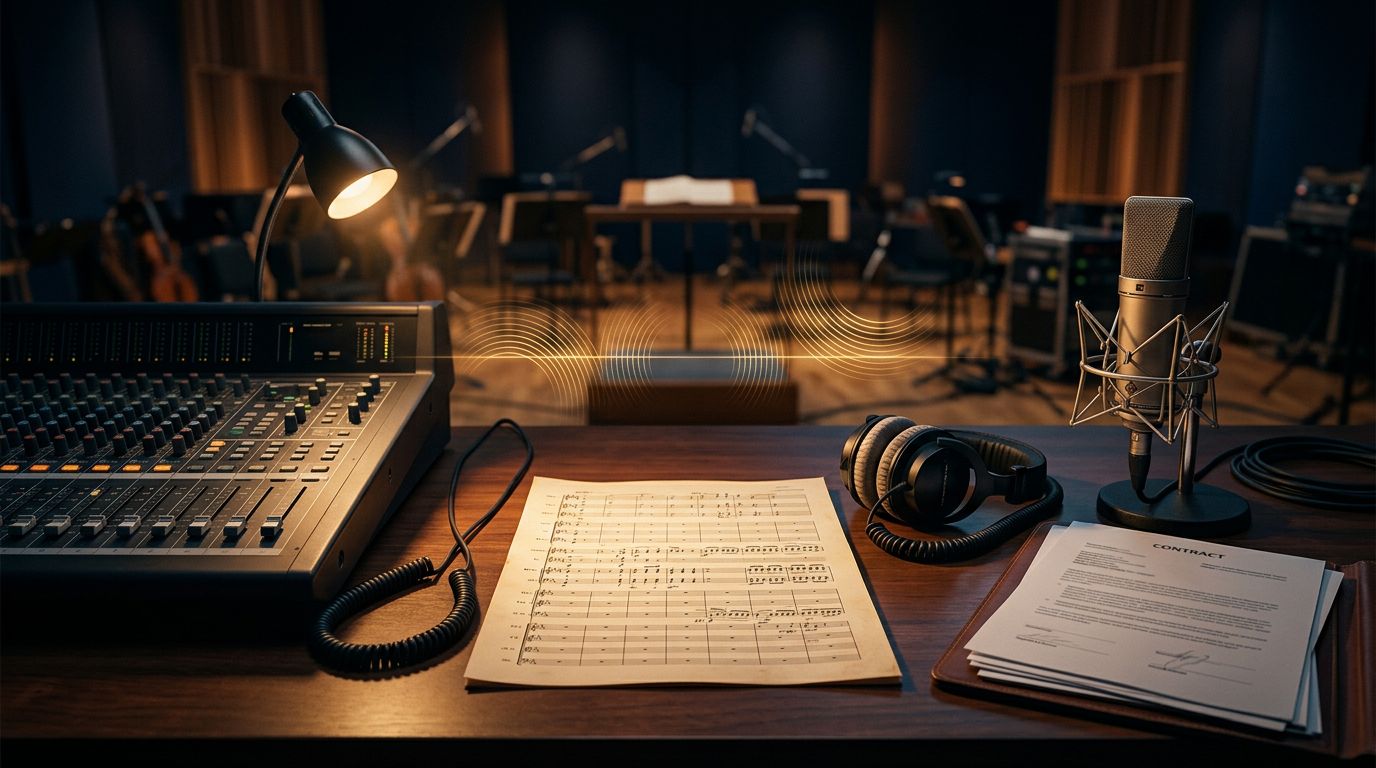
A film score can stay with an audience for decades, while a weak contract can cost its creator income for just as long. Music composer agreements decide who owns the score, who can reuse it, and who receives money when the film reaches theaters, streaming services, television, or a soundtrack album.
For filmmakers, the agreement protects the chain of title needed for distributors, insurers, and buyers. For composers, it turns a vague promise of “credit and royalties” into terms that can be enforced. The best time to resolve those issues is before the first cue is written.
Table of Contents
ToggleHow Music Composer Agreements Set Score Ownership
A score involves more than melodies written to picture. It may include the underlying musical compositions, master recordings, stems, alternate mixes, orchestration, MIDI sessions, demos, and source files. A contract should state who owns each category, rather than treating all music as one undefined asset.
The starting point under U.S. law is the Copyright Act. Section 106 gives the copyright owner exclusive rights to reproduce, distribute, adapt, publicly perform, and authorize use of a protected work. The agreement determines whether the production company owns those rights or receives a license from the composer.
Work for hire and assignment are different deals
A work-made-for-hire clause can make the production company the legal author and owner from the moment of creation. For a commissioned film score, the arrangement must fit a statutory category, such as a contribution to a motion picture or other audiovisual work, and both parties must sign a written agreement that calls the work a work made for hire.
The label alone does not settle the question. In Community for Creative Non-Violence v. Reid, 490 U.S. 730 (1989), the U.S. Supreme Court held that courts use common-law agency factors to decide whether a creator is an employee for work-for-hire purposes. Job titles and payment labels do not control the result.
A freelance composer may instead create the music first and assign copyright to the producer. That structure can still transfer full ownership, but 17 U.S.C. Section 204(a) requires a signed writing from the copyright owner. Present-tense wording such as “Composer hereby assigns” is stronger than a future promise to assign later.
The core ownership models have very different commercial outcomes:
| Deal structure | Copyright owner | What the composer may retain |
|---|---|---|
| Work made for hire | Production company, if statutory requirements are met | Contractual fee, credit, and any reserved royalty rights |
| Copyright assignment | Composer initially, then production company after signed transfer | Rights and income expressly reserved in the agreement |
| Exclusive film license | Composer | Copyright ownership, subject to the producer’s licensed rights |
| Shared ownership or co-publishing | Composer and company under stated percentages | Defined approval, income, and accounting rights |
A producer may want full control over edits, re-releases, trailers, sequels, and foreign distribution. A composer may accept that control in exchange for a meaningful fee, a writer’s share of performance income, or a soundtrack royalty. Music composer agreements work best when both sides choose the ownership model first, then build the payment terms around it.
Define the Score Before Services Begin
A clear scope of work prevents a common production problem: the picture changes, the music needs multiply, and nobody knows whether the original fee covers the extra work. A composer agreement should identify the project, the producer, the intended media, the anticipated running time, and the type of score.
The services clause should cover spotting sessions, themes, underscore, source cues, revision rounds, recording sessions, mixing, mastering, and delivery. It should also state whether the composer must attend mix sessions, supply music editors with stems, or obtain live musicians.
List every deliverable and deadline
Avoid a promise to provide “all music reasonably requested.” That language gives neither side a usable finish line. Instead, the agreement should identify the number or estimated duration of cues, the delivery format, the deadline for rough cuts, the number of included revisions, and the final delivery date after picture lock.
A practical delivery schedule often includes:
- A date for the spotting session and written creative brief.
- A deadline for sketches or demo cues tied to a locked or near-locked cut.
- A revision process that identifies who gives notes and how quickly.
- Final files, including full mixes, stems, alternate mixes, and cue documentation.
- A change-order process for new scenes, major recuts, or extra recording sessions.
Picture changes need special treatment. If the producer recuts a film after approval, adds scenes, or changes the release format, the composer should not absorb unlimited new work under the original fee. The agreement can set an hourly rate, per-minute rate, or fixed fee for material changes.
The parties should also identify any pre-existing music. A composer may license an earlier theme, a sample library element, or a track created outside the film project. Those assets should appear on a schedule that states the owner, the permitted use, the territory, and whether the producer can exploit them outside the picture.
That distinction matters with beats, loops, and producer-created tracks. Terms that sound like a purchase may only grant limited rights. Review the ownership language found in beat lease agreements before treating any pre-existing music as fully acquired.
Royalty Terms That Survive Delivery and Release
The composer fee is only one part of the financial deal. A contract may offer a flat all-inclusive fee, a fee paid in installments, a per-episode amount, or a fee plus contingent compensation. Each structure can work, but the agreement must state what the fee includes.
For example, the composer may receive installments at signing, delivery of demos, delivery of final masters, and final acceptance. The contract should state whether that amount covers studio expenses, musicians, orchestrators, music preparation, mixing, and travel. Otherwise, a fee that appears fair can disappear before the composer takes home any income.
Performance royalties require equal attention. Television broadcasts, streaming uses, foreign exhibition, and other public performances may generate income through performing rights organizations such as ASCAP, BMI, SESAC, or GMR. The production company’s cue-sheet obligations affect whether those uses are reported accurately.
ASCAP’s film composer guidance explains that the composer agreement determines who retains the publisher share. When a company pays an up-front composing fee, it commonly keeps the publisher share while the composer keeps the writer share. That result is not automatic, and the contract should match the parties’ intended registrations.
A royalty clause should separate each revenue source:
| Revenue source | Contract term to define |
|---|---|
| PRO performance income | Writer and publisher shares, registrations, cue-sheet filing, and foreign collections |
| Soundtrack album income | Owner of masters and compositions, royalty rate, recoupment, and distributor deductions |
| Later sync licenses | Who can approve a new license and how fees are divided |
| Trailer, game, podcast, and promotional uses | Whether the original grant covers those uses or requires additional payment |
| Backend compensation | The revenue base, permitted deductions, statements, audit rights, and payment dates |
The phrase “net profits” needs a definition. A producer’s net profits may remain zero after distribution fees, marketing expenses, interest, overhead, and unrelated costs. If the composer receives a backend share, the agreement should identify the actual receipts included, the deductions permitted, and whether the score’s income can be cross-collateralized against the film.
Accounting language should give the composer regular statements and a right to inspect records. The clause can set a reasonable audit period, limit the number of audits, require a qualified accountant, and require reimbursement of audit costs after a material underpayment.
A royalty percentage has little value until the agreement defines the revenue pool, deductions, reporting dates, and audit remedy behind that percentage.
For soundtrack releases, clarify whether the producer can release the score independently, license it to a label, or use it in compilations. The agreement should also state who pays digital distribution charges, artwork costs, and marketing expenses. The same careful review used for music distribution agreements helps prevent a broad distribution clause from quietly absorbing score income.
Credit, Cue Sheets, and Metadata Need Contract Language
Screen credit matters to a composer’s next job. “Music by,” “Original Music by,” “Original Score by,” and “Additional Music by” carry different professional weight. The contract should use the correct credit, identify its placement, and state whether it will appear in the main titles, end titles, press materials, metadata, and soundtrack releases.
A producer cannot promise identical credit treatment on every streaming platform, airline edit, festival version, or social post. Still, the agreement can require reasonable efforts to preserve the agreed credit wherever credits are customarily provided. It can also require correction in future versions if an error is discovered.
Cue sheets deserve their own clause. The producer should prepare and submit accurate cue sheets that list cue titles, durations, uses, composers, publishers, and performing rights affiliations. The composer should receive a copy before submission and have a chance to flag missing or incorrect data.
Metadata also affects collections and discovery. The parties should identify who registers the compositions, who assigns or supplies ISWC and ISRC information when appropriate, and who maintains the data after a distributor or publisher changes.
Co-written scores require another layer of planning. Under U.S. copyright law, joint authors generally co-own a joint work unless they agree otherwise. A separate collaboration agreement can set composition splits, approval rights, credits, recoupment, and the authority to license. Those choices should align with the co-publishing agreement terms that govern later publishing income.
Clauses That Address Real Production Risks
The producer needs warranties that the score is original and does not infringe another party’s rights. The composer needs fair limits on that promise. A composer should not bear responsibility for infringement claims caused by producer-supplied temp tracks, requested soundalikes, picture edits, lyrics, or unapproved changes made after delivery.
Temp music can create pressure to mimic a recognizable track. The agreement should say that references guide mood and pacing, not copying. It should also give the composer the right to raise concerns when a requested cue could create a music-clearance problem.
Generative AI needs direct treatment in current agreements. The parties can state whether AI-generated material is prohibited, permitted only with written approval, or allowed for limited technical tasks. If AI tools are allowed, the contract should address training data, source disclosure, human authorship, confidentiality, ownership of outputs, and whether score files can be used to train a platform.
Session players, programmers, orchestrators, arrangers, vocalists, and mixers can create chain-of-title gaps. The agreement should identify who hires them, who pays them, and who obtains their signed releases or work-for-hire agreements. If American Federation of Musicians obligations apply, the production budget should account for wages, pension, health, and possible new-use payments.
The agreement also needs a practical exit path. A producer may replace the composer after a creative disagreement or financing delay. A composer may face nonpayment, prolonged silence, or an impossible revision schedule. Termination terms should address notice, cure periods, kill fees, ownership of completed cues, and whether either side may use unfinished work.
Broad future-use language needs limits that fit the deal.
A grant covering every use “now known or later devised” can be appropriate, but it should still state whether it includes sequels, series adaptations, games, soundtrack albums, and stand-alone music licenses.
A Better Negotiation Process for Composers and Producers
The strongest agreement comes from early information, not rushed signatures after a composer has started writing. Before negotiations begin, the parties should identify the budget, distribution plan, anticipated media, delivery needs, and whether the score may have value outside the film.
A focused review usually follows this order:
- Map every contributor and confirm who owns the compositions, recordings, samples, and pre-existing materials.
- Choose work-for-hire, assignment, licensing, or shared ownership before debating royalty percentages.
- Match the fee to the real scope, expenses, revision process, and production schedule.
- Put credit, cue-sheet, registration, accounting, and audit duties in writing.
- Set remedies for late payment, project cancellation, incorrect credits, and unauthorized uses.
Chase Lawyers helps composers, independent filmmakers, and production companies review and negotiate film-music contracts before unclear terms become expensive disputes. With entertainment law practices in Miami and New York City, the firm can assess ownership structure, copyright transfers, royalty provisions, publishing rights, and the chain of title needed for distribution.
A signed contract should give the producer the music rights required to release the film. It should also give the composer a clear record of payment, credit, and income rights that remain after final delivery.
Final Thoughts
A film score often outlives its first release window. It may appear in a restored edition, a television broadcast, a foreign version, a soundtrack album, or a later adaptation.
Well-written music composer agreements protect those future uses before the pressure of production makes careful terms feel inconvenient. When ownership, scope, credit, and royalty language point in the same direction, both the film and the music have a stronger legal foundation.



- 21 SE 1st Ave, Suite 700, Miami, FL 33131
- 305-373-7665
- 305-373-7668
- info@chaselawyers.com
- 1345 Avenue of the Americas, 2nd Floor, New York, NY 10105
- 212-601-2762
- info@chaselawyers.com
Get a response within 24 hours. We’ll clearly explain how we can support and protect your brand while staying within your budget.