


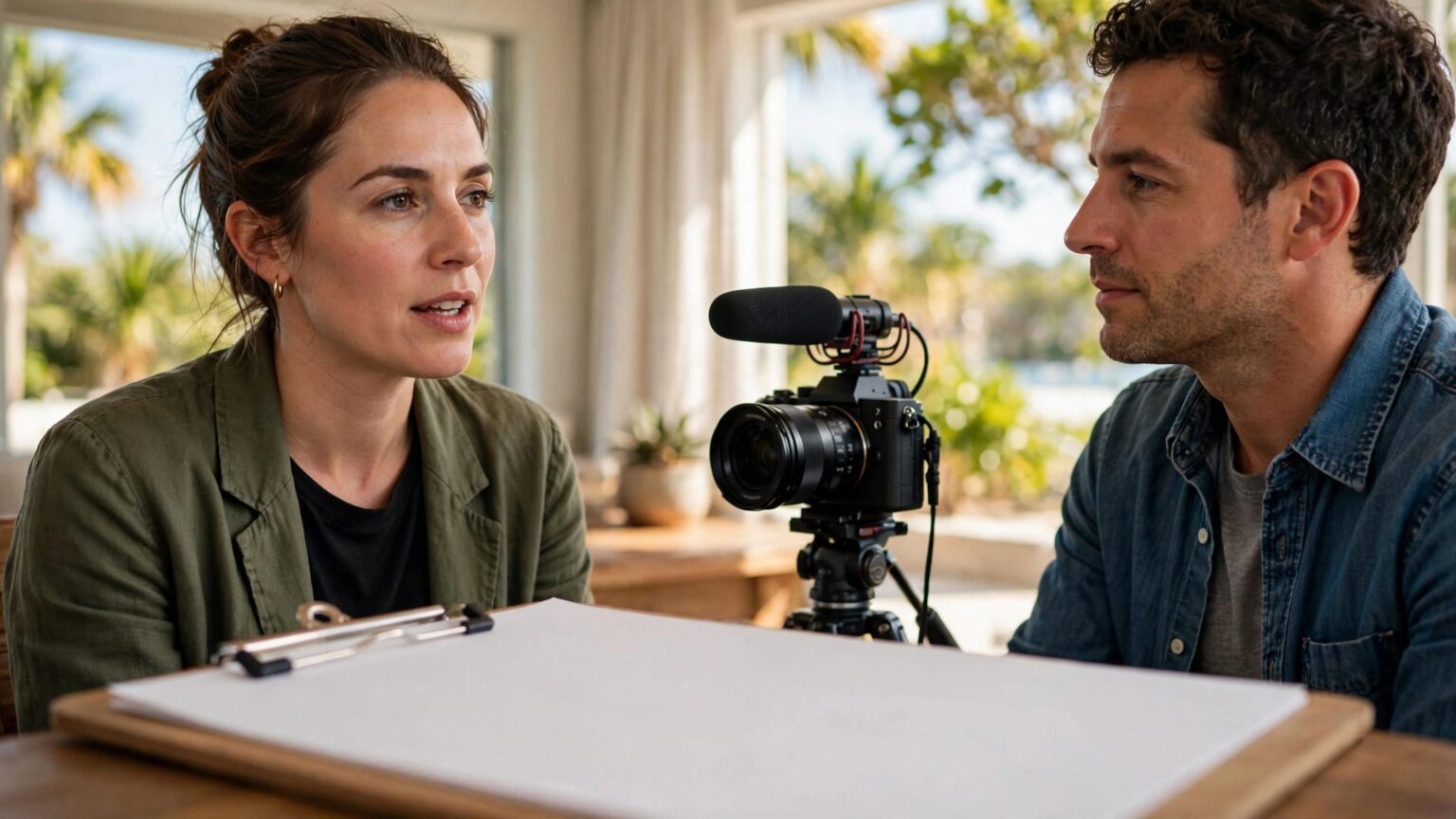
Florida Recording Consent Law for Documentary Interviews
Florida generally requires every party’s prior consent before you record a protected documentary interview. Florida recording consent law applies to covered conversations, so the setting and participants’ privacy expectations matter.
Your production also needs permission for editing and distribution, beyond consent to record. Start by separating the statutory recording rule from the release rights your film needs.
Table of Contents
ToggleKey Takeaways
- Obtain consent from every participant before recording a covered conversation, including interpreters and additional speakers.
- Federal one-party consent rules don’t displace stricter state requirements that apply to an interview.
- Separate permission to record from permission to edit, distribute, promote, or reuse someone’s voice and likeness.
- Preserve signed releases and consent records alongside footage because unlawful recording can create criminal exposure and civil liability.
Florida’s All-Party Consent Rule
What section 934.03 requires
Under Florida Statutes section 934.03, intentionally intercepting covered wire, oral, or electronic communications is generally unlawful unless an exception applies. Section 934.03(2)(d) permits interception when all parties have given prior consent.
For documentary producers, the practical starting point is straightforward: obtain everyone’s permission before recording a protected interview. Your own participation doesn’t supply consent for the other speakers.
“All-party” is more accurate than “two-party.” A conversation involving an interviewer, subject, and interpreter may require consent from all three.
Why federal permission isn’t enough
Under 18 U.S.C. section 2511(2)(d), federal law generally allows recording with one participant’s prior consent. That exception doesn’t cover interception undertaken for a criminal or tortious purpose.
However, federal permission doesn’t settle the state-law question. A producer who participates in a Florida conversation shouldn’t assume the federal rule authorizes recording it.
Similarly, a documentary’s journalistic purpose doesn’t establish recording consent. Evaluate how you obtain the material separately from the legal protections that may apply to publishing it.
Privacy Depends on the Conversation’s Setting
Protected oral communications
Florida’s definition of an oral communication considers whether the speaker expects the communication not to be intercepted. The circumstances must also justify that expectation.
Consequently, location alone doesn’t answer the question. A private exchange in a restaurant can present different issues from remarks addressed to an audience at a public meeting.
For production planning, distinguish the scheduled interview from incidental conversations nearby. Access to a location doesn’t grant permission to capture every conversation inside it. Similarly, a property owner’s approval doesn’t establish consent for everyone speaking there.
What Florida court decisions illustrate
In State v. Inciarrano, 473 So. 2d 1272 (Fla. 1985), the Florida Supreme Court held that communications made without a reasonable expectation of privacy fell outside section 934.03’s protection.
The decision turns on its circumstances. It shouldn’t become a production-wide assumption that visible equipment or a business setting eliminates privacy expectations.
By contrast, State v. Mozo, 655 So. 2d 1115 (Fla. 1995), recognized protection for conversations conducted over a cordless telephone inside a home. Together, these decisions show why filmmakers need a context-specific analysis before recording without express permission.
Obtain Consent Before Any Audio Capture
Document permission before the first take
Section 934.03’s consent exception requires prior consent; it doesn’t universally demand a signed form. Nevertheless, written permission provides evidence that a disputed recollection cannot.
Identify the production company, interview subject, project, and authorized recording methods. Address audio, video, remote-platform recording, and transcription where relevant.
After securing permission, confirm on the recording that participants understand recording is underway. That confirmation supplements advance consent. Starting a recorder secretly to capture the first request for permission creates an avoidable problem.
Assign someone responsibility for consent paperwork before the camera and sound teams begin work.
Define when recording starts and stops
Consent to a scheduled interview shouldn’t become an assumption about every conversation surrounding it. Discuss sound checks, breaks, pre-interview conversations, and behind-the-scenes footage separately.
If someone requests an off-record conversation, stop recording before that exchange begins. A promise to remove the material during editing doesn’t prevent its initial capture.
Also address new participants when they join. A subject cannot ordinarily authorize recording on behalf of an interpreter, relative, or additional source.
A microphone left running during a break can capture a different conversation from the interview everyone agreed to record.
Keep final signed documents, their execution dates, and any recorded confirmations together. Link those records to the correct interview files rather than leaving permissions scattered across crew members’ inboxes. Our film chain of title checklist explains how these records fit into the broader rights documentation buyers and distributors may review.
Remote Interviews Can Trigger Multiple State Laws
An interstate interview can involve the laws where the interviewer, subject, and other participants are located. The production company’s address doesn’t necessarily determine the applicable recording rule.
Before the session, identify participant locations and obtain express advance consent from everyone. A governing-law clause in a release doesn’t necessarily resolve which interception statute applies.
Platform notices can support notice of recording. However, don’t treat a recording icon or automated announcement as a substitute for an agreed consent process.
Also account for separate recording functions. Local audio backups, cloud recordings, and automated transcription may capture communications through different systems. Explain the capture methods your production plans to use rather than describing everything as a video call.
Our guidance on podcast guest releases addresses similar consent and distribution issues for remote interviews. The same distinction matters for documentaries: participants should understand both how you will capture the conversation and how you intend to use it.
Recording Consent and Release Rights Are Different
Identify each permission the production needs
Permission to record doesn’t automatically resolve publication, copyright, promotional use, or ownership questions. A documentary release should identify the interview and describe the rights the subject grants.
These permissions address different stages of production:
| Permission | What the agreement should address |
|---|---|
| Recording | Audio, video, follow-up sessions, and transcription |
| Editing | Excerpts, captions, translations, and contextual limits |
| Distribution | Media, territory, duration, and licensing |
| Promotion | Names, images, trailers, social clips, and advertising |
A usable release connects each planned use to permission. Our guidance on film talent release forms explains why documentary subjects need paperwork suited to their participation.
Set boundaries for editing and reuse
Producers usually need permission to shorten answers, remove pauses, adjust sound, and create excerpts. However, editing rights don’t eliminate claims arising from misleading context or unsupported factual allegations.
Separate promotion of the documentary from an unrelated product endorsement. Likewise, a standard interview release shouldn’t silently become permission to create a synthetic voice or digital replica.
Third-party materials require separate attention. A subject’s signature doesn’t clear someone else’s photograph, song, or archival footage.
At ChaseLawyers®, we draft and negotiate releases around the production’s intended uses. That includes identifying which rights the interview subject can grant and which require separate clearance.
Unlawful Recording Can Create Criminal and Civil Exposure
A violation of section 934.03(1) is generally a third-degree felony. The legal risk can also extend beyond the person operating the recorder because the statute addresses certain disclosures and uses of unlawfully intercepted communications.
Separately, Florida Statutes section 934.10 creates a civil cause of action for unlawful interception, disclosure, or use.
Available remedies include equitable or declaratory relief, punitive damages, and reasonable attorney’s fees and litigation costs. The statute provides actual damages subject to a liquidated-damages floor of $100 per day of violation or $1,000, whichever is higher.
The limitations period is two years after the claimant first has a reasonable opportunity to discover the violation.
Treat questionable footage as a legal issue before placing it into an edit or sharing it externally. A later release shouldn’t be assumed to cure an earlier unlawful interception. Likewise, removing the audio from the final film doesn’t erase the circumstances of its original capture.
Frequently Asked Questions
Can I rely on a visible camera as consent?
A visible camera may support an argument that someone understood recording was occurring. However, it doesn’t establish the scope of permission in every circumstance. A person may see a camera without knowing that a separate microphone is capturing a private exchange. Express advance consent provides clearer evidence.
Does filming in public eliminate the need for consent?
Public location alone doesn’t decide whether an oral communication is protected. The speaker’s expectation and surrounding circumstances matter. The Florida Attorney General’s analysis of communication privacy explains this context-dependent approach. Public remarks and a private conversation nearby require separate analysis.
Can an interview subject withdraw permission after filming?
The answer depends on the agreement and any independent legal claim. A release should address withdrawal, takedown requests, approval rights, and continued use of existing footage. Regretting an authorized interview doesn’t automatically establish a right to removal. However, permission to publish doesn’t authorize uses outside the agreed scope.
Does a release protect misleading edits?
A release can authorize editing without excusing unlawful conduct or every harmful portrayal. Combining separate answers or removing context can create risks beyond recording consent. Producers should assess whether the finished sequence communicates a materially inaccurate or damaging factual claim about an identifiable person.
Protect the Interview Before Recording Begins
Florida’s consent rules make advance permission the foundation of a sound interview process. Clear releases then address editing, distribution, and the uses your participants authorize.
At ChaseLawyers®, we help documentary producers structure consent and release terms before recording creates a dispute. Bring the interview plan, participant locations, and intended uses to a free consultation so we can address the production’s legal needs before the first take.
- 21 SE 1st Ave, Suite 700, Miami, FL 33131
- 305-373-7665
- 305-373-7668
- info@chaselawyers.com
- 1345 Avenue of the Americas, 2nd Floor, New York, NY 10105
- 212-601-2762
- info@chaselawyers.com
Get a response within 24 hours. We’ll clearly explain how we can support and protect your brand while staying within your budget.