


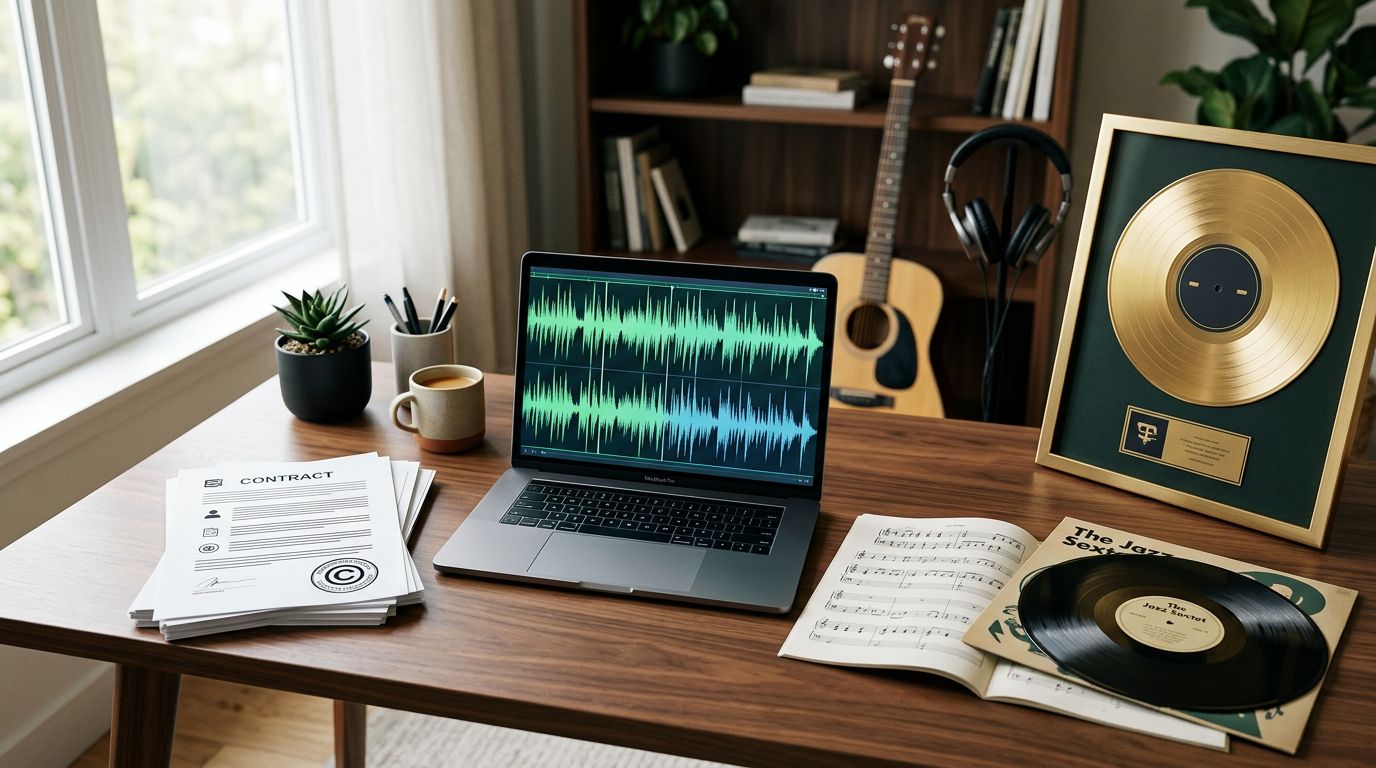
Register Unreleased Songs Before a Label Pitch
A label pitch can move faster than your paperwork. One email may reach an A&R executive, producer, manager, or publisher, then circulate far beyond your original contact list.
You already own copyright when you create and record an original song. However, copyright registration gives that ownership a formal public record and preserves stronger legal options if a dispute appears. Filing before you share unreleased music puts you in a far better position to pitch with confidence.
Table of Contents
ToggleKey Takeaways
- Copyright exists once an original song is fixed in a recording or written form, but registration provides major enforcement benefits.
- A song’s composition and its master recording are separate works that may need separate attention.
- A private pitch usually does not make a song “published,” so many artists can file it as an unpublished work.
- Early registration can protect access to statutory damages and attorney’s fees if infringement occurs after registration.
- Chase Lawyers can review ownership, filing strategy, producer agreements, and label-pitch documents before unreleased music leaves your control.
Copyright Exists Before Registration, but Registration Changes Your Options
Under U.S. copyright law, an original musical work receives protection when it is fixed in a tangible medium. That can mean a voice memo, a session file, a written lyric sheet with melody, or a finished WAV file. You don’t need a label deal, a release date, or a copyright certificate to become the copyright owner.
Still, ownership and proof are different matters. A dated session folder may support your story, but it does not carry the same legal weight as a registration record from the U.S. Copyright Office.
Registration matters most if someone uses your song without permission. Under 17 U.S.C. Section 411(a), registration or refusal by the Copyright Office is generally required before the owner of a U.S. work can bring an infringement lawsuit. The U.S. Supreme Court confirmed that rule in Fourth Estate Public Benefit Corp. v. Wall-Street.com, LLC (2019). Filing an application alone does not necessarily mean you can immediately sue.
The timing also affects available remedies. Under 17 U.S.C. Section 412, registering an unpublished work before infringement can preserve eligibility for statutory damages and attorney’s fees. Those remedies can be unavailable when the artist waits until after the infringement begins.
Copyright registration does not stop someone from copying a song. It gives you a clearer path to enforce your rights if they do.
That distinction matters before a label pitch. Most industry professionals act professionally, and established labels have strong reasons to avoid claims over unsolicited material. Yet songs can pass through collaborators, playlists, shared folders, producers, and email chains. A registration record gives you a more solid foundation if questions arise later.
Identify What You Own Before You Register Unreleased Songs
When artists register unreleased songs, they often focus only on the finished audio file. Yet a track can contain two separate copyrights.
| Copyrighted work | What it covers | Common owners |
|---|---|---|
| Musical composition | Melody, lyrics, musical arrangement, and underlying music | Songwriters and music publishers |
| Sound recording | The recorded performance and production captured in the master | Recording artist, producer, label, or production company |
If you wrote and recorded a song alone, you may own both copyrights. In that situation, an application may cover the musical composition and sound recording when the ownership and authorship information align.
However, tracks often involve several people. A co-writer may own a composition share. A producer may claim a master interest, publishing share, or both. A featured artist may have contributed lyrics or an original vocal melody. A beat license may limit what you can register, distribute, or assign to a label.
Before filing, confirm these facts:
- Who wrote the music, lyrics, and any original arrangement?
- Who owns the master recording?
- Did anyone contribute on a work-for-hire basis under a signed agreement?
- Does a producer agreement assign master rights or grant only a license?
- Are samples, interpolations, loops, or exclusive beats part of the track?
A 50 percent writing split stated in a text message may be evidence, but it is not a complete agreement. Written split sheets and producer agreements reduce the risk that a label discovers conflicting claims during due diligence.
Chase Lawyers works with artists, producers, influencers, and creative businesses in Miami and New York City. For musicians preparing music-industry deals, the firm can assess whether the ownership story in the registration application matches the agreements behind the record.
Is a Label Pitch a Publication of Your Song?
A limited song pitch is usually not a publication. Copyright law generally treats publication as distributing copies or phonorecords to the public, or offering to distribute them to a group for further distribution, public performance, or public display.
Sending a private streaming link to selected A&R representatives, a publisher, a manager, or an entertainment attorney normally does not turn an unreleased track into a published work. The same is often true when you share a password-protected folder with a small group of potential business partners.
Public release is different. Uploading a song to Spotify, Apple Music, YouTube, Bandcamp, or TikTok can create publication issues. Selling downloads, pressing physical copies, or widely distributing promotional files may also change the analysis.
The difference affects the information you provide on a copyright application. A wrong publication status can create delays or require correction. Therefore, keep a clean record of where the track has appeared and who received it.
Be careful with “soft releases.” Posting a full hook publicly, releasing a visualizer, or placing a song in an open-access electronic press kit may affect the facts. Short social clips do not always settle the question by themselves, but they deserve review before you file.
A confidential pitch also benefits from practical controls. Use private links, disable downloads when appropriate, limit access to people with a genuine business reason, and keep a record of recipients. These steps do not replace registration, but they show that you treated the work as confidential before any public release.
File the Right Application and Submit a Complete Deposit
The Copyright Office’s online system is the usual starting point for music registrations. Your filing needs accurate titles, authorship, claimant information, publication status, and a deposit copy of the work.
For an unreleased composition, the deposit might include an audio recording or readable sheet music. For an unreleased sound recording, you generally submit the audio file that contains the recording you are registering. The submitted copy should match the song you intend to protect.
A few practical details can avoid trouble:
- Use consistent titles. If the session is called “Midnight Demo 7” but you pitch it as “Midnight Call,” disclose alternate titles where appropriate. Inconsistent naming can make later proof harder.
- Name every author accurately. List only copyrightable contributions. A person who booked studio time or gave general feedback is not automatically an author.
- Describe authorship truthfully. Claim lyrics, music, sound recording authorship, or other original material only if the claimant owns those contributions.
- Address preexisting material. A song that contains licensed samples, public-domain elements, or earlier registered material may require exclusions or limitations in the application.
- Save the filing record. Keep the application confirmation, deposit file, payment receipt, registration number, certificate, and supporting agreements together.
A registration’s effective date can be the date the Copyright Office receives an acceptable application, fee, and deposit, even if the certificate arrives later. That timing can matter for remedies. Still, an incomplete deposit or inaccurate claim can cause problems, so rushing through the form is rarely wise.
Group Registration Can Help, but It Has Limits
Artists with a large batch of demos may look for a single filing that covers everything. Group registration for unpublished works can reduce administrative burden, but the rules are narrow and change over time.
The Copyright Office has procedures that can allow up to 10 unpublished works in one group application when eligibility requirements are met. The works generally need common authorship and claimant information, and the application must satisfy the Office’s current rules. A group of songs with different producers, featured writers, and split ownership may not qualify.
Don’t use a group filing as a shortcut around ownership questions. Each track still needs a clear chain of title. A label may ask for split sheets, producer releases, sample clearances, and registrations for individual songs during a deal.
A single-song filing can be cleaner when a priority track has distinct ownership or you expect to pitch it immediately. Meanwhile, group registration may suit a set of solo-written demos that remain unpublished and share the same ownership.
Fees and filing procedures can change, so confirm the Copyright Office’s current requirements before submitting. The lower filing cost is not useful if the application fails to cover the work you intended to protect.
Registration Is Only One Part of a Safe Label Pitch
A copyright certificate cannot repair a broken producer deal or clear an uncleared sample. Before sending a package, review the legal and business details around each song.
Use accurate metadata for every track. The title, writers, publishers, PRO affiliations, producer credits, ISRC status, and master owner should be easy to locate. If you do not yet have an ISRC, don’t invent one. Assign it through the appropriate distributor or label process when needed.
Keep pitch emails direct and factual. State that the music is confidential if the circumstances support that label. Avoid claiming rights you do not own, and don’t promise exclusive rights before discussing terms.
You should also keep your best material organized. Save dated exports, lyric drafts, beat licenses, project files, version histories, and communications about splits. These records can help prove how a song developed and who contributed original work.
For artists entering negotiations, Chase Lawyers can pair copyright planning with contract review. The firm’s entertainment and intellectual property practice helps creative clients protect songs, recordings, and business opportunities without treating the registration as an isolated task.
Protect the Song Before the Conversation Starts
A strong label pitch begins with clean ownership. Registering unreleased songs before sharing them creates a formal record, supports better enforcement options, and forces you to resolve credits and splits before a label asks difficult questions.
The best time to discover a missing producer release is before the track reaches an A&R inbox. Early registration and clear documentation let the music speak for itself while your rights remain protected.



- 21 SE 1st Ave, Suite 700, Miami, FL 33131
- 305-373-7665
- 305-373-7668
- info@chaselawyers.com
- 1345 Avenue of the Americas, 2nd Floor, New York, NY 10105
- 212-601-2762
- info@chaselawyers.com
Get a response within 24 hours. We’ll clearly explain how we can support and protect your brand while staying within your budget.