


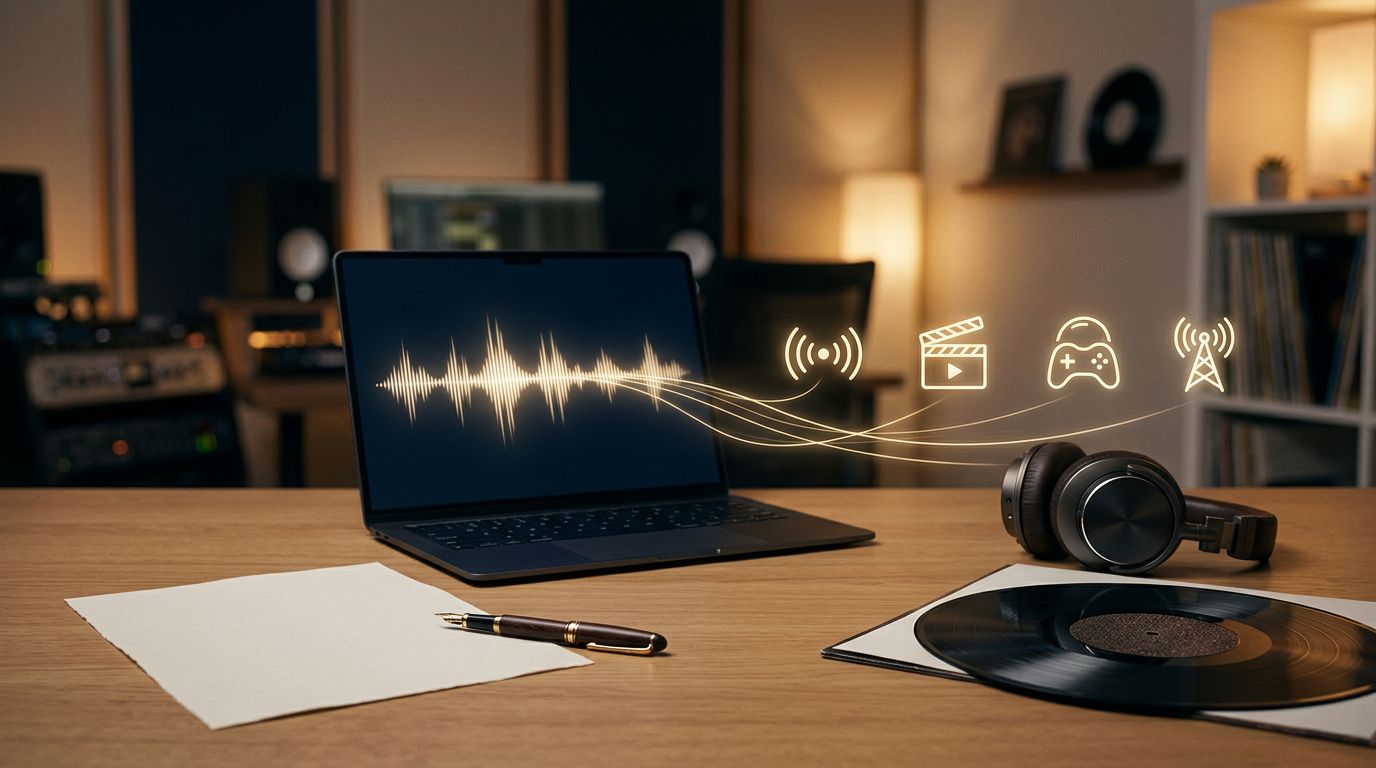
Direct Music Licensing Agreements for Independent Publishers
A strong song can earn in several markets at once, but a weak license can give away control before the first payment arrives. Direct music licensing gives independent publishers a way to set deal terms with the users of their catalogs instead of accepting a one-size-fits-all arrangement.
That freedom comes with real responsibility. You must know which rights you control, whether a PRO or statutory license affects the deal, and how the agreement handles money, data, approvals, and breach. A well-drafted direct license turns a promising use into trackable revenue.
Table of Contents
ToggleWhat Direct Music Licensing Means for an Independent Publisher
Direct music licensing occurs when a publisher or copyright owner grants permission straight to a music user. The user may be a streaming service, social platform, production company, game developer, broadcaster, venue operator, fitness company, or brand.
The agreement can cover one song, a defined catalog, or a selected group of works. It can also be narrow, such as permission to use a composition in a single advertising campaign, or broad, such as a multi-year license for a digital service.
For an independent publisher, the appeal is clear. Direct deals let you negotiate rates, payment timing, reporting rules, promotional commitments, geographic scope, and approval rights that fit the catalog’s value.
However, a direct deal only works when the publisher can grant the right in question. Song rights are often split among multiple writers, publishers, administrators, and estates. A publisher with a 25% share cannot promise 100% clearance unless it has written authority from the other owners.
Music users also need to separate composition rights from sound-recording rights. The song itself, including lyrics and melody, is a musical composition. The recorded performance is a separate sound recording. This overview of publishing and master rights explains why a user may need both permissions before releasing an audiovisual project or commercial recording.
A license for the composition does not automatically clear the master recording, and a master-use license does not clear the underlying song.
That distinction affects every direct negotiation. A publisher may issue a synchronization license for a composition while the label or artist that owns the master recording negotiates separately.
Start With the Rights You Actually Control
The Copyright Act gives copyright owners exclusive rights to reproduce, distribute, publicly perform, publicly display, and prepare derivative works. In practical music publishing terms, those rights create several licensing categories, each with different rules.
A direct license should identify the exact right being granted. General phrases such as “all music rights” invite disagreement later. The grant should state whether the license includes mechanical reproduction, public performance, synchronization, lyric display, print, audiovisual use, sampling, adaptation, or another defined use.
For example, a publisher may control:
- A writer’s share under a co-publishing or administration agreement.
- The publisher’s share for songs acquired through a catalog purchase.
- Worldwide rights for some works and only U.S. rights for others.
- Synchronization rights while a PRO administers public-performance income.
- Mechanical rights subject to a third-party administrator or statutory framework.
Public-performance rights deserve close attention. ASCAP, BMI, SESAC, and GMR licenses can affect what a venue, broadcaster, or service already has permission to do. A publisher affiliated with a PRO must review its affiliation agreement before granting a direct public-performance license that overlaps with the PRO’s authority.
For interactive streaming, the compulsory mechanical license under Section 115 also changes the analysis. The Mechanical Licensing Collective administers blanket mechanical licenses for eligible digital music providers. A publisher can still make voluntary commercial deals, but those agreements should state whether they replace, supplement, or sit outside statutory licensing obligations.
The U.S. Copyright Office advises creators that permission may come directly from the copyright owner or under the terms of a licensing contract. Its copyright guidance for musicians is a useful starting point, but publishers need a rights-by-rights review before they sign.
A clean chain of title is the foundation. Confirm writer agreements, assignments, split sheets, administration grants, work registrations, and any reversion rights. If a work includes an interpolation or sample, confirm the scope of the earlier clearance. A buyer will not care that a missing signature was difficult to obtain.
Direct Music Licensing Agreements: Clauses That Protect Value
A direct music licensing agreement should answer a practical question: what may this licensee do, for how long, where, and for what price? If the document leaves those points open, the parties may have a business understanding but not a reliable operating agreement.
Define the licensed compositions and permitted use
Attach a schedule listing each composition, writer, publisher, ownership percentage, IPI number if available, and relevant registration data. For a catalog deal, include a process for adding or removing works.
Next, describe the approved use with precision. A sync license for a television episode needs different language than a license for a user-generated content platform. Terms to define include:
- The media format, such as linear television, connected TV, social media, theatrical, in-app, or podcast use.
- The territory, whether worldwide, the United States, or named countries.
- The term, including any renewal option and notice deadline.
- Whether the licensee may edit, translate, subtitle, loop, adapt, or combine the song with other content.
- Whether the use includes paid advertising, political content, alcohol, gambling, adult content, or artificial-intelligence training.
Avoid broad phrases such as “all media now known or later developed” unless the fee and business purpose support that reach. A small campaign should not acquire permanent worldwide rights by accident.
If the license covers a commercial, trailer, or audiovisual production, reserve approval over the final context where the catalog’s reputation matters. This is especially important for songs associated with an artist’s public identity, family-friendly audience, or political views.
Set the financial terms before the use begins
The payment clause should state the license fee, currency, due date, payment method, late charge, and withholding-tax treatment. A publisher should also state whether the fee is recoupable, non-refundable, advanceable against royalties, or separate from performance income.
Revenue-share deals require even more detail. Define gross revenue, permitted deductions, bundle treatment, minimum guarantees, audit access, and the reporting cycle. Do not accept “net receipts” without a definition. That phrase can hide marketing costs, platform fees, affiliate commissions, internal allocations, and foreign exchange deductions.
A licensee should deliver statements in a usable format. Song-level reporting is better than a lump-sum total because it allows the publisher to match usage against its own catalog data. Require the licensee to retain records for a set period, often three to five years, and give the publisher audit rights with a reasonable notice period.
Reporting is part of the bargain, not clerical paperwork. Without usable usage data, a publisher cannot verify royalties or identify an unlicensed expansion of use.
Protect the catalog after the agreement expires
Expiration language should state what happens to copies, promotional assets, archived content, and works already in production. A short sell-off period may be reasonable for physical products. In contrast, a digital platform should remove the music promptly after termination unless the agreement grants a clear wind-down right.
The agreement also needs termination rights for nonpayment, material breach, unauthorized uses, insolvency, false warranties, and reputationally harmful use. Give the licensee a limited cure period for problems it can fix. For intentional infringement or repeated late payment, the publisher should preserve stronger remedies.
Finally, include indemnity provisions that match each party’s promises. The publisher can indemnify for a breach of its ownership warranty. The licensee should indemnify for its content, distribution, marketing, data practices, and use beyond the granted rights.
Pricing a License Without Ignoring U.S. Royalty Rules
Direct negotiations work best when a publisher knows the legal floor, the market context, and the song’s commercial value. The price for a direct license should reflect the use, not simply a familiar rate card.
A well-known chorus used in a national advertisement carries different value than a brief background use in an independent documentary. Territory, term, exclusivity, placement, artist association, audience size, paid-media support, and the licensee’s ability to sublicense all affect the fee.
Statutory rates matter most on the mechanical side. Section 115 permits qualifying users to rely on a compulsory mechanical license for certain reproductions and distributions of musical works, subject to statutory conditions. The Copyright Royalty Board sets those rates, while the rate structure for interactive streaming is more complicated than a per-song sync fee.
Under the Phonorecords IV framework, headline interactive-streaming mechanical rates rise over the 2023 through 2027 period, reaching 15.35% of service revenue in 2027. Yet a service’s actual payment calculation can include subscriber and content-cost components. A direct deal should not casually waive statutory rights or accept less favorable reporting without confirming the economic result.
The courts also shape the rate environment. In 2025, Judge Analisa Torres of the Southern District of New York dismissed the Mechanical Licensing Collective’s challenge to Spotify’s audiobook bundle treatment. The dispute showed how product bundles can reduce the revenue base used for music royalty calculations. Independent publishers should study a service’s product design, not only its advertised subscription price.
Meanwhile, public-performance economics remain tied to PRO structures and rate litigation. The Second Circuit sent a BMI live-concert rate dispute involving major concert promoters back for further proceedings after rejecting a large district-court increase. Direct music licensing can create flexibility, but it does not erase the legal rules surrounding PRO-administered rights.
Build a Repeatable Licensing Process for Your Catalog
A direct deal moves faster when your catalog records are accurate before the inquiry arrives. Keep a central rights file for each work, including ownership splits, writer contact information, controlled territories, registrations, prior licenses, restrictions, and approval requirements.
Many independent publishers lose time because the business team knows a song is popular but cannot prove who can authorize a use. A current metadata record helps you respond with confidence and prevents conflicting licenses.
Use a structured intake process when a request arrives:
- Ask the licensee for the media, territory, term, budget, release date, and exact music use.
- Confirm composition ownership, co-owner approval, administration status, and master-recording needs.
- Identify any PRO, MLC, foreign subpublisher, or prior-exclusive license that affects the requested rights.
- Send a written proposal that states the fee and the limits of the proposed grant.
- Do not authorize use until all required parties sign and payment conditions are met.
This process also improves negotiation power. A publisher who can quickly provide a rights summary, quote, and approval path looks organized. A party that gives informal clearance by email may later struggle to prove what it intended to license.
For international uses, review local collecting-society arrangements and subpublishing agreements. A U.S. publisher may own a work but have assigned local administration in a particular territory. The license should say who collects which income streams and which party handles tax forms, currency conversion, and foreign reporting.
Direct music licensing is also a data project. Compare licensee statements against your administrator reports, PRO distributions, cue sheets, and platform analytics. A mismatch may be innocent, but it may also reveal a missing work, a faulty identifier, or use outside the agreement.
Common Deal Mistakes That Cost Publishers Money
The largest mistake is granting more rights than the fee supports. A licensee may ask for “all promotional use” when it needs one social post. Limit the authorization to the agreed campaign, platforms, and term. If the campaign expands, require a new fee and written amendment.
Another problem is confusing approval with ownership. A songwriter’s verbal approval does not grant rights held by a publisher, co-writer, estate, or administrator. The same issue appears when a licensee obtains a master-use license but assumes it can use the composition.
Publishers also miss money when agreements do not separate upfront fees from backend income. A sync fee does not necessarily include public-performance royalties, mechanical royalties, or writer payments that arise from later uses. The agreement should say which payments are included and which remain payable through standard collection channels.
Overbroad warranties create another risk. Promise only what you have verified. A publisher should not guarantee that a song has no claims if a co-writer’s ownership remains disputed. Instead, disclose known issues and make clearance a closing condition where appropriate.
Finally, do not let an email thread replace the agreement. Emails can establish obligations, but they often omit license limits, audit rights, indemnity, governing law, and termination rules. A short-form agreement can work for a simple use, provided it still identifies the work, rights, fee, duration, territory, and signatures.
How Chase Lawyers Helps Independent Music Publishers
Independent publishers need counsel that understands both the song and the business model behind the request. Chase Lawyers advises publishers, songwriters, producers, labels, and catalog owners on licenses that protect ownership while supporting commercial opportunities.
The firm can review chain-of-title documents, identify rights that require co-owner consent, draft direct agreements, negotiate fee structures, and address royalty reporting or audit issues. Its music rights licensing and royalty management services are built for uses across streaming, film, television, advertising, video games, and live entertainment.
Chase Lawyers also helps clients protect the broader intellectual-property position behind a deal. That can include copyright assignments, administration agreements, producer contracts, artist agreements, catalog acquisitions, and enforcement when a licensee exceeds the granted scope.
A direct license is often signed under time pressure. Legal review before a campaign launches is usually less expensive than fixing an ownership dispute, missing royalty statement, or unauthorized worldwide use after release.
Protect the Song Before It Starts Earning
Direct music licensing gives independent publishers meaningful control over how their songs earn money and where those songs appear. That control depends on accurate ownership records, a narrow grant of rights, clear payment terms, and reporting that can be audited.
The strongest agreement treats the composition as a long-term asset, not a one-time transaction. A precise license protects today’s fee and preserves tomorrow’s opportunities.


- 21 SE 1st Ave, Suite 700, Miami, FL 33131
- 305-373-7665
- 305-373-7668
- info@chaselawyers.com
- 1345 Avenue of the Americas, 2nd Floor, New York, NY 10105
- 212-601-2762
- info@chaselawyers.com
Get a response within 24 hours. We’ll clearly explain how we can support and protect your brand while staying within your budget.