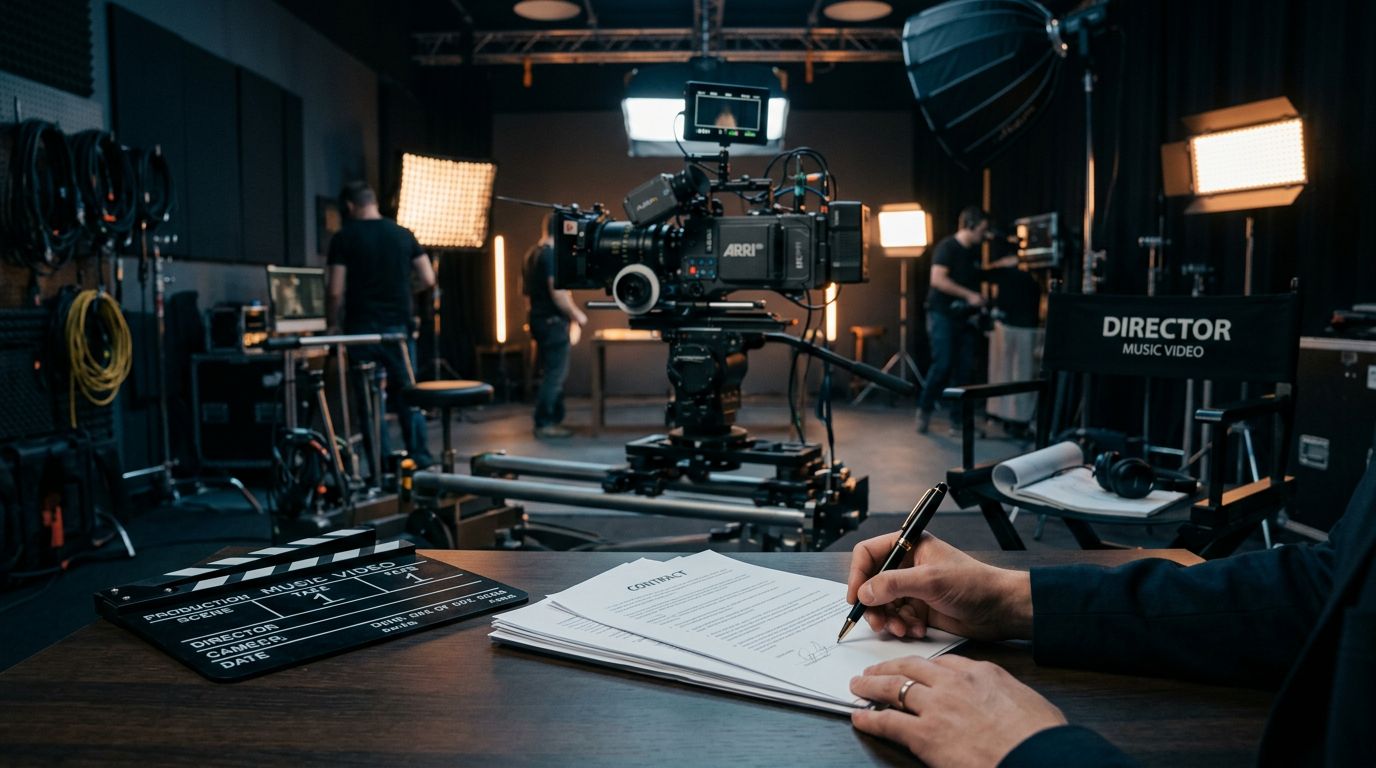
A shoot can look locked in and still fall apart on paper. Before the first light goes up, music video production agreements decide who owns the footage, who pays for overtime, and who can block release.
Artists and managers often focus on treatment, wardrobe, and locations first. The harder problems usually sit in the contract stack, especially when labels, publishers, dancers, private property, and rented gear are involved.
A careful pre-shoot review keeps a promising video from turning into an ownership fight. Start with the agreements that control the project itself.
A music video shoot is really a bundle of agreements
Most artists don’t sign one contract for a video. They sign several, or they approve a producer’s paperwork without seeing how the documents fit together. That gap causes trouble.
At a minimum, the team should review the main production agreement, the director or production company deal, location releases, appearance releases, and any union paperwork. If the song has outside owners, the label, publisher, or distributor may need to approve use before filming starts. A branded placement, borrowed artwork, choreographer, or featured guest can add still more contracts.
Informal permission is where many projects go wrong. A text that says “yes” may feel good in the moment, but it rarely covers ownership, edits, territory, media, payment, or release timing. It also may come from the wrong person. If a label owns the master or a publisher controls the song, the artist alone may not have the power to approve the video.
This is where artist-side counsel matters. Chase Lawyers, a boutique firm with offices in Miami and New York, works with musicians, producers, influencers, athletes, and creative brands on contracts that touch intellectual property and media rights. For artists who need help before cameras roll, the firm’s page on artist and producer contract protection is a useful starting point.
The basic rule is simple. If the video matters to your release plan, the paperwork matters before the shoot, not after it.
Start with the master production agreement
The main production contract should identify the parties with precision. That means legal names, loan-out entities if any, the song title, the approved concept, the shoot dates, and the exact deliverables. “One music video” is too vague. The agreement should say whether the artist gets a full-length master, short-form cutdowns, vertical edits, teaser clips, lyric overlays, stills, and behind-the-scenes content.
Creative approval is another early flashpoint. Some artists assume they can reject a rough cut that changes the story or image. Some producers assume they control the final edit once hired. The contract should say who approves the treatment, casting, wardrobe, choreography, edit, color, visual effects, and release version. It also should cap the number of revision rounds so nobody argues over “reasonable changes” later.
This quick comparison helps show where the agreement should be clear:
| Clause | What it should say | Why artists care |
|---|---|---|
| Scope of work | Exact deliverables and versions | No fight over what was promised |
| Approval rights | Who approves each stage | Protects image and release strategy |
| Schedule | Shoot dates, edit dates, reshoot rules | Keeps launch plans on track |
| Budget | Line items, overages, change orders | Stops surprise invoices |
| Ownership | Work-for-hire and assignment terms | Avoids later copyright disputes |
| Termination | Kill fee, default, refund rules | Limits damage if the project stalls |
A sample music video production agreement can help teams compare structure, payment timing, and rights language. Still, a sample is only a map. It won’t tell you whether your specific deal protects the artist’s brand, budget, and ownership position.
Copyright ownership should be explicit before the first shot
If the contract never says who owns the finished video, someone will claim rights when the video starts earning attention. That’s predictable, because a music video combines many copyright interests at once, including the audiovisual work, the footage, graphics, animation, and sometimes third-party clips.
Under U.S. copyright law, a commissioned music video can qualify as a work made for hire because it is an audiovisual work, but the contract must say so in writing and the structure of the deal still matters. The Supreme Court’s decision in Community for Creative Non-Violence v. Reid made clear that paying an independent contractor does not magically make the client the author. If the work-for-hire language fails, the agreement should include a backup assignment that transfers all rights in the footage, edits, and related materials to the artist or artist company.
Ownership language should never rely on assumptions. It should say who owns the video, who can exploit it, and who can stop others from using it.
The contract also should cover source files and project assets. Many disputes start because the artist receives only a final export, while the producer keeps raw footage, edit files, color sessions, and visual effects elements. If the artist wants future trailers, remasters, tour visuals, or social edits, the agreement should require delivery of those materials and state when they must be handed over.
Credit and portfolio use need their own clause. Directors and production companies often want to display the video on reels, pitch decks, and websites. That’s reasonable, but it should not allow early release, paid reuse, or a separate monetization plan. The artist should also control use of name, likeness, logos, album art, and unreleased music snippets outside the approved campaign.
Once ownership is clear, register the finished video and the underlying song. In Fourth Estate Pub. Benefit Corp. v. Wall-Street.com, the Supreme Court held that a copyright owner usually needs the Copyright Office to act on the application before filing an infringement suit in federal court. Registration won’t stop a dispute, but it improves the artist’s position when a dispute starts.
Budget, payment, and overage terms can change the whole deal
Budget language is where creative excitement often meets hard reality. A treatment may promise cranes, night exteriors, dancers, drones, and post-heavy effects. The contract decides who pays when the approved concept costs more than the initial quote.
Start with the payment schedule. Many productions use a deposit, a production installment, and a final payment after delivery. That can work, but the trigger for each payment must be tied to real milestones, not vague phrases like “substantial completion.” Artists also should ask whether the budget includes equipment insurance, permits, location fees, security, meals, parking, overtime, media storage, union costs, and post-production revisions.
Overages deserve special attention. The producer should not have open-ended power to exceed budget and bill the artist later. A solid contract requires written approval before any overage above a stated threshold. It should also say who pays for weather delays, cast no-shows, broken props, lost footage, hard-drive recovery, and reshoots caused by producer error.
Termination rules matter because shoots fail for ordinary reasons. A featured artist drops out. A location revokes access. A sponsor pulls support. If the project stops, the agreement should spell out the kill fee, refund rights, and who keeps work already created. Without that language, the artist may lose both cash and footage.
Teams working around release plans should also protect delivery timing. If the editor misses the deadline and the single launch collapses, the artist’s loss may be larger than the invoice amount. Chase Lawyers often reviews those timing provisions together with the artist’s larger release strategy, because a late video can affect label obligations, ad buys, and platform rollouts.
Releases, permits, union rules, and insurance can’t wait until shoot day
A strong production agreement still won’t solve a missing location release. If you film on private property, get written permission from the owner or authorized manager. The release should cover recording, still photography, signage, set dressing, and the right to exploit the footage in all planned media. If the property displays protected artwork, trademarks, or recognizable branding, the team may need extra clearance or a plan to blur those elements.
Appearance releases matter just as much. Dancers, extras, models, featured guests, makeup artists, stylists, and choreographers may contribute more than labor. They may contribute performance, image rights, or creative material. The contract stack should match that reality. Minors add another layer because parental or guardian consent is required, and labor rules can change by state.
If the production uses union performers, SAG-AFTRA rules may apply even on a small set. Their music video agreement outlines coverage for singers, dancers, actors, models, narrators, and stunt performers. That paperwork affects rates, working conditions, and reporting. Waiting until the shoot day to ask whether the production is union can create instant cost and compliance problems.
Insurance is often ignored until a venue asks for a certificate. The producer should carry general liability coverage, workers’ compensation where required, and gear coverage if the budget depends on rented equipment. The artist may want to be named as an additional insured. If there are vehicles, water work, pyrotechnics, weapons, drones, or stunts, the contract should assign safety responsibility and require proof of specialty coverage.
Right of publicity laws also matter. A person may own rights in their name, image, voice, or likeness under state law, and those claims can sit beside copyright claims. That is one reason written releases are not optional.
Song rights and label approvals often decide whether release is even possible
A production contract can be perfect and still fail if the music rights are wrong. Pairing music with video usually requires sync rights for the composition. If the video uses an existing sound recording that the artist does not fully control, it may also require master-use permission. Buying the track or getting a casual “go ahead” from the artist is not enough.
This problem shows up often with indie acts who sign distribution or label deals after the song is recorded. The artist may still write and perform the track, but a label or publisher may control approval. That is why managers should review chain of title before filming. Who owns the master? Who controls publishing? Has a producer retained approval rights? Is there a featured guest whose agreement limits video use?
Cover videos need extra care. If the artist records someone else’s song, the video still needs sync permission for the composition. If the artist also plans a separate audio release of that cover, a mechanical license may be needed for the sound recording release. Those rights should be checked before money is spent on the shoot.
The third-party approvals clause is not filler. A specimen production agreement from the Musicians’ Union is useful to compare how contracts handle outside permissions and responsibilities. In practice, the safest draft names who must obtain each clearance and what happens if a required approval never arrives.
Artists tied to label or distribution deals should also review what to look for in a record label contract and the issues that come up when negotiating music distribution and licensing deals. Those agreements often affect release windows, exclusivity, recoupment, and who controls audiovisual exploitation.
Red flags that should stop a signature
Some clauses deserve negotiation. Others deserve a full stop.
Watch for these problems before anyone signs:
- The agreement never states who owns the finished video and raw footage.
- Work-for-hire language appears, but there is no backup assignment.
- The producer can exceed budget without written approval.
- Delivery terms never mention edit files, raw media, or social cutdowns.
- The artist gives broad name and likeness rights for unrelated promotion.
- The indemnity runs only against the artist, even when the producer caused the issue.
- The contract assumes the artist controls the song, without checking label or publisher approvals.
- Verbal approvals or screenshots stand in for written licenses and releases.
- Governing law, venue, and dispute terms are missing or one-sided.
- Insurance duties are vague, even though the shoot includes risk-heavy elements.
Another common issue is silence around reuse. A producer may want to repurpose footage for a documentary reel, stock package, NFT drop, or ad pitch. If that reuse is not barred or narrowly licensed, the artist can lose control of both image and campaign timing.
Managers should also check confidentiality and release timing. Unreleased song clips, wardrobe concepts, and featured appearances can leak through call sheets, behind-the-scenes content, or crew social posts. A simple confidentiality clause can save a rollout.
When stakes are high, a fast legal review is cheaper than a reshoot or takedown. Chase Lawyers built its practice around creative industries and regularly helps artists translate dense contract language into workable deal points, so the project can move without giving away rights that matter later.
Final thoughts
A music video can raise an artist’s profile in days, but a weak contract can create problems that last for years. The safest time to fix ownership, approvals, overages, releases, and music rights is before the first setup.
The strongest takeaway is simple: paper the project early. If the contract stack is incomplete, the video is not ready, no matter how good the treatment looks.
For artists, managers, producers, and label teams, that discipline protects the budget, the release plan, and the work itself.