


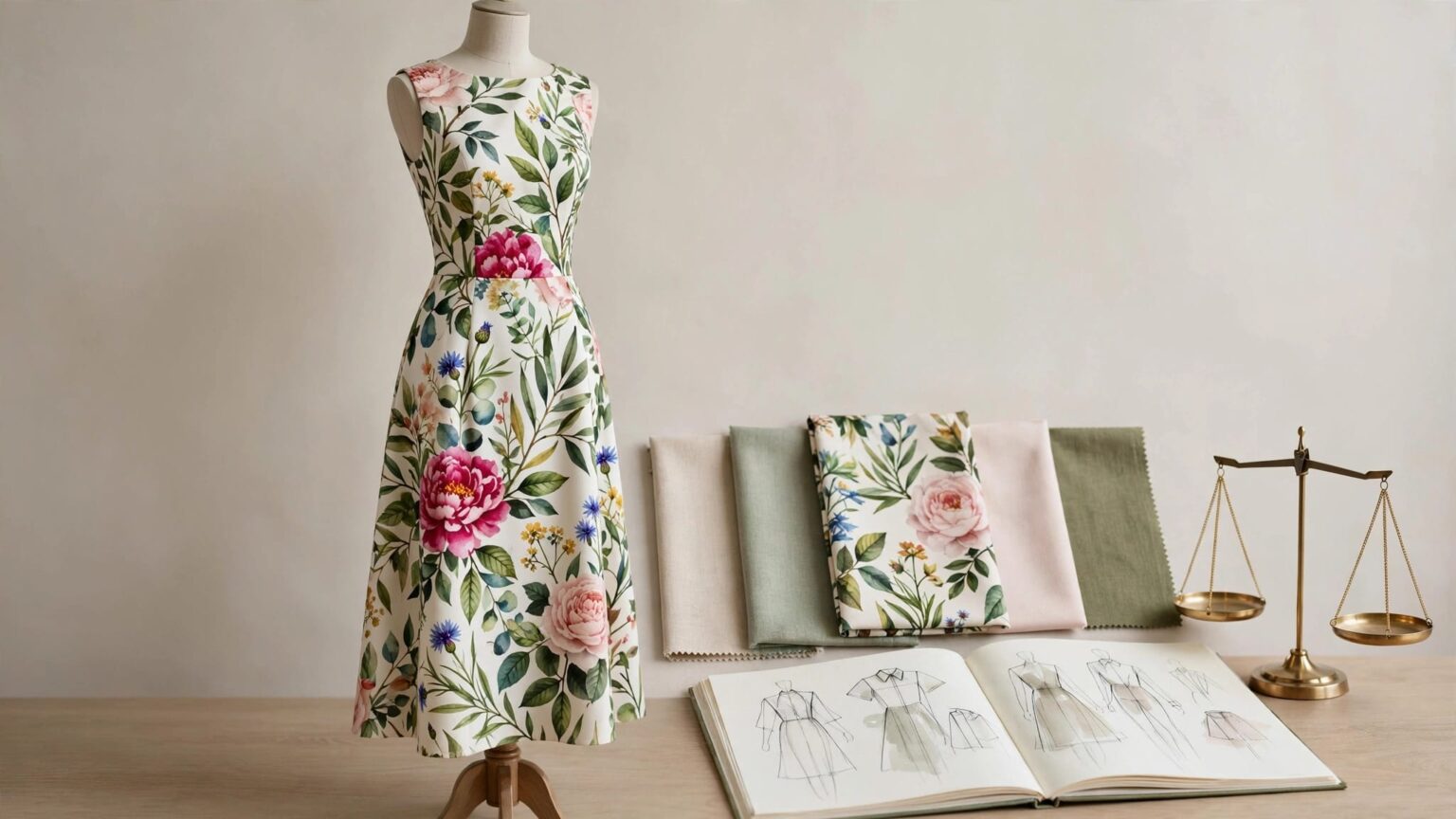
Fashion Design Copyright: Protection Under U.S. Law
U.S. copyright law can protect original textile prints, graphics, and separable artistic features, but it generally doesn’t protect a garment’s cut, fit, or silhouette. For designers, identifying the protected artwork is the starting point for stopping unlawful copying.
A competing label may copy a dress’s shape without infringing copyright, while copying its original print may support a claim. Fashion design copyright protection therefore depends on what someone copied and which rights your business owns.
The distinction starts with how federal law treats clothing.
Table of Contents
ToggleKey Takeaways
- Clothing is generally a useful article, so copyright protection usually concerns qualifying artwork rather than the garment’s functional design.
- The Supreme Court’s Star Athletica decision supplies the test for separating artistic features from useful articles.
- Clear ownership agreements and timely registration strengthen a brand’s enforcement position.
- Copyright, trademarks, trade dress, and design patents address different features of a fashion business.
What Fashion Design Copyright Can Protect
Clothing is generally a useful article
Under 17 U.S.C. § 101, a useful article has an intrinsic practical function beyond portraying its appearance or conveying information. Clothing falls within this category because people wear it for coverage and other practical purposes.
As a result, copyright generally doesn’t protect a garment’s overall shape, construction, or functional arrangement. An unusual neckline or innovative tailoring doesn’t automatically create copyright protection.
The Copyright Office’s discussion of fashion protection describes this distinction between clothing designs and copyrightable artistic elements. Expense, craftsmanship, and commercial success don’t substitute for the statutory requirements.
Original surface artwork may qualify
An original textile print, illustration, or graphic can qualify as a pictorial or graphic work. Applying that artwork to clothing doesn’t automatically remove its protection.
However, copyright protects the author’s original expression. It doesn’t give a designer exclusive rights to floral themes, animal prints, geometric ideas, or individual colors. A particular arrangement may qualify even when its basic components remain available to others.
Fashion illustrations and product photographs can also carry separate copyrights. Our guidance on copyright registration for visual art addresses protection for these creative assets.
How the Supreme Court’s Separability Test Works
The two-part test in Star Athletica
In Star Athletica, LLC v. Varsity Brands, Inc., 580 U.S. 405 (2017), the Supreme Court established the controlling test for artistic features incorporated into useful articles.
A feature must first be identifiable as a two-dimensional or three-dimensional work of art separate from the useful article. Second, it must qualify as a protectable pictorial, graphic, or sculptural work when imagined apart from that article.
The Supreme Court’s Star Athletica opinion makes this a conceptual inquiry. Designers don’t have to physically detach the artwork. However, the imagined separate feature must satisfy copyright’s other requirements, including originality.
What the cheerleading-uniform ruling established
The dispute concerned arrangements of stripes, chevrons, colors, and shapes on Varsity Brands’ cheerleading uniforms. The Court held that the decorations could qualify as two-dimensional artwork apart from the uniforms.
That holding didn’t grant copyright protection to the uniforms’ cut or dimensions. Nor did it settle every question concerning originality or infringement.
A feature can pass the separability test without establishing that a competitor infringed it. Eligibility and infringement require separate analysis.
For fashion businesses, the practical task is to identify the claimed artwork precisely. Calling an entire collection “copyrighted” doesn’t explain which elements the law protects.
Establish Ownership Before Licensing or Enforcement
Paying a designer doesn’t automatically transfer copyright
An apparel company may commission a freelance illustrator to develop prints without acquiring ownership of those prints. Payment alone ordinarily doesn’t transfer copyright.
Employees’ qualifying work created within the scope of employment generally belongs to the employer under work-made-for-hire rules. Independent contractors present different issues. A contract’s work-made-for-hire label doesn’t override the statute’s limits.
Under 17 U.S.C. § 204(a), copyright transfers generally require a signed writing. A properly drafted assignment can place ownership in the intended company. Without one, a brand may hold only a license whose scope depends on the agreement and circumstances.
Define what collaborators and manufacturers may use
Contracts should distinguish ownership from permission to use artwork. A manufacturer may need production files without receiving permission to reuse the print for other customers.
Similarly, a collaboration agreement should address exclusivity, permitted products, territories, and the agreement’s duration. It should also explain who can enforce the rights and whether sublicensing is allowed.
Keep signed agreements with source files and development records. This chain of title connects the original creator to the business asserting ownership. It also matters when distributors or potential buyers ask what the brand actually controls.
Register Early to Preserve Enforcement Options
Copyright exists before registration, but lawsuits have prerequisites
Under 17 U.S.C. § 102, copyright generally arises when an original work becomes fixed in a tangible medium. Registration doesn’t create the underlying right.
However, 17 U.S.C. § 411 generally requires registration before filing a federal infringement lawsuit involving a U.S. work. The statute also provides a route to sue following refusal of a properly submitted claim.
In Fourth Estate Public Benefit Corp. v. Wall-Street.com, LLC (2019), the Supreme Court held that submitting an application alone ordinarily isn’t enough. A pending application therefore doesn’t generally place a brand in the same litigation position as a completed registration.
Timing affects damages and attorney’s fees
Section 412 makes registration timing important. For unpublished works, infringement beginning before registration generally prevents recovery of statutory damages and attorney’s fees.
For published works, registration within three months after first publication can preserve eligibility for those remedies despite infringement beginning during that period. Otherwise, infringement beginning before registration generally creates the same limitation, subject to statutory exceptions.
Actual damages and attributable infringer profits may remain available even when statutory damages aren’t. Courts also decide whether the claimant has proved infringement and qualifies for the requested relief.
Registration should therefore be part of launch planning. Posting an image online doesn’t automatically settle its publication status, so the underlying release facts matter when preparing a claim.
Use Other IP Rights for Different Fashion Assets
Copyright doesn’t cover every valuable feature of an apparel business. A protection strategy may also involve trademarks, trade dress, and design patents.
Trademarks protect source identifiers, including qualifying brand names and logos. In contrast, copyright protects eligible artistic expression. A sufficiently original logo may involve both rights, but each has separate requirements.
Trade dress can protect qualifying nonfunctional product appearances that identify a commercial source. In Wal-Mart Stores, Inc. v. Samara Brothers, Inc., 529 U.S. 205 (2000), the Supreme Court held that product design requires acquired distinctiveness. Consumers must associate the claimed appearance with a source; visual appeal alone isn’t enough.
Design patents may protect new, original, ornamental designs for articles of manufacture. They require an application and examination rather than arising automatically upon creation.
These rights aren’t interchangeable. A copied print, a confusingly similar brand name, and a copied product configuration raise different questions. Selecting the right claim helps a business avoid demanding rights it doesn’t possess.
Respond to Copying With a Defined Claim
Start by preserving the evidence. Save product listings, dated screenshots, seller information, and advertising images. Retain original artwork, development files, agreements, and registration records alongside that material.
Next, compare the allegedly copied elements with the protected work. Similarity in an unprotected silhouette doesn’t establish infringement of a print. Independent creation, licensing, and fair use can also affect the analysis.
A cease-and-desist letter should identify the rights involved and describe the disputed conduct accurately. When online content infringes copyright, a properly supported DMCA notice may help secure removal. However, removal isn’t a court ruling, and registration isn’t generally required to send a notice.
At Chase Lawyers, we help creative businesses identify protectable work, establish ownership, and select an appropriate response. Our copyright registration and enforcement services include registration strategy, licensing, takedown notices, and litigation when necessary.
The response should fit the evidence and commercial stakes. Negotiation may resolve a limited use, while continuing sales or disputed ownership may require a broader legal strategy.
Frequently Asked Questions
Can someone copy my dress if I copyrighted its sketch?
Copyright in a sketch doesn’t automatically prevent others from manufacturing the depicted dress. It protects qualifying expression in the drawing. Separate artwork shown on the dress may also qualify, but the garment’s functional design requires its own analysis.
Does changing a print by a certain percentage avoid infringement?
No fixed percentage makes copying lawful. Courts examine protected expression and the applicable infringement standards. Changes to color or scale don’t necessarily resolve a claim, particularly when recognizable original elements remain.
Can a fashion brand enforce copyright without registration?
Some enforcement steps, including demand letters and appropriate takedown notices, don’t generally require registration. Federal lawsuits involving U.S. works ordinarily require registration or refusal first. Delaying registration can also restrict remedies, even when the brand can ultimately prove infringement.
Protect the Artwork Your Brand Actually Owns
Fashion design copyright protection works best when a brand identifies its eligible artwork, documents ownership, and registers early. A broad claim to an entire garment can obscure the stronger rights in its prints or decorative features.
A defined claim gives licensing and enforcement a firmer foundation. Before a collection launches, organize the artwork, ownership agreements, and registration strategy around the assets the law can protect.
- 21 SE 1st Ave, Suite 700, Miami, FL 33131
- 305-373-7665
- 305-373-7668
- info@chaselawyers.com
- 1345 Avenue of the Americas, 2nd Floor, New York, NY 10105
- 212-601-2762
- info@chaselawyers.com
Get a response within 24 hours. We’ll clearly explain how we can support and protect your brand while staying within your budget.