


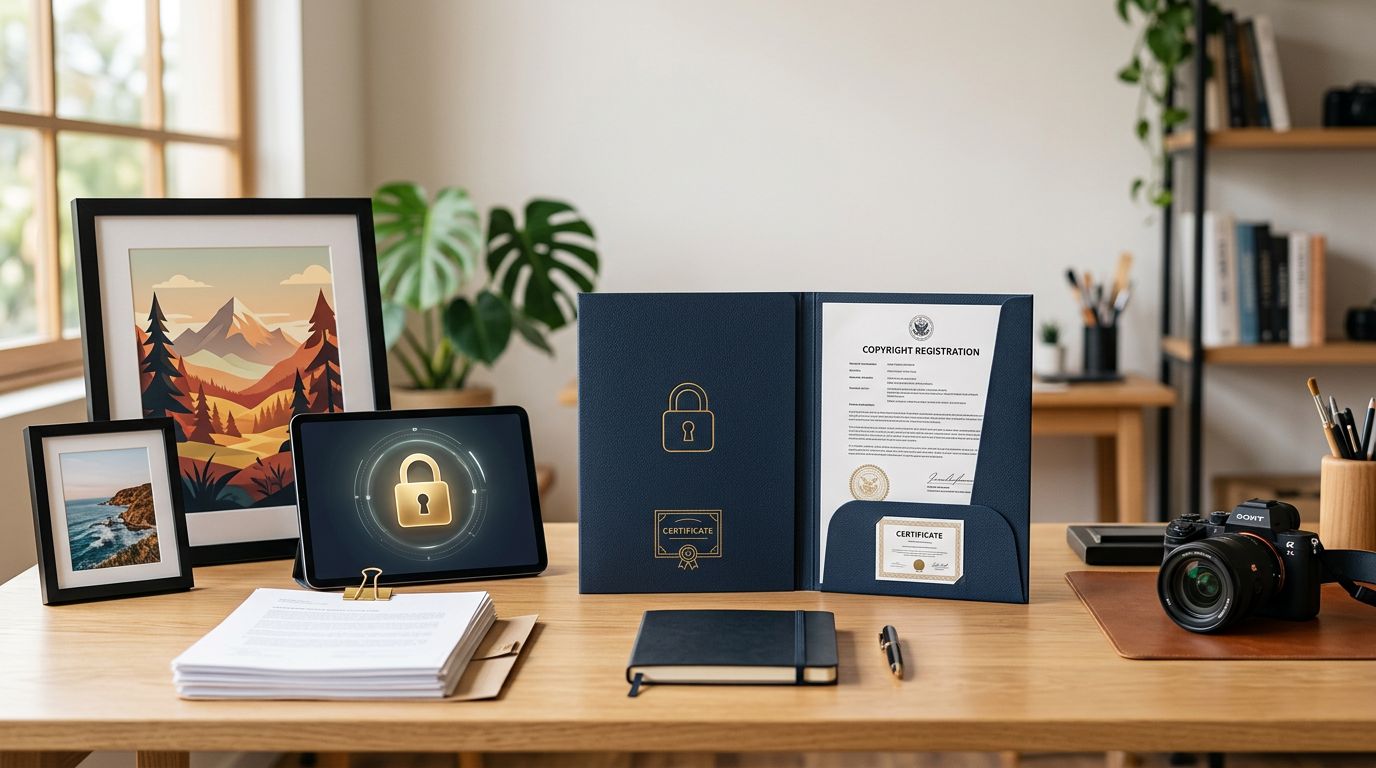
Copyright Registration for Visual Artists: Protect Your Work
A copied image can travel farther online in a day than many artists can track in a month. Copyright registration gives photographers, illustrators, designers, and artists a stronger record of ownership before a dispute puts their work under a microscope.
Copyright exists when you create an original image and fix it in a tangible form. However, federal registration changes what you can do when someone copies, reposts, sells, or licenses your work without permission.
The best time to prepare a claim is while your files, dates, and ownership records are still easy to locate.
Table of Contents
ToggleCopyright Begins Before You Register
U.S. copyright protection starts automatically when you create an original work and record it in a file, print, canvas, sketchbook, or other fixed format. A photograph, digital illustration, painting, collage, graphic design, and sculpture may qualify if it contains original creative expression.
That protection covers your expressive choices. For example, a photograph may reflect original decisions about lighting, composition, timing, angle, and framing. An illustration may protect its particular lines, colors, arrangement, and visual details.
Copyright does not protect an idea, artistic method, color palette, subject matter, or general style. Another artist can photograph the same skyline or paint a similar flower. They cannot copy your protected image without permission.
The author is not always the person holding the camera
In many freelance projects, the creator owns the copyright at the start. A client paying for a shoot or illustration does not automatically become the owner.
Ownership can shift through a written transfer, an employment relationship, or a valid work-made-for-hire arrangement. A freelance agreement that casually calls work “work made for hire” may not settle the issue. Federal law imposes detailed rules, and most commissioned visual work does not fall within the limited categories that qualify.
When ownership is unclear, registration can expose the problem rather than solve it. Review the agreement before listing an author or claimant on the application.
Why Registration Changes Your Position
A federal registration does not make a weak claim strong. It does, however, create a public record that identifies the work, author, claimant, and registration details. For creative professionals who license work regularly, that record can matter long after the original project closes.
If registration occurs before publication or within five years after publication, the certificate can provide prima facie evidence of the facts stated in it. That does not end a dispute, but it can improve your starting position in court.
Registration also matters when infringement becomes expensive. A copied campaign photo, an unlicensed print run, or a brand’s use of an illustration may require more than an email demand.
Registration preserves access to stronger remedies
For most U.S. works, a copyright owner needs registration or a refusal from the U.S. Copyright Office before filing an infringement lawsuit. Timely registration can also preserve the ability to seek statutory damages and attorney’s fees under 17 U.S.C. Section 412.
Statutory damages can range from $750 to $30,000 per infringed work, with higher awards possible for willful infringement. A court decides whether to grant damages and fees, so registration is not a payment guarantee.
Still, an artist who registers before infringement has more options than one who waits until a dispute appears.
Copyright arises at creation, but waiting to register can limit remedies that are often most useful after commercial misuse.
Choosing the Right Copyright Registration Path
The U.S. Copyright Office offers different applications based on the work, authorship, publication status, and whether you are registering one piece or a permitted group. The current Copyright Office fee schedule should be checked before filing because filing fees and application rules can change.
A qualifying Single Application costs less than a Standard Application. However, it only fits a narrow set of claims. If you select the wrong path to save money, the Office may contact you for corrections or require a new filing.
| Registration option | Often fits | Current starting point |
|---|---|---|
| Single Application | One work, one author, one claimant, and no work-for-hire issue | $45 |
| Standard Application | Most individual visual-art claims | $65 |
| Group of Unpublished Works | Up to 10 eligible unpublished works | $85 |
| Group Registration of Two-Dimensional Artwork | Two to 20 eligible published 2D works | $85 |
The table offers a useful starting point, but the application requirements control. Use the Copyright Office registration portal to confirm the correct form and current instructions.
Match the form to the work’s real status
Do not group images because they look related or came from the same client. Group rules require common authorship and other shared facts.
A series of ten unpublished illustrations may fit the Group Registration of Unpublished Works process. On the other hand, a mix of published photos, commissioned graphics, and co-created designs usually needs separate analysis.
Copyright registration works best when the filing matches the actual facts, rather than the filing that seems quickest.
GR2D Gives 2D Artists a New Group Option
The Group Registration of Two-Dimensional Artwork, often called GR2D, is an important 2026 development for illustrators, painters, graphic artists, and similar creators. The U.S. Copyright Office made the option available on February 17, 2026.
GR2D permits one application for between two and 20 eligible published two-dimensional artworks. The official visual-arts registration page lists the category for artwork, illustrations, jewelry, fabric, and related visual works.
Each work in the group must meet the Office’s conditions. They must share the same author, claimant, and calendar year of publication. The application and deposit must identify every work in an organized way.
GR2D is useful, but it has limits
GR2D does not cover every item with a flat image file. It excludes three-dimensional works, architecture, technical drawings, audiovisual works, sound recordings, and certain works made up of multiple pictorial or graphic images.
A designer who posts 20 individual logo designs may have a different registration question than an artist registering 20 standalone illustrations. The Copyright Office’s GR2D announcement provides the rule background, but creators should compare their work to the current application instructions before submitting.
Photographers Need to Use Photo-Specific Rules
Photography has its own group-registration framework. Do not assume that GR2D replaces the separate group option for photographs.
Eligible photographers may register up to 750 published photographs in one group claim when they meet the Office’s requirements. The same general principle applies to unpublished photography groups, although the rules differ from published-photo claims.
The images generally need common authorship, common claimant information, and the required publication details. A wedding photographer, editorial shooter, or commercial studio should keep records that sort images by publication year and ownership.
Posting online can complicate publication status
Publication is a legal term, not a casual label. Public display alone is not automatically publication under the Copyright Act. Yet an online gallery, sales page, client-delivery system, or downloadable portfolio can raise facts that change the analysis.
For that reason, don’t label a group unpublished only because the images first appeared on Instagram or a personal website. The Copyright Office’s guidance for visual and graphic artists is a useful resource, but a complicated online-release history may call for legal advice.
Prepare the Claim Before Opening the Application
Strong applications begin with organized records. Locate the best available copies of each work, then collect the facts you will need to state under penalty of perjury.
Start by confirming the author, claimant, creation date, first-publication date, and title for every work. If the title has changed since you uploaded the image, make a clear internal record that connects the old and new names.
You should also identify material created by someone else. A poster that includes a licensed stock image, a client’s trademark, or a pre-existing photo may need a limitation-of-claim statement. Registration covers your original contribution, not material you do not own.
Your deposit should identify the work clearly
The deposit is the copy of the work submitted to the Copyright Office. A low-resolution screenshot with a vague filename may be enough to show an image exists, but it can create trouble if you later need to identify exactly what the registration covers.
Use consistent filenames, preserve original masters, and maintain a spreadsheet with image titles, file dates, project names, and publication information. Keep the submission confirmation with that archive.
For unpublished groups, the Group Registration of Unpublished Works FAQ confirms the current limit of up to ten qualifying works in one application.
File Carefully and Track the Application
Electronic filing usually starts with the appropriate application in the Copyright Office’s online system. The process is manageable for a straightforward claim, but small errors can have outsized effects later.
A practical filing routine has four parts:
- Confirm the work category and whether the work is published or unpublished.
- Select the application that fits the authorship and grouping facts.
- Enter titles, dates, claimant information, and authorship details consistently.
- Pay the fee, submit the deposit, and save every confirmation email and PDF receipt.
The Office may ask questions after submission. Respond promptly and preserve copies of your answers. If you modify a claim, keep notes explaining why.
File before conflict makes the records messy
When an image has already been copied, creators often rush to register a portfolio without sorting out the work’s titles, publication dates, or ownership history. That approach can lead to avoidable inaccuracies.
Build registration into your business routine instead. A commercial photographer might register each completed campaign batch. An illustrator could review published work quarterly and group eligible pieces under the right option.
Court Decisions That Affect Registration Strategy
Federal court decisions explain why filing an application and receiving a certificate are different stages.
In Fourth Estate Public Benefit Corp. v. Wall-Street.com, LLC, 586 U.S. 231 (2019), the U.S. Supreme Court held that a claimant generally must wait for the Copyright Office to act on an application before starting an infringement lawsuit. Submitting the application alone is not enough.
That waiting period can matter when copied work remains in an active advertising campaign or product listing. It is one reason artists benefit from filing well before a dispute.
The effective date still matters
Under 17 U.S.C. Section 410(d), the effective date of registration is generally the date when the Office receives a proper application, deposit, and fee. Yet under Fourth Estate, court action still waits for the Office to register or refuse the claim.
This distinction matters for Section 412 timing. Registration before infringement is the cleanest position. If a work is first published before registration, filing within three months after publication may preserve statutory damages and attorney’s fees, even when infringement begins during that period.
Innocent mistakes do not always destroy a registration
In Unicolors, Inc. v. H&M Hennes & Mauritz, L.P., 595 U.S. 178 (2022), the Supreme Court ruled that a registration does not become invalid merely because it contains an inaccuracy that the applicant did not knowingly include.
The decision helps creators who made a good-faith mistake about complicated registration rules. It should not encourage careless filings. Correct dates, authorship, publication status, and ownership claims remain important because the application may become evidence in a dispute.
Contracts and Releases Protect Different Rights
Copyright registration protects the creative work. It does not replace a clear license, a model release, a property release, or trademark permission.
A client may need limited rights for a website and social-media campaign. Another client may want exclusivity, paid advertising rights, print use, editing rights, or permission to share the image with affiliates. Put those terms in writing before delivery.
For photographers, a model’s appearance does not make the model a copyright owner of the photograph. However, a recognizable person’s privacy or publicity rights can affect commercial use. Review photo licensing for social media when a brand plans to repost or promote images online.
Your agreements should match your registration record
If you work with second shooters, retouchers, designers, or co-illustrators, address ownership in written agreements. A client agreement should also state whether copyright transfers or whether the client receives a defined license.
Keep those contracts with your registration records. A certificate identifies the claim, while contracts explain the chain of title and the rights you granted to others.
Responding When Someone Uses Your Work Without Permission
Start with evidence. Save screenshots that show the copied work, web address, account name, date, surrounding advertisement, and any credit line. Preserve your original files, metadata, drafts, invoices, licenses, and registration certificate.
Next, compare the use to any permission you gave. A client may have a web-use license but no right to create merchandise. A publication may have an editorial license but no permission for paid advertising.
For many online uses, a DMCA notice can seek removal before registration is complete. Chase Lawyers’ DMCA takedown guide for photographers explains why removal requests and federal lawsuits require different planning.
A registration certificate does not automatically prove infringement. You still need to show copying of protected expression and establish the scope of any license. However, timely registration gives you stronger choices if the use continues or causes financial harm.
When Chase Lawyers Can Help
Copyright filing becomes more complicated when work is commissioned, co-created, acquired from another artist, published across several platforms, or tied to a larger brand deal. The same is true when a commercial user disputes ownership or claims it had permission.
Chase Lawyers works with photographers, illustrators, designers, artists, creators, and creative businesses from offices in Miami and New York City. The firm can help assess ownership, organize a registration plan, review licenses and releases, and address unauthorized use.
For matters involving a valuable catalog or active dispute, copyright registration and enforcement support can connect the filing process to the contracts and evidence needed to protect the work.
Final Thoughts
Your work has copyright protection when you create it, but timely registration turns that protection into a more practical legal asset. Accurate records, the right application, and clear contracts give an artist a stronger foundation before misuse occurs.
A clean registration file is more than paperwork. It is part of how you protect the value of the images and art you worked to create.


- 21 SE 1st Ave, Suite 700, Miami, FL 33131
- 305-373-7665
- 305-373-7668
- info@chaselawyers.com
- 1345 Avenue of the Americas, 2nd Floor, New York, NY 10105
- 212-601-2762
- info@chaselawyers.com
Get a response within 24 hours. We’ll clearly explain how we can support and protect your brand while staying within your budget.