


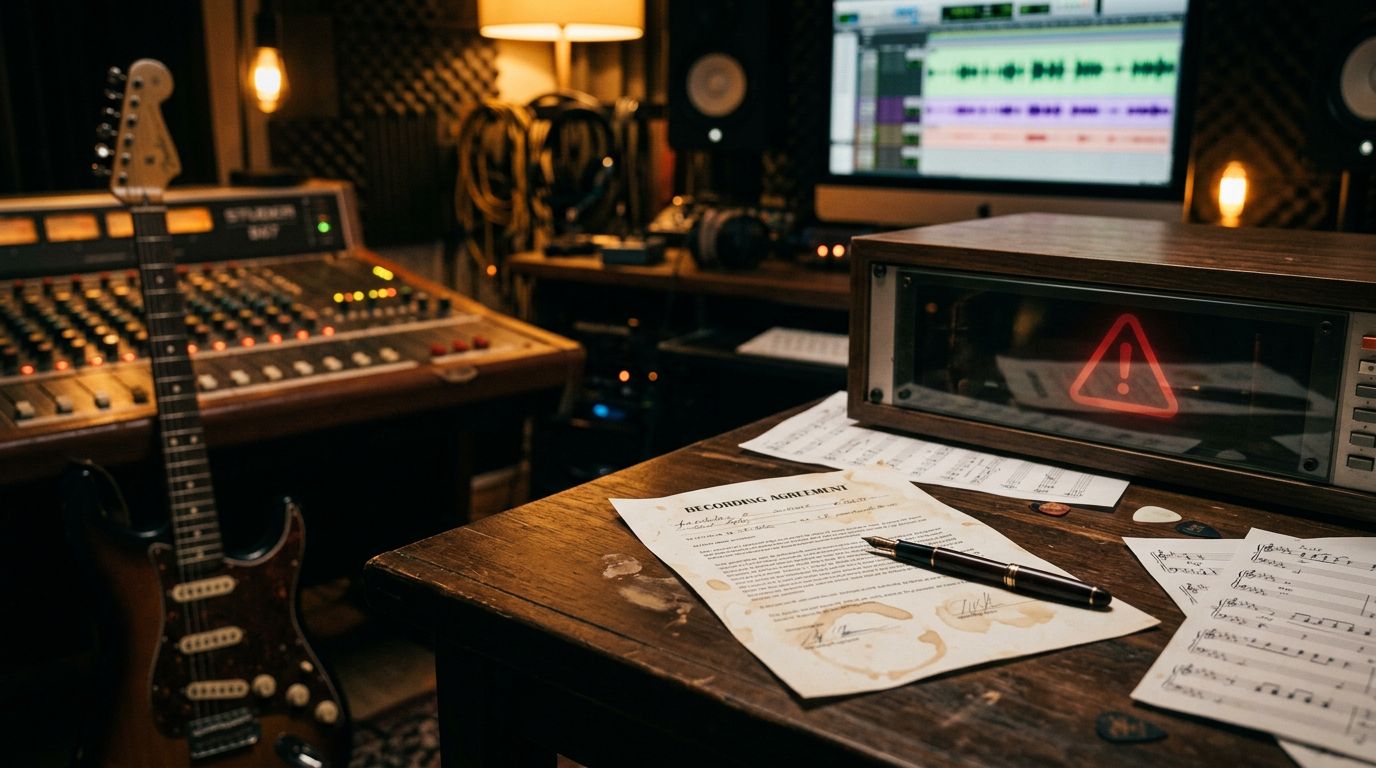
Producer Agreement Red Flags Indie Artists Should Catch
A great beat can cost you your catalog if the paperwork is wrong. Most producer agreement red flags hide in plain sight, inside ownership clauses, royalty language, and vague promises made after a late-night session.
Independent artists often sign fast because the song feels good and the producer wants momentum. That speed can hand away master rights, publishing income, or release control before the track even hits DSPs. The smart move is to slow down and read the deal like your career depends on it, because it does.
Table of Contents
ToggleWhy producer deals go bad so fast
Producer agreements often start with trust. You met through a mutual friend, booked a home studio, made something strong, and everybody says they’ll “work it out later.” Later is where trouble starts.
When there is no signed contract, people fill the gaps with memory, texts, and assumptions. In the United States, copyright ownership and contract rights don’t get clearer because everyone had good intentions. They get messier. Under 17 U.S.C. 204(a), a copyright transfer must be in a signed writing. If your deal is vague, or never signed, both sides may still fight over who owns what.
That problem gets worse for indie artists because sessions move fast. A producer may send a one-page agreement after the song is done, or slip terms into an invoice. Meanwhile, the artist is thinking about artwork, rollout, and playlist pitching, not legal language.
Common warning signs show up early. One side rushes the signature. Payment terms look incomplete. Credit is left for later. Sample use gets brushed off with “don’t worry about it.” Many of the broader artist-side warnings in SoundGirls’ contract red flag roundup show up in producer deals too, especially pressure, exclusivity, and unclear promises.
This is why early review matters. Legal guidance on music producer contracts can save an artist from signing away more than a fee or a few points. Chase Lawyers, a boutique entertainment firm with offices in Miami and New York, works with musicians, producers, and creative brands on these agreements before a small issue turns into a lawsuit.
Master ownership should never be fuzzy
The biggest red flag is simple: the contract does not clearly say who owns the master recording. If that sentence is missing, buried, or written in foggy language, stop.
In many indie producer deals, the safer setup is straightforward. The artist owns the master, and the producer receives a fee, royalty points, or both. That does not mean every deal must look the same. Some producers finance recording, bring major value, or co-release the project. Still, if the producer gets any share of the master, the agreement should say exactly what share, how long it lasts, and what rights come with it.
Problems start when a producer claims ownership because they made the beat, paid for studio time, or helped shape the record. Those facts may matter in a dispute, but they do not replace clean contract language. If the artist expects full ownership, the agreement should say the producer assigns any rights in the recording to the artist, subject only to the payment terms the parties agreed on.
If a producer agreement doesn’t clearly settle master ownership, assume the dispute is already scheduled for later.
Watch for language that gives the producer broad control over reproducing, distributing, licensing, or exploiting the recording. Those are copyright rights under 17 U.S.C. 106, and they belong to the owner unless the contract says otherwise. If the producer wants “ownership” when what they really want is backend compensation, the deal is oversized.
A fair contract also separates the master from the song. The sound recording and the composition are different assets. If your agreement blends them together, you’re looking at another red flag.
Money terms that eat your release budget
Money fights do not start with greed. They start with unclear math.
A producer agreement should say whether the producer gets a flat fee, an advance, royalty points, publishing, or some mix of those items. It should also say when payment is due, whether any part is non-refundable, and what happens if the song is never released. If the deal says the producer is paid from “net profits,” take a harder look. “Net” can become a moving target if costs are not defined line by line.
That issue shows up in many artist contracts, not only label deals. Sonicbids’ take on recording contract red flags highlights how vague profit language can shrink an artist’s share long after release day. The same logic applies to producer terms. A royalty sounds fair until the agreement lets the other side subtract endless costs first.
Recoupment needs the same attention. If the producer can recoup travel, musicians, engineers, plug-ins, revisions, or marketing spend, the contract should define each category. Otherwise, a recoupment clause works like a taxi meter left running while you sleep. The song can make money, but you still may not see any.
Accounting rights matter too. If a producer is paid from royalties, the artist needs a clear method for tracking sales, streams, sync income, and deductions. If the artist is paid by a label or distributor first, the agreement should say how the producer’s share is calculated from those receipts. Audit rights help keep everyone honest. Without them, underpayment can hide inside spreadsheets no one gets to inspect.
Be wary of open-ended producer points that apply to every version of a track, every remix, every deluxe edition, and every future exploitation forever. Those rights may be fair in some deals, but only when the contract states them with precision.
Credit, publishing, and split sheets are not side notes
Artists often focus on money first. Then, months later, the real fight is over credit and songwriting.
A producer should be credited exactly as the parties agree. That includes stage name, spelling, featured billing if any, metadata delivery, and where the credit must appear. A missing credit can hurt more than pride. It can affect discovery, reputation, and future work.
Publishing is a separate issue. A producer does not receive composition ownership only because they produced the recording. If the producer helped write melody, lyrics, chord changes, or other copyrightable parts of the song, then a publishing split may be appropriate. If not, giving away publishing “just because everyone does it” is a bad habit, not a rule.
The best time to settle this is the day the song is written. Split sheets are simple, but they prevent expensive memory contests later. They should match the producer agreement, the metadata, and any PRO registrations. If those documents conflict, payment delays and ownership claims follow.
United States case law shows why intent matters. In Childress v. Taylor, the Second Circuit made clear that joint authorship requires more than helpful contribution. The parties must also intend to be co-authors. That principle is useful in music disputes. A producer’s input may be important, yet that alone does not make the producer a co-writer of the composition.
Artists should also watch for “admin” language that sneaks control over publishing into a producer contract. A producer can have a songwriting share without controlling registration, collection, or licensing of the entire song. Those are different rights.
If your agreement says credit, publishing, and splits will be “determined later,” it is unfinished. Unfinished contracts create finished problems.
Samples, loops, and warranties can trigger bigger claims
A track can sound original and still carry legal risk. Samples, unlicensed loops, and borrowed stems are common sources of trouble.
If a producer uses any outside material, the contract should say who is responsible for clearance. Never assume the producer handled it because the file sounded clean. If a beat includes an uncleared sample, the artist may face takedowns, delayed release, lost sync deals, or a copyright claim after the song gains traction.
United States courts have treated sampling disputes seriously for years. In Bridgeport Music, Inc. v. Dimension Films, the Sixth Circuit took a strict view of unlicensed sound recording sampling. Other courts have approached the issue differently, but that does not make casual sampling safe. If a producer says a sample is too short to matter, that is not legal protection.
Warranties help manage this risk. The producer should promise that the work is original, that they have the right to contribute it, and that it does not knowingly infringe anyone else’s rights. The agreement should also cover whether the producer used AI tools, loop libraries, or third-party collaborators, and whether those uses complied with the related license terms.
Indemnity language deserves close review. Some agreements make the artist responsible for every claim tied to the track, even if the producer caused the problem. That is backwards. If the producer brought the sample, the producer should take responsibility for that breach. Shared risk can be fair in some situations, but one-sided indemnity is a classic red flag.
The same goes for beat leases and packs. If the producer licensed a beat non-exclusively from someone else, the artist needs to know. You do not want to discover after release that five other artists have rights in the same instrumental.
Approval rights and control clauses can block your release
Some of the worst terms do not look scary at first glance. They look like “approval,” “consultation,” or “mutual agreement.” Then the release date arrives, and the producer can hold the song hostage.
A producer usually does not need the right to approve the artist’s release schedule, artwork, distribution partner, remix plan, or sync pitch. If the contract grants broad approval rights, narrow them. Limit them to matters the producer truly controls, such as use of their name in advertising or edits that change the production in a material way.
Exclusivity is another trouble spot. A reasonable clause may stop the artist from using the same beat for another song. An unreasonable one may block the artist from working with other producers, recording in a similar style, or releasing related tracks for months. That is too much power for a single production deal.
Term and termination language also matter. The agreement should say when services start, when they end, what counts as delivery, and how either side can end the deal if the other side breaches. Add a cure period. State what happens to unfinished tracks. State whether the producer keeps any upfront fee. State whether the artist can use partially completed material.
Vague control language causes real release delays. So does silence. If the contract never says who can release the song, edit it, or pull it down, you have left your future in a blank space.
This is where clear drafting helps. Chase Lawyers often works with artists and indie teams that need essential terms for production contracts spelled out before release plans or relationships break down.
“Work made for hire” is often used the wrong way
Many producer agreements include the phrase “work made for hire.” Artists see it, producers see it, and both assume it solves ownership. Sometimes it does not.
Under 17 U.S.C. 101, a work made for hire has a specific legal definition. For independent contractors, the rule is narrower than many people think. In Community for Creative Non-Violence v. Reid, the Supreme Court explained that calling someone an independent contractor does not magically turn their work into a work made for hire. Courts look at the real relationship, and the statute limits when commissioned works qualify.
Music production services do not always fit neatly into those statutory categories. That means a producer agreement that relies only on work-for-hire language can leave room for an ownership fight. The safer approach is to include both concepts: state the parties’ work-for-hire intent if applicable, and add a backup assignment of all rights in the master to the artist.
This matters because labels, distributors, and buyers want a clean chain of title. If the artist later pitches the track for sync, sells catalog rights, or signs a distribution deal, sloppy work-for-hire language can slow the whole process. Nobody likes hearing that the song is great but the paperwork is suspect.
There is another common mistake here. Some agreements use work-for-hire wording to sweep in the composition too, even when the producer is also a co-writer. That creates a conflict. If the producer wrote part of the song and keeps a publishing share, the contract must separate those rights carefully.
The phrase sounds powerful. On its own, it is not enough.
What a fair producer agreement usually looks like
A fair deal is not always a cheap deal. It is a clear deal.
Most solid agreements cover the same core points: who the parties are, what the producer must deliver, what the artist must pay, who owns the master, whether there is any publishing split, how credit appears, who clears samples, and what happens if the relationship ends. When those terms are plain, both sides can focus on making music instead of saving screenshots.
This quick comparison shows how healthy language differs from a risky clause:
| Deal point | Fair artist-side approach | Red flag |
|---|---|---|
| Master rights | Artist owns the master, producer gets fee or points | Producer gets undefined ownership or control |
| Payment | Fee, points, and due dates are specific | “Net profits” with no cost definition |
| Publishing | Split only if producer helped write the song | Automatic publishing share in every track |
| Credit | Name, placement, and metadata are stated | Credit left for later |
| Samples | Producer discloses and clears outside material, or duties are assigned clearly | No sample language at all |
| Accounting | Royalty method and audit rights are written down | No reporting or inspection rights |
| Approvals | Limited approval on narrow issues | Producer can veto release or edits |
The point is not to squeeze the producer. A strong agreement protects both sides. Producers deserve clear compensation and proper credit. Artists deserve clean ownership and freedom to release their work.
That is where Chase Lawyers can help. The firm is a boutique practice focused on entertainment, media, intellectual property, and the business side of creative work. With offices in Miami and New York, the team works with artists, musicians, producers, influencers, and other creative clients who need contracts that match real careers, not boilerplate pulled from a group chat.
Conclusion
The most expensive producer agreement red flags are rarely hidden in legal jargon. They sit in plain terms about ownership, money, publishing, samples, and control.
If the contract leaves any of those points fuzzy, the risk stays with the artist. A strong record should not depend on wishful thinking or “we’ll fix it later.” Chase Lawyers helps independent artists, managers, and indie teams review producer deals before those loose ends turn into lost rights or stalled releases.

- 21 SE 1st Ave, Suite 700, Miami, FL 33131
- 305-373-7665
- 305-373-7668
- info@chaselawyers.com
- 1345 Avenue of the Americas, 2nd Floor, New York, NY 10105
- 212-601-2762
- info@chaselawyers.com
Get a response within 24 hours. We’ll clearly explain how we can support and protect your brand while staying within your budget.