


Film Location Agreements That Protect a Production
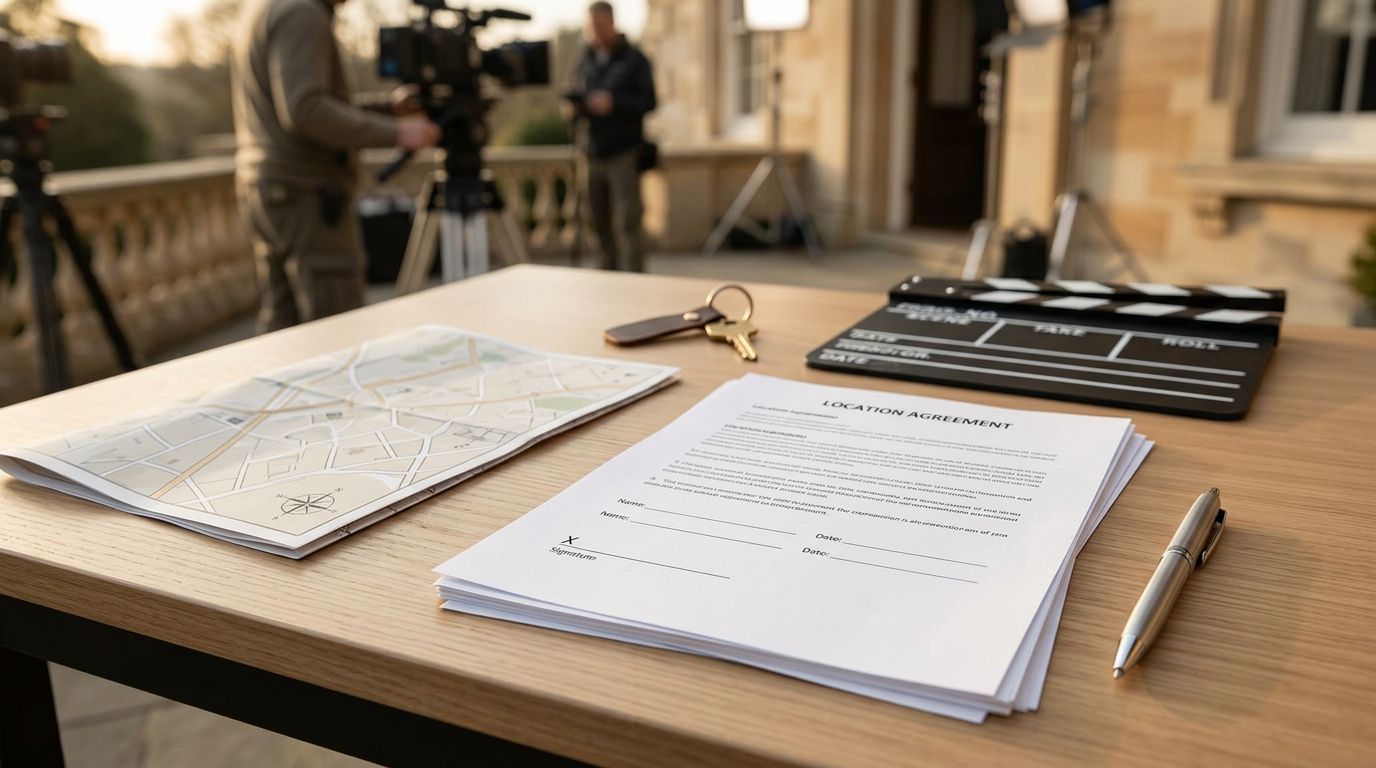
A perfect location can become an expensive problem when the paperwork arrives late, names the wrong party, or misses a restriction. Film location agreements give a production written permission to occupy, alter, photograph, record, and portray a property before trucks, talent, and equipment arrive.
A handshake with a homeowner or venue manager won’t satisfy a distributor, insurer, or completion bond company. Clear documents protect the schedule, the budget, and the right to use footage long after wrap.
Table of Contents
ToggleKey Takeaways
- A private-property agreement and a public filming permit solve different legal problems, and many shoots need both.
- The signer must own the location or hold written authority to grant access and screen-use rights.
- Define every approved area, activity, date, crew need, alteration, and restoration duty before the first prep day.
- A location release does not clear artwork, trademarks, music, people, drones, or neighboring property.
- Chase Lawyers can coordinate location documentation with the broader clearance and production-contract work required for distribution.
Film Location Agreements: What the Contract Actually Secures
A location agreement is a contract between the production entity and the party who controls the property. It grants a limited license to enter and use the site for an identified production. It should never read like a vague permission slip.
At minimum, the agreement should identify the production company, the project title or working title, the location’s full address, and the exact spaces available. A house agreement may cover the living room, kitchen, driveway, and backyard, while excluding bedrooms, a home office, or a neighbor’s side gate. A warehouse agreement may authorize a soundstage but exclude loading areas shared with other tenants.
The agreement should also state the permitted uses. A still-photo shoot, a dialogue scene, a night exterior, and a controlled special-effects sequence present very different risks. The more the production plans to do, the more exact the contract needs to be.
A useful location agreement overview describes the central purpose well: the property owner gives a production permission to use the premises under agreed conditions. For producers, the important detail is the scope of permission. General permission to film does not automatically cover overnight access, prop weapons, rain effects, drone work, parking trucks, or marketing photographs.
The document should grant the production the right to record the property and use the resulting footage in the completed project, trailers, clips, publicity, advertising, and distribution materials. Without that screen-use language, an owner may later claim that the crew had permission to enter but not to feature the location in a commercial release.
Film location agreements also help establish a clean production file. Distributors and errors and omissions insurers often review chain-of-title and clearance records. A signed release, organized with permits, certificates of insurance, and photographs of the site, shows that the producer secured rights before principal photography.
Private Locations and Public Permits Are Different
Private property generally requires the owner’s written consent. Public property usually requires authorization from the government agency that controls it. Those are separate approvals, and one does not replace the other.
A production filming inside a privately owned restaurant may have a signed agreement with the restaurant owner. However, it may still need a city permit if it occupies the sidewalk, reserves curbside parking, blocks pedestrian traffic, places equipment in the street, or asks police officers to control traffic.
New York City treats permits as necessary for productions that use equipment packages, production vehicles with requested parking privileges, exclusive city property, prop weapons, stunts, police uniforms, or NYPD and FDNY support. Local film offices often impose similar triggers, although their rules and lead times vary.
Use this distinction when building the location packet:
| Situation | Primary Approval | Common Extra Issue |
|---|---|---|
| Home interior | Owner’s location agreement | Neighbor access, parking, noise |
| Private office building | Agreement from authorized owner or manager | Tenant consent and building rules |
| Public sidewalk | City film permit | Traffic control and parking |
| State park or historic site | Agency permit | Restricted areas and restoration |
| Federal land | Agency authorization when required | Group size, props, closures, resource impacts |
Federal land rules have changed in recent years. The EXPLORE Act, enacted in January 2025, generally limits permit and fee requirements for certain small-scale filming and photography on land managed by the Departments of the Interior and Agriculture. Still, productions should check the responsible agency’s current rules. A shoot with sets, actors, props, vehicles, crew, or resource impacts may require approval even when a small content-creation project does not.
A signed agreement for a private lot does not authorize a production to occupy a public street beside it.
Build permit lead time into the schedule. Public agencies may require site plans, parking maps, proof of insurance, traffic-control plans, fire review, security details, or neighborhood notices. A location manager cannot solve a permit issue after a city inspector stops the shoot.
Confirm Who Has Authority to Sign
The person showing a producer around a property may not have the legal power to grant filming rights. This issue appears often with commercial buildings, vacation rentals, estates, condominiums, churches, schools, restaurants, and properties managed by a third party.
Start with ownership and control. A deed holder may own the building, but a property manager may control day-to-day access under a management agreement. A commercial tenant might control its suite but lack authority over hallways, lobby areas, elevators, exterior signage, loading docks, or the building facade. A homeowner’s association may control the common areas of a residential development.
Ask for written proof when the circumstances call for it. That may include a management authorization, lease provision, board resolution, estate representative documentation, or a landlord’s written approval. It is far easier to resolve this before a company move than after an owner threatens to revoke access.
The same principle applies to residences occupied by someone other than the owner. A landlord’s signature may permit access to the property, yet an occupant may have privacy rights and possessory rights that make separate consent wise or necessary. If the production will use personal belongings, family photographs, or a distinctive nameplate, the clearance review should go further.
US courts have treated unauthorized recording in private settings seriously. In Dietemann v. Time, Inc., 449 F.2d 245 (9th Cir. 1971), the Ninth Circuit upheld liability for intrusion after reporters entered a private home under false pretenses and secretly recorded the resident. The case involved journalism, not narrative production, but its lesson applies on set: media status does not excuse intrusive conduct on private premises.
For a sensitive home, school, medical facility, religious site, or operating business, Chase Lawyers can review authority, use limits, and privacy concerns as part of its movie and TV production support. A release only works when the right party signs it.
Define the Rights Grant and Every Use of the Property
The rights clause should match the actual shooting plan. Broad language can protect distribution, but it should not hide operational details that make an owner uneasy. Producers get better cooperation when the agreement plainly describes what the crew will do.
Set out the approved production period, including prep, tech scout, load-in, filming, strike, restoration, and hold days. If the project may return for pickups, include an option for additional dates with a stated fee or a clear approval process. Rain dates need the same attention.
The contract should address these practical boundaries in plain language:
- Which rooms, exteriors, structures, driveways, rooftops, and storage spaces the crew may use.
- Whether the production may dress the set, move furniture, cover walls, remove fixtures, or place temporary signs.
- Whether it may use haze, smoke, rain towers, open flame, generators, high-decibel sound, animals, prop weapons, or special effects.
- Whether it may show the property’s real name, address, signage, or distinctive appearance in the project and promotion.
- Whether the crew may park, run cable, stage equipment, or hold cast in designated exterior areas.
The release should grant screen-use rights in all media, worldwide, and for the full copyright term, including extensions, if that is the commercial deal. Producers need those rights because a project can later move from a festival screening to theatrical, streaming, airline, educational, social-media, or promotional use. A limited one-year grant may conflict with normal distribution demands.
However, the agreement should respect meaningful restrictions. A hospital may permit filming but prohibit its name, logos, patient areas, and identifiable operations. A historic home may allow furniture moves only under a preservation consultant’s supervision. A location owner may approve a comedy scene but reject a depiction tied to criminal conduct, adult content, political advocacy, or a competing brand.
State those limits with enough detail to administer them. “Appropriate use only” invites an argument. “No exterior signage, no use of the property’s name, and no simulated criminal activity inside the chapel” gives the production team a workable rule.
Put Money, Damage, and Insurance Terms in Writing
Location fees need more than a total number. The agreement should identify the base fee, deposit, overtime rate, hold-day charge, cancellation fee, payment deadline, and the party receiving payment. If a location representative expects cash, confirm the payee and tax documentation before release day.
A deposit should have a stated purpose. Is it a refundable damage deposit, an advance against the location fee, or both? The contract should say when the owner must return it and how the parties will handle a claimed loss. Otherwise, a dispute over a scratched floor or broken lamp can delay the production’s closeout.
Document the property’s condition before entry. A location manager should take dated photographs and video, prepare an inventory of fragile items, and record existing damage. The owner or authorized representative should review the condition report. Repeat the process after strike.
Restoration language should cover more than cleaning. Address repainting, landscaping, debris removal, fixture replacement, wall repair, pest treatment after animals, and professional cleaning where the work requires it. If the production cannot restore an item to its prior condition, set a process for replacement value or repair estimates.
Insurance language must reflect the actual risk. A location owner may require commercial general liability coverage, workers’ compensation where required, automobile coverage for production vehicles, and additional-insured status. A certificate of insurance proves that a policy exists, but an endorsement may be necessary to give the owner additional-insured protection. The production should review the policy requirements with its broker instead of promising coverage it cannot provide.
Indemnity should be tailored too. The production may indemnify the owner for claims arising from the crew’s use of the property. In return, the owner should remain responsible for pre-existing dangerous conditions, undisclosed defects, and its own negligence. An agreement that shifts every possible risk to one side often creates a fight when something goes wrong.
For larger shoots, include a site-safety plan and an emergency contact list. If the property has a pool, unstable stairs, old wiring, restricted rooms, or known hazards, place those facts in writing. A location agreement cannot erase a duty of care, but it can assign reporting, access, and safety responsibilities before the crew arrives.
Clear Rights the Location Owner Cannot Grant
A property agreement is one part of a larger clearance package. The owner cannot release rights it does not own. Producers should identify those gaps before filming material that becomes costly to replace.
Artwork is a frequent example. A homeowner may own a painting, but the artist may still own copyright in the work. The same issue can arise with murals, sculptures, photographs, architectural elements, branded wallpaper, and product packaging. A location agreement may allow filming in the room, yet it does not necessarily grant permission to feature protected artwork.
Trademarks require judgment as well. Incidental background appearances often carry less risk than deliberate, prominent use that suggests affiliation, disparages a brand, or confuses viewers. A real business may also have contractual reasons to restrict its trade dress, uniforms, menus, and customer-facing signs.
People at the location need their own releases when they are identifiable participants. This includes employees, patrons, neighbors, and family members who appear on camera. A property owner’s consent does not replace talent, appearance, or privacy releases.
Drones present another separate issue. A location owner can approve takeoff and landing on its land, but that approval does not replace Federal Aviation Administration requirements, airspace restrictions, pilot rules, or local conditions. Plan aerial work early because the location contract, permit package, and aviation compliance need to match.
This is where a review of legal considerations for film production companies can prevent a false sense of security. A complete clearance process connects property rights with intellectual property, talent releases, music, permits, and insurance.
Negotiate a Location Package Before the Schedule Hardens
The right time to negotiate is before the location becomes the creative department’s only workable option. Once a director blocks a scene around a particular staircase or skyline, the owner has more power to demand higher fees or impose late restrictions.
First, send a concise location brief. It should identify the production entity, project type, dates, approximate crew size, equipment, vehicles, parking needs, scene description, special activities, insurance limits, and contact information. Owners respond better when they can see the operational plan.
Next, walk the site with the location manager, department heads, and safety personnel who need to assess it. Mark approved holding areas, generator positions, bathrooms, cable routes, parking spaces, load-in paths, and restricted zones. Put the final map or exhibit into the agreement when boundaries matter.
Then, circulate the contract to the person with authority to sign. Do not rely on an email that says, “Sounds good,” especially where the document requires an owner signature, insurance certificate, or agency permit. Save signed copies, amendments, receipts, permits, and condition reports in one production file.
A practical film location agreement checklist can help a line producer spot missing terms. Still, templates cannot account for a location’s ownership structure, state law, special-use restrictions, or a distributor’s delivery requirements.
Chase Lawyers helps producers turn location terms into enforceable documents that fit the project’s financing, insurance, clearance, and distribution plans. Strong production contract guidance starts with clear project definitions, but it also depends on precise rights grants and risk allocation at each location.
Final Thoughts
A location can look perfect in a scout and still create serious legal and financial exposure on shoot day. The strongest film location agreements name the right parties, define the permitted use, allocate risk fairly, and preserve the footage rights a production needs after wrap.
When the release, permit, insurance, and clearance files tell the same story, the crew can focus on the work instead of an avoidable shutdown or ownership dispute.


- 21 SE 1st Ave, Suite 700, Miami, FL 33131
- 305-373-7665
- 305-373-7668
- info@chaselawyers.com
- 1345 Avenue of the Americas, 2nd Floor, New York, NY 10105
- 212-601-2762
- info@chaselawyers.com
Get a response within 24 hours. We’ll clearly explain how we can support and protect your brand while staying within your budget.