


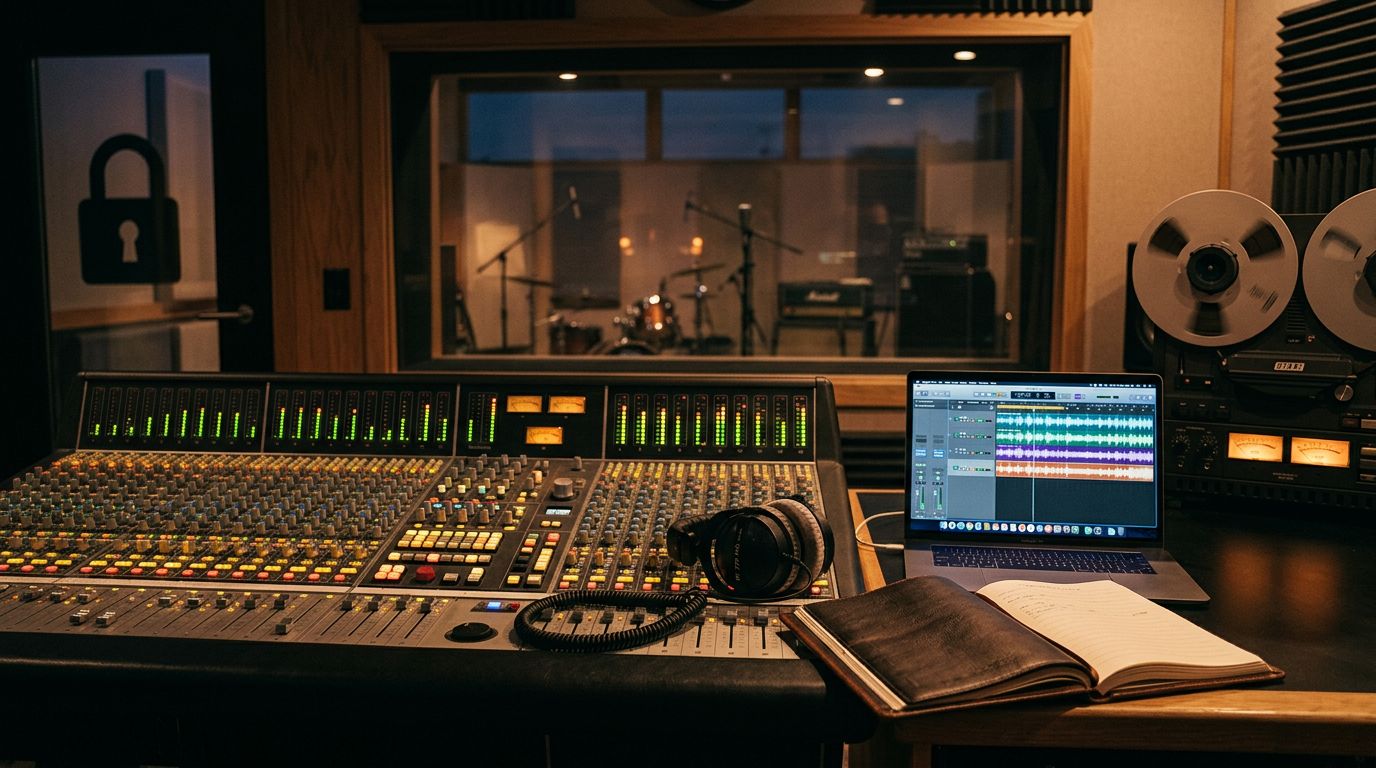
Recording Studio Agreements That Guard Unreleased Music
An unreleased song can lose value long before anyone hears it. A leaked reference mix, a disputed beat file, or a studio engineer sharing a session folder can turn months of work into a rights problem.
Strong recording studio agreements set clear rules before the first vocal take. They establish who owns the masters, who can access files, what stays confidential, and what happens if a relationship ends badly.
The best time to protect a recording is before stems, rough mixes, and lyric drafts begin moving between people.
Table of Contents
ToggleKey Takeaways
- A studio agreement should state that the artist or agreed rights holder owns all session files and masters.
- Confidentiality terms must cover unreleased songs, lyrics, beats, stems, metadata, passwords, and session details.
- Studios need clear limits on who may access, copy, store, or share recordings.
- Producer, engineer, writer, and featured-artist contributions require separate ownership and credit terms.
- Copyright registration and organized file records strengthen an artist’s position if a dispute arises.
Start With a Clear Ownership Clause
The ownership clause is the center of any agreement for studio recording. Without it, people may make assumptions that later conflict. An artist may believe payment buys the finished master. A studio owner may believe possession of the hard drive gives the studio control. A producer may believe a creative contribution creates co-ownership.
Those assumptions can be expensive.
A recording studio agreement should identify the owner of every type of material created or handled during the project. That includes the final master recording, alternate takes, multitrack files, vocal comps, instrument stems, rough mixes, final mixes, metadata, artwork files, lyrics, and project files created in Pro Tools, Logic Pro, Ableton Live, or another digital audio workstation.
In many artist-funded sessions, the artist should own the sound recordings upon creation. The agreement should state this directly. It should not rely on phrases such as “the artist has full rights,” which can leave open questions about what rights are included.
Under Section 106 of the U.S. Copyright Act, a copyright owner holds exclusive rights to reproduce, distribute, publicly perform, and create derivative works from protected material. For sound recordings, that ownership can affect releases, sampling decisions, sync licenses, remixes, catalog sales, and takedown demands.
The agreement should also distinguish the sound recording from the underlying musical composition. A singer may own the master recording, while the songwriters own the lyrics and melody. A beatmaker may retain rights in a composition or a pre-existing instrumental unless the paperwork says otherwise.
This distinction matters because a studio contract cannot transfer a songwriter’s rights by accident. The parties need language that fits the deal they made.
Paying for studio time does not automatically settle ownership of the music created there.
A written copyright transfer needs careful wording. Section 204(a) of the Copyright Act generally requires a signed writing to transfer copyright ownership. An email exchange may sometimes create evidence, but it is a weak substitute for a complete agreement signed by every person with a possible ownership claim.
For commissioned work, parties sometimes use “work made for hire” language. That phrase has legal limits. Under the Copyright Act, a work-for-hire arrangement depends on the type of work, the written agreement, and the legal relationship between the parties. In Community for Creative Non-Violence v. Reid, the U.S. Supreme Court examined common-law agency factors to decide whether a creator was an employee for work-for-hire purposes.
A studio should not casually label every engineer, producer, or musician an employee. The agreement should use a tailored assignment clause when ownership needs to move to the artist or label. It should also require further cooperation if signatures are needed for registrations, claims, or license deals later.
Build Confidentiality Around the Entire Recording Process
Unreleased music is more than a WAV file. It includes the lyrics saved in Notes, a voice memo of a hook, a producer’s beat pack, an unfinished chorus, the title listed in a session calendar, and a private playback for an A&R representative.
A useful confidentiality clause defines “Confidential Information” broadly enough to cover that full process. However, it should remain readable. The studio, engineer, assistant, producer, musicians, and any invited contractor should understand what they must keep private.
The clause should cover:
- Unreleased masters, demos, alternate versions, lyrics, melodies, beats, stems, session files, and metadata.
- Artist names, working titles, release dates, label discussions, budgets, and creative plans.
- Video, photographs, livestreams, social posts, and behind-the-scenes content from the session.
- Passwords, cloud-folder links, drive access, and studio security information.
Confidentiality should apply whether material is shared orally, in person, by text message, through Dropbox, Google Drive, WeTransfer, Frame.io, or a studio server. It should also cover material created before a formal final mix exists. A leak of a chorus may be enough to disrupt a release campaign.
The agreement should state that the studio cannot post, preview, play, distribute, sell, upload, pitch, or otherwise use unreleased content without the artist’s prior written approval. That restriction should apply to the studio’s portfolio, website, social accounts, reels, and marketing materials.
A studio may want the right to announce that an artist recorded there. If so, make that permission separate and narrow. For example, the artist could approve a factual credit after a commercial release, while the studio has no right to use audio, video, cover art, or unreleased titles.
Confidentiality terms also need practical exceptions. A studio may disclose information to its lawyer, accountant, insurer, or contractor who needs access for legitimate work, provided that person has equivalent confidentiality duties. The agreement can also allow disclosures required by law, with advance notice when legally permitted.
Trade-secret law may offer added protection for information that has economic value because it is not generally known and is subject to reasonable secrecy measures. The federal Defend Trade Secrets Act can apply in appropriate commercial situations. Still, an artist should not depend on trade-secret law alone. A clear contract gives the parties direct duties and remedies.
Control Access to Sessions, Files, and Backup Copies
Most leaks do not start with a dramatic theft. They start with easy access. An assistant downloads stems to a personal laptop. A collaborator forwards a private link. A studio employee keeps an old backup drive after the client leaves.
The agreement should identify who has authority to enter sessions, request files, approve exports, and receive links. An artist’s manager may need access. A label A&R contact may need watermarked listening copies. Those names should come from the artist or another approved representative, not from informal requests made at the front desk.
File delivery should follow a written process. State the format, delivery method, timing, and number of included revisions. If the artist pays for multitracks and session files, say so. If the studio only provides a final stereo master unless the artist purchases an archive package, say that too.
A short delivery schedule prevents a common dispute. The artist believes the paid session includes every file. The studio believes the artist purchased only recording time.
The agreement should also address storage. A studio may retain backup copies for a defined period, such as 30, 60, or 90 days, but the artist should know the policy before recording begins. After that period, the studio can delete files unless both sides agree to paid archival storage.
Security obligations should be concrete. Reasonable measures can include password-protected systems, unique user accounts, two-factor authentication, access logs, encrypted drives, and private transfer links. A shared generic login is a poor choice when multiple clients have unreleased work on the same system.
If a breach occurs, the studio should promptly notify the artist, identify the affected files if known, preserve relevant records, and cooperate with reasonable containment efforts. Fast action can reduce further spread. It can also preserve evidence if an artist needs to seek a takedown or pursue a claim.
A studio should never promise perfect security. No agreement can prevent every breach. Yet a contract can require reasonable safeguards and a responsible response when something goes wrong.
Separate Studio Services From Producer and Writer Rights
A recording studio may provide a room, equipment, engineers, and administrative support. A producer may shape the sound, arrange the music, program drums, write a melody, or deliver an instrumental. Those roles can overlap, but their legal rights should not.
An engineer who records and edits vocals may receive a fee and credit without owning any part of the master or composition. A producer who creates original musical elements may have a producer royalty, a master percentage, composition rights, or a combination of those rights. A featured vocalist may have approval rights or a share of income. Each deal needs its own written terms.
Joint authorship is not automatic because several people helped create a song. In Aalmuhammed v. Lee, the Ninth Circuit stressed the importance of authorial control and an intent to be co-authors when assessing a joint-authorship claim. The case involved film rather than music, but its reasoning often appears in disputes about creative collaboration.
For music projects, the contract should identify each person’s role and compensation. It should also answer whether the person receives:
| Contributor | Common Contract Question | Terms That Should Be Written Down |
|---|---|---|
| Studio owner | Does the studio own any music? | Usually no, unless a separate deal grants rights |
| Recording engineer | Is the engineer paid a flat fee or royalty? | Fee, credit, revisions, ownership assignment |
| Producer | Does the producer retain master or publishing rights? | Producer points, advance, split, recoupment, credit |
| Beatmaker | Is the beat exclusive? | License scope, exclusivity, samples, publishing split |
| Session musician | May the performance be reused? | Fee, reuse terms, credit, ownership waiver or assignment |
| Featured artist | Can the feature be released without approval? | Release approval, credit, compensation, promotional use |
The table shows why a single generic studio contract often falls short. A studio agreement can handle the facility relationship, but producer agreements, split sheets, featured-artist agreements, and musician releases may still be necessary.
A split sheet should be completed while the session details remain fresh. It identifies the writers and the agreed percentages for the composition. For example, a vocalist who changes a lyric may or may not earn a share. The answer depends on the contribution and the parties’ agreement. Put it in writing before the song gains traction.
The agreement should also prohibit unapproved use of the recording or its components. A producer should not release an alternate mix, sell the beat again, upload stems to a marketplace, or use the artist’s vocals for an AI voice model without written permission. Likewise, the artist should respect any valid terms covering pre-existing beats, samples, and producer work.
Set Rules for Portfolio Use, Social Posts, and AI Training
Studios often want proof of their work. Artists want privacy until they control the release. Both interests can fit in the same contract if the permission is narrow.
A studio may receive permission to list the artist’s name after the track has been commercially released. That does not give the studio permission to post the music, show video from the session, upload a clip to TikTok, or use a recognizable artist voice in promotional content.
Written approval should be required for any public use. The clause should identify who may approve it, such as the artist, manager, label, or attorney. It should also say that silence is not consent.
Social content needs special attention. An Instagram Story can disappear after 24 hours, but screen recordings and reposts can stay online indefinitely. The same rule should apply to assistants, interns, freelance engineers, photographers, and videographers working on-site.
Artificial intelligence raises another issue. Session files can contain clean vocal takes, isolated instruments, speech, and creative prompts. The agreement should prohibit the studio and its personnel from using recordings, stems, lyrics, or artist likenesses to train, test, improve, or populate an AI system unless the artist provides express written consent.
That language should cover both internal tools and third-party platforms. Uploading stems to an external AI service can create rights and privacy issues even if the studio never intends to release the resulting material.
Address Payment, Cancellations, Liens, and the Right to Withhold Files
Money disputes often create file disputes. A studio owner may feel justified holding a final mix until an invoice is paid. An artist may believe the studio cannot withhold sessions because the artist owns the music. The agreement should settle the issue in advance.
State the hourly, daily, or project rate. Include overtime, engineer fees, equipment charges, deposits, cancellation deadlines, late-payment terms, and taxes where applicable. If the studio requires a deposit, identify whether it is refundable and when it applies to the final balance.
The agreement should also explain whether the studio can pause work or withhold deliverables for nonpayment. That right should be limited to the materials and invoices connected to the project. It should not permit a studio to claim ownership of the artist’s copyrights because of an unpaid bill.
State lien laws vary. In some states, a business may claim a possessory lien in certain circumstances. However, applying that concept to digital files, intellectual property, and unfinished masters can be complicated. A studio should seek legal advice before asserting a lien, deleting files, or threatening to release project materials.
Artists should avoid contracts that let a studio exploit or license recordings as a payment remedy. The studio can pursue ordinary collection rights without gaining permission to distribute music.
If a session ends early, the contract should address file handoff, refunds, unfinished work, and unused booked time. A clear termination clause reduces the chance that either side holds the project hostage.
Preserve Evidence and Prepare for a Copyright Dispute
Good contracts matter most when memories fade. Keep signed agreements, invoices, payment confirmations, dated session notes, version histories, metadata, emails, and delivery receipts in one organized location. A folder with clear file names can help establish what existed, when it existed, and who had access.
Copyright registration adds another layer of protection. In the United States, copyright generally exists once an original work is fixed in a tangible medium, such as a recorded audio file. Yet registration with the U.S. Copyright Office has major practical value.
For U.S. works, registration is generally required before filing an infringement lawsuit in federal court. In Fourth Estate Public Benefit Corp. v. Wall-Street.com, LLC, the U.S. Supreme Court held that registration occurs when the Copyright Office registers the claim, or refuses registration, rather than when the applicant merely submits an application.
That timing matters after a leak. Artists should consider registering important unreleased masters and compositions before release when timing and project plans allow. A music lawyer can help determine whether to register the sound recording, the musical work, or both, and how to describe authorship accurately.
If an unauthorized upload appears online, preserve screenshots, URLs, account names, dates, and copies of communications before reporting it. Then assess whether a platform complaint, a Digital Millennium Copyright Act notice, a demand letter, or litigation makes sense.
A well-drafted agreement can support those steps. It may show that the artist owns the master, that the studio had no permission to share it, and that the parties agreed to keep the material confidential.
When Chase Lawyers Can Help Protect a Music Project
A template can cover a few basic points, but it rarely captures the realities of a recording project with producers, labels, beats, features, split claims, and multiple file custodians. Those details often determine who has the right to release, license, or stop use of a recording.
Chase Lawyers works with artists, producers, managers, and creative businesses on music-industry contracts and intellectual property matters. The firm has offices in Miami and New York City, and its work includes protecting creative rights, negotiating agreements, and addressing disputes involving music and media projects.
For an artist, the legal review may focus on ownership language, producer points, split sheets, confidential treatment, sample risks, and access to masters. For a studio owner, the focus may include payment terms, employee and contractor agreements, security policies, client expectations, and fair limits on liability.
The right agreement should reflect the actual working relationship. A bedroom producer sending beats by email needs different terms than a commercial facility hosting a label-funded album session.
Protect the Song Before Anyone Presses Play
Unreleased music is often at its most vulnerable when many people are excited about it and few boundaries exist. A written agreement gives the project a record of ownership, confidentiality duties, access limits, and payment expectations before pressure builds.
The strongest recording studio agreements do more than assign rights. They set practical rules for files, collaborators, credits, backups, and public use.
A song deserves protection while it is still private, because control over unreleased music is often what preserves its future value.

- 21 SE 1st Ave, Suite 700, Miami, FL 33131
- 305-373-7665
- 305-373-7668
- info@chaselawyers.com
- 1345 Avenue of the Americas, 2nd Floor, New York, NY 10105
- 212-601-2762
- info@chaselawyers.com
Get a response within 24 hours. We’ll clearly explain how we can support and protect your brand while staying within your budget.