


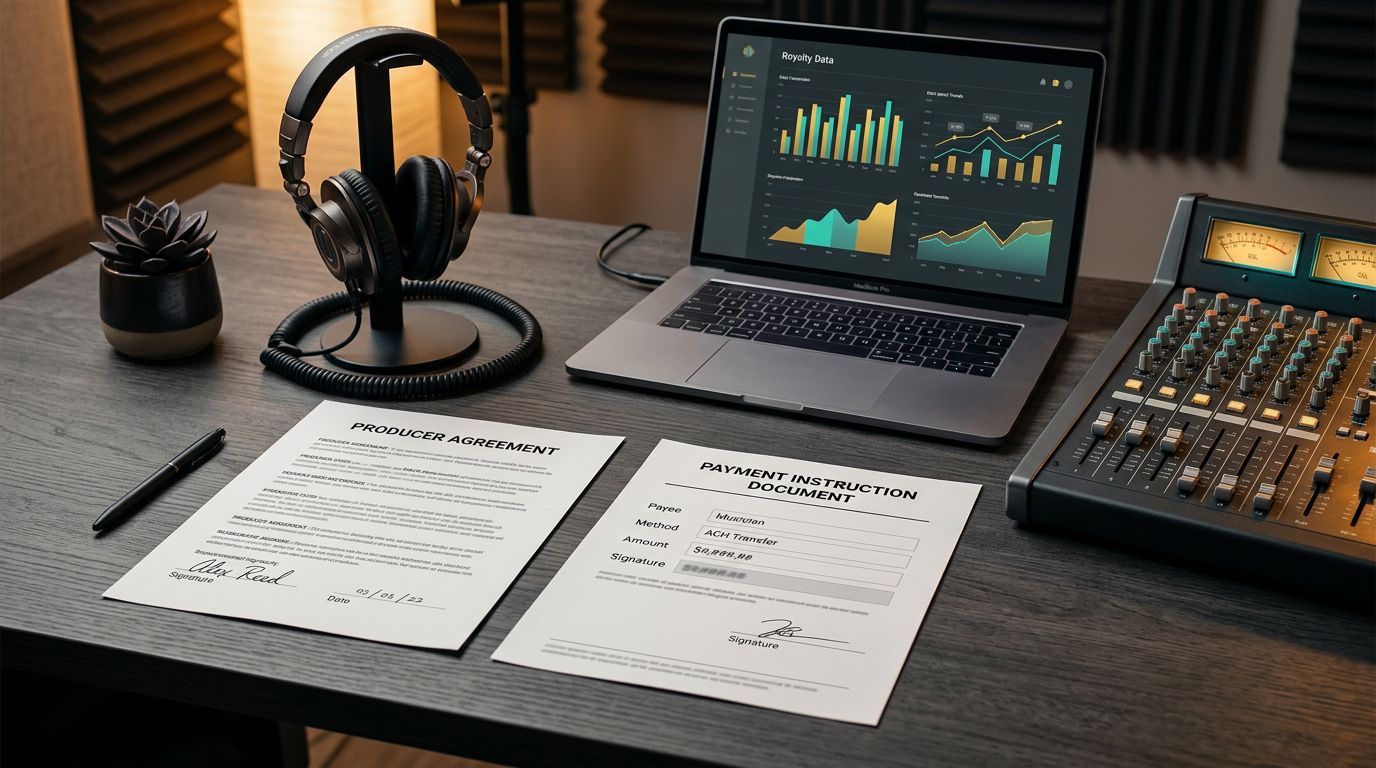
Producer Letters Direction for Clear Royalty Payments
Music revenue problems often begin after a great session, when an agreed producer share has no payment route. The shorthand “producer letters direction” often refers to a producer letter of direction, a signed instruction telling a label or royalty administrator where to send a defined share.
The letter does not replace the producer agreement. Instead, it puts that agreement into a payer’s accounting system, so the producer is not waiting for an artist to receive and forward every payment. The document must match the deal before royalties appear on a statement.
Table of Contents
ToggleProducer Letters Direction: What the Document Does
A producer letter of direction, often called an LOD, tells a record label, distributor, or royalty administrator to pay part of a designated royalty stream directly to a producer. It identifies the payee, the relevant recordings, the percentage or points due, and the payment source.
That direct-payment instruction can reduce a common source of friction. Without it, a label may pay the artist’s account in full, leaving the producer to chase a separate payment from the artist. A properly drafted LOD gives the payer written authority to divide the money at the source.
Still, the LOD is an administrative document, not the foundation of the producer’s rights. The producer agreement creates the payment obligation. If the agreement never grants royalty points, defines them poorly, or allows recoupment that consumes the producer’s share, a letter of direction cannot repair those terms.
Music-industry guidance on producer agreements and payment terms commonly treats the LOD as part of a larger package that includes credit, points, accounting, advances, and ownership language. Those documents should tell the same story.
A payer can follow a letter of direction perfectly and still pay the wrong amount if the underlying producer agreement is vague.
Producer letters direction paperwork also does not transfer master ownership unless the contract says it does. It generally authorizes a payment route. The producer should not assume that direct payment creates a copyright interest, publishing share, or approval right over later uses of the recording.
Separate Label Royalties From SoundExchange Payments
An LOD can apply to more than one income stream, but each stream has different rules. The most frequent mistake is treating all royalty money as if it comes from one place.
| Payment source | What the letter can direct | What it does not decide |
|---|---|---|
| Record label or distributor | A producer’s contractual royalty share from the applicable artist or label account | The meaning of “net,” recoupment, reserves, or the royalty base |
| SoundExchange | Part of a featured artist’s statutory digital performance royalty allocation | Publishing income, mechanical royalties, or the sound recording owner’s share |
| Artist-owned release account | A portion of revenue paid by the distributor to the artist’s business entity | Whether the producer has ownership or publishing rights |
For a label release, the artist or rights holder may direct the label to pay the producer’s points from the artist royalty account. In an independent release, the artist’s company may send a comparable instruction to a distributor or accounting platform. The label’s written confirmation matters because some systems cannot split payments without a formal vendor setup.
SoundExchange LODs are narrower. Under the U.S. Copyright Act’s statutory sound-recording performance royalty system, SoundExchange collects certain noninteractive digital performance royalties. The Music Modernization Act included the Allocation for Music Producers Act, which supports direct payments to producers, mixers, and engineers when the featured artist submits the required direction.
That SoundExchange process concerns the featured artist’s allocation. It does not move publishing royalties, mechanical royalties administered through The MLC, or ordinary interactive-streaming income from services such as Spotify and Apple Music. A SoundExchange LOD also does not give the producer access to the label’s separate sound-recording owner share.
For a useful comparison of label-facing practice, see this discussion of producer agreements and letters of direction. The payer, payment source, and applicable contract all shape the correct form.
Terms That Belong in a Producer Letter of Direction
A short letter can carry substantial financial consequences. It should be specific enough for a label business-affairs team or distributor’s royalty department to implement without guessing.
At minimum, the document should address the following points:
- Name the producer’s legal payee entity, mailing address, tax ID information, and payment details required by the payer.
- Identify each recording by artist name, track title, version, album project, ISRC where available, and release date or anticipated release.
- State the exact share due. If the agreement uses points, the letter should say what royalty base the points apply to.
- Identify the payment source. The wording should make clear whether the payment comes from the artist’s royalties, gross receipts, net receipts, a label account, or a defined SoundExchange allocation.
- Explain recoupment. A producer advance may recoup only from the producer’s royalty share, or the deal may treat it differently. The LOD should not create a conflict.
- Cover remixes, deluxe editions, re-recordings, audiovisual versions, and future exploitations only when the producer agreement includes them.
- State the effective date and whether the direction reaches royalties accrued before the letter was processed.
- Set out when the instruction may be changed or revoked. A producer should not discover that an artist cancelled payment instructions without notice.
- Require royalty statements that show the producer’s calculation and preserve audit rights from the producer agreement.
- Include signatures from the party with authority to direct payment, along with the producer’s acknowledgement when the payer requests it.
The word “royalties” alone is not enough. It can mean a share of artist royalties after deductions, a percentage of label receipts, or a statutory payment outside the recording agreement. Each formula can produce a different result.
For example, a producer paid from the artist’s account may bear deductions that an at-source producer payment would avoid. Conversely, an at-source deal may still include a cap, reserve, or recoupment provision. The direction should repeat the contract’s formula without adding new language that changes the bargain.
Get the Letter Executed Before Release
Timing matters because royalty departments need time to load a payee and payment instruction into their system. The strongest practice is to make delivery of the LOD a producer-agreement obligation and obtain the signed document before commercial release.
The producer, artist manager, and label operations contact should compare the final LOD against the executed producer agreement. Track titles, artist entities, point calculations, and royalty bases often change during a project. A mismatch can cause the payer to reject the letter or hold funds until the parties resolve the discrepancy.
After submission, request written confirmation that the payer accepted the instruction. Keep the signed letter, delivery email, confirmation, producer agreement, and royalty statements in one project file. If the payment is missing later, that record makes the issue easier to identify.
Some distributors permit direct royalty splits through account settings rather than a traditional letter. Those tools can be useful, but the contract still controls the producer’s entitlement. A direct-payment LOD discussion also highlights why a written instruction remains important when a third party controls the payment system.
When a project involves a label deal, producer points, multiple producers, or uncertain recoupment language, Chase Lawyers can review the full chain of documents. Its producer contracting and royalty safeguards work includes producer agreements, royalty accounting, and payment disputes for music-industry clients in Miami, New York, and beyond.
U.S. Contract Law Still Controls the Royalty Formula
Producer letters direction documents work within contract law. They do not erase a label’s contractual defenses, create rights that the artist never had, or override a recording agreement that restricts payment assignments.
The result in FBT Productions, LLC v. Aftermath Records shows why wording matters. In that Ninth Circuit case, the producer agreement treated licenses differently from records sold. The court upheld the interpretation that iTunes downloads fell within the agreement’s licensing provision, which carried a 50 percent net-receipts rate. The ruling did not establish a universal producer rate. It enforced the language the parties chose.
That same lesson applies to letters of direction. A producer who is promised “three points” needs to know whether those points are calculated on the artist’s royalty, a defined all-in rate, or a share of receipts. An LOD should never mask that unanswered question.
Disputes also arise when an artist changes managers, a label sells a catalog, or a release gains traction years later. Clear notice provisions, an audit clause, and a record of payer acceptance give both sides a practical path to resolve the issue before unpaid royalties become litigation.
A Payment Instruction Worth Keeping
A producer letter of direction is small compared with a recording agreement, yet it can determine whether earned royalties arrive on time. It should identify the right recordings, the right payer, the right formula, and the right payee.
The safest approach connects a signed LOD to a precise producer agreement and verifies that the payer implemented both. Clear payment instructions protect the working relationship as much as the royalty stream.



- 21 SE 1st Ave, Suite 700, Miami, FL 33131
- 305-373-7665
- 305-373-7668
- info@chaselawyers.com
- 1345 Avenue of the Americas, 2nd Floor, New York, NY 10105
- 212-601-2762
- info@chaselawyers.com
Get a response within 24 hours. We’ll clearly explain how we can support and protect your brand while staying within your budget.