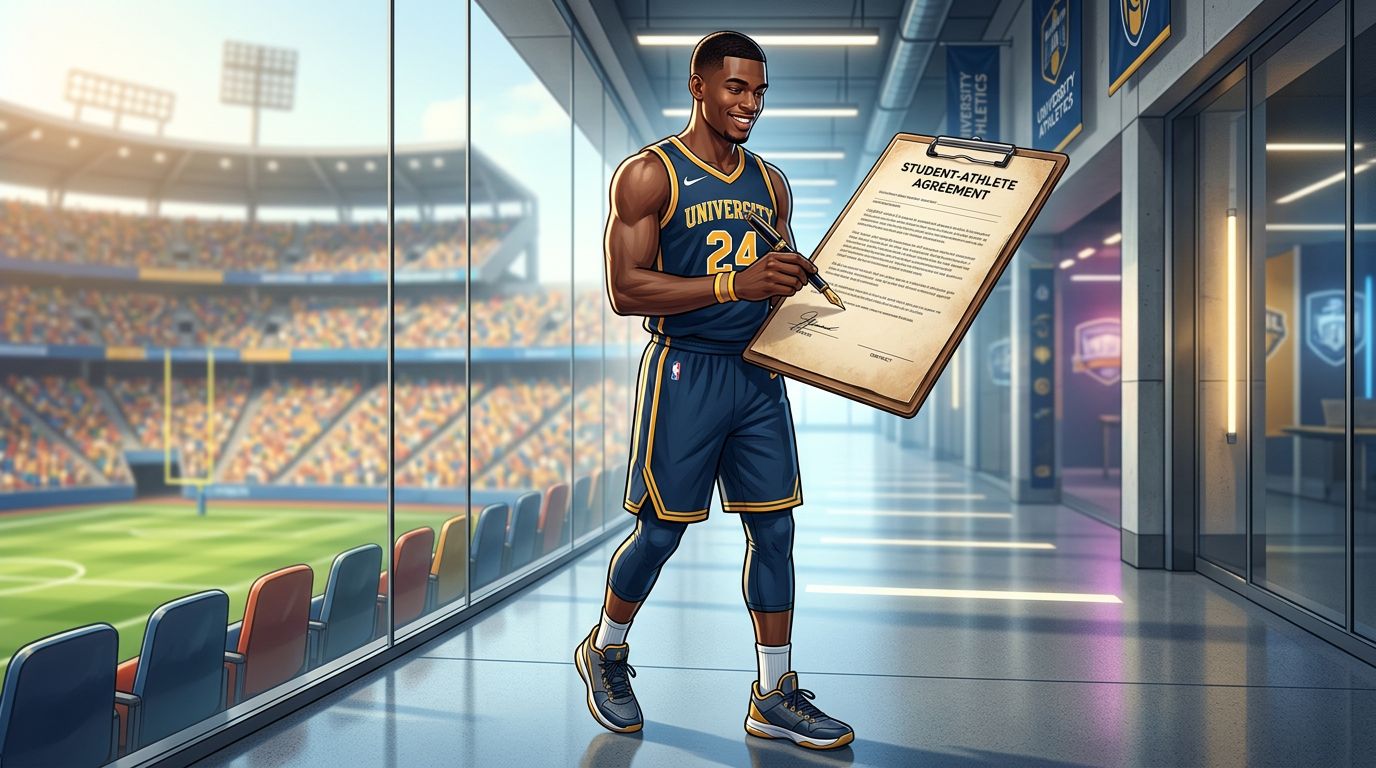
The fastest way to lose NIL value is to sign a contract that treats your identity like a school asset. A NIL collective agreement may look routine, but the wrong clause can tie up your future earnings, limit a transfer, or hand your content to third parties.
That risk is higher in 2026 because college sports still run on a patchwork of school forms, conference rules, state law, and new reporting requirements. Before you sign, you need the same mindset you would bring to a business deal, because that is what this is.
The best place to start is the contract language that controls your rights after the first payment hits.
Key Takeaways
- No formal college sports CBA exists as of July 2026, so athletes still need to negotiate school, conference, and collective forms one clause at a time.
- The biggest danger is often not the pay amount, it is the rights grant, especially exclusivity, sublicensing, and transfer restrictions.
- Payment terms need hard numbers, fixed dates, limited clawbacks, and no open-ended power to cut compensation later.
- Compliance rules matter because Division I athletes must report many third-party NIL deals quickly, and mistakes can create eligibility and contract problems.
- Chase Lawyers can help athletes and families review NIL language, protect publicity rights, and negotiate terms that fit both current rules and long-term career goals.
There is no true college sports CBA yet
As of July 2026, student-athletes do not have a formal, legally recognized collective bargaining agreement across college sports. Athletes are not classified as employees, and no clear bargaining counterpart has agreed to bargain on a nationwide basis. That matters because many schools still present NIL-related forms as if they are standard and non-negotiable, when in reality they are still contracts open to challenge and revision.
At the same time, the pressure to standardize keeps growing. Athletes.org released a draft college sports CBA framework, which shows where the conversation is headed. A separate discussion on how collective bargaining could work in college sports makes the same point in simpler terms: schools and athletes are already acting like business partners, even if labor law has not caught up.
The legal backdrop also changed fast. In NCAA v. Alston, the Supreme Court rejected part of the NCAA’s old compensation limits. Then the 2024 House v. NCAA settlement reshaped the market again, with roughly $2.8 billion in back damages and a forward revenue-sharing model capped at about $20.5 million per school each year. Yet those changes did not create a fair template for every athlete. They only raised the stakes.
Meanwhile, Congress still has not passed a single national NIL statute. Proposed federal plans such as the SCORE Act and the Protect College Sports Act point in different directions, and neither has solved the employee-status question. Because of that, any NIL collective agreement still sits on top of state law, conference policy, NCAA rules, and now College Sports Commission oversight.
That legal mix means one thing for athletes and parents: treat every agreement as negotiable, even when a school says “everyone signs this.”
Start with the rights clause, not the money
Most athletes look at the compensation figure first. The smarter move is to start with the rights grant, because a cheap rights transfer can outlast a generous first check.
Narrow the license to your real NIL use
Your agreement should say exactly what the school, collective, or sponsor can use, where they can use it, and for how long. If the document says the school can use your name, image, likeness, voice, signature, biographical information, social content, and future content in any media now known or later developed, the grant is far too broad.
Ask for a limited license tied to listed campaigns, specific platforms, and a defined term. If the deal is about one season of team marketing, the license should end when that season ends, or shortly after. If the agreement covers only group licensing, it should not quietly include solo endorsement rights.

Many families miss the content piece. A school photo day, team media session, or sponsor shoot can produce valuable assets. Your contract should state who owns the raw footage, finished edits, and outtakes, and whether you can reuse them on your own channels. If that language is missing, assume the other side wrote the silence for its benefit.
For athletes who want help with protecting personality rights and NIL, Chase Lawyers can review those license terms before they become long-term problems.
Watch for exclusivity and sublicensing
Exclusivity is where many NIL collective agreements become restrictive. Some forms block athletes from signing similar deals with other schools, brands, or collectives, even when the current deal pays modestly. Others let the school re-license your NIL to almost any third party.
That is a red flag. A sublicensing clause should name the categories of approved users, limit the purpose of the sublicense, and require payment if your NIL moves into a new revenue stream. Otherwise, your rights can travel far beyond the original deal while your compensation stays flat.
Families should also be alert to transfer-related language. Reports on major conference templates have described agreements that make an athlete’s NIL rights effectively less portable after a transfer. A practical guide to NIL agreements and collectives warns about the same trap: long-term rights grants can keep paying someone else after the athlete moves on.
A fair agreement does not need ownership of your future.
Money terms need math, dates, and limits
Once the rights clause is tight, turn to compensation. Vague promises create the worst disputes because both sides think they agreed to something different.
Start with the base payment. The contract should state the amount, the payment dates, the method of payment, and whether compensation depends on deliverables, team status, or revenue generated. If the school or collective wants to pay from a pool, ask how that pool is funded, who controls the calculation, and whether you have any right to review the math.
The problem gets worse when the other side keeps unilateral adjustment power. If the agreement says compensation may be revised at any time to reflect institutional priorities, donor support, or market conditions, you are being asked to accept uncertainty while giving up concrete rights. That is not a balanced exchange.
This quick table shows the terms worth pinning down before signing.
| Clause | Better ask |
|---|---|
| Base compensation | Fixed dollar amount and exact payment dates |
| Bonus triggers | Measurable benchmarks, not coach or school discretion |
| Pay reductions | Only for listed events, with notice and a chance to cure |
| Expenses | Written rule on who pays for travel, production, and agent costs |
| Revenue share | A formula, accounting access, and timing for reconciliations |
The takeaway is simple: if money depends on future events, the agreement needs a formula, not a promise.
Taxes, bonuses, and clawbacks deserve their own review
NIL income is taxable, so the contract should say whether the payer will withhold anything or whether you must handle the full tax burden. Many athletes spend the first check and forget the tax bill until later. A short tax clause can prevent an ugly surprise.
Next, look at bonuses. If appearance fees, social post bonuses, or championship incentives exist, the agreement should spell out the trigger, the deadline for payment, and what proof counts as completion. If the school can decide whether a deliverable was “satisfactory” with no standard, payment becomes optional.
Clawbacks need the same attention. A narrow clawback for fraud or a clear rules violation may be reasonable. A broad clawback tied to injury, reduced playing time, transfer rumors, or brand discomfort is not. Also push back on language that lets the school offset future amounts against disputed past amounts without a final decision.
If the deal is large or likely to expand, Chase Lawyers can help structure the contract the way a serious athlete business should be structured, with rights, money, and risk lined up instead of scattered across side emails and verbal promises.
Protect transfer options and eligibility
A short-term deal should not become a chain around your next decision. Yet many NIL collective agreements create that result because they ignore transfers, roster changes, and reporting duties until something goes wrong.
Limit the term and preserve transfer freedom
Start with the term. If the agreement runs longer than one academic year, ask why. Multi-year deals make sense only when compensation, rights, and exit rights all scale fairly over time. Otherwise, a one-year term with an athlete option to renew is safer.
Then review what happens if you enter the transfer portal, change schools, redshirt, or lose roster status. The contract should state whether the deal ends automatically, pauses, or converts to a limited rights license for past content only. It should also say what happens to unused deliverables and unpaid amounts. Without that language, the other side may argue that your obligations continue even when your role does not.
The same principle applies to renewal. Avoid automatic renewals unless you control the decision. A school should not be able to roll over your rights into another year because it sent a notice during finals week.
Match the contract to current reporting rules
Compliance language has become more important since the College Sports Commission took a larger role. Under current Division I rules, many third-party NIL deals worth $600 or more must be reported through NIL Go within five business days. The College Sports Commission’s NIL guidance also describes current review standards, including the business-purpose review and smaller-deal exemptions.
Your agreement should place reporting duties where they belong. If the school or collective requires you to submit deal details, it should also promise timely support, clear forms, and prompt notice of any issue. You should not be left guessing while the compliance clock runs.
Also ask for a clause stating that if a rule changes after signing, both sides will work in good faith to amend the agreement rather than treating the athlete as instantly in breach. That matters because the rulebook is still moving, and schools often react by shifting risk downward.
Eligibility trouble rarely starts with fraud. More often, it starts with loose drafting and rushed compliance.
Fix the one-sided legal terms before they trap you
The legal boilerplate at the end of the agreement is where many athletes lose leverage. Schools know most people skim those pages. You should read them twice.
Demand balanced termination and dispute terms
A fair contract gives both sides clear exit rights. If the school can terminate for a long list of reasons but you cannot exit for non-payment, misuse of your NIL, or a material change in the deal, the contract is tilted from day one.
If the school can cut pay, end the deal, and decide disputes in its own committee, the agreement is tilted before the first dollar is paid.
Dispute resolution is just as important. Some college sports forms have been criticized because they send disputes to internal school committees instead of a neutral arbitrator or court. That setup raises due process concerns because the institution controls the forum, the rules, and often the facts. Ask for neutral arbitration, a fair venue, and attorney’s fees for the prevailing party in a material contract dispute.
Pay attention to governing law too. Because state NIL laws vary, a venue clause can change the practical value of your rights. Parents often focus on the payment line and miss the forum line. The forum line may matter more once the relationship sours.
Push back on no-employment waivers and empty promises
Many recent school and conference documents include strong “no employment” language. That issue matters because federal law still has not settled whether college athletes are employees, and some institutions want athletes to waive future arguments before the law catches up.
A no-employment clause may be acceptable as a statement of current status. It becomes dangerous when it also waives claims, disclaims any duty to the athlete, or tries to block future challenges against the school, conference, or NCAA. Read that language carefully.
Courts also look at whether a contract is too one-sided to be enforced cleanly. If one side can change compensation whenever it wants, keep broad termination rights, and avoid meaningful obligations, you may be looking at an adhesion contract or an illusory promise problem. Those are legal terms, but the practical point is simple: one side should not get all the options.
Schools have already sued athletes over alleged NIL breaches, and many disputes settle before trial. That is one reason early legal review matters. Chase Lawyers, a boutique firm with sports, media, and intellectual property work in Miami and New York, helps athletes and families sort through these issues before signature, not after a breach notice arrives.
Build protections for your brand, health, and future earnings
A good NIL collective agreement does more than pay you now. It protects the commercial life of your identity after college.
Keep control over content, approvals, and brand fit
Your NIL is not only your face on a poster. It includes your social reach, your voice, your image library, and the reputation attached to your name. Therefore, the agreement should say when approval is required for posts, ads, captions, and brand pairings.
Approval rights matter most when the contract tries to bundle team content with outside sponsor use. If a collective or school can post branded content in your name without prior review, you risk endorsing products you would never choose. That can hurt future deals more than a small payment helps.
You should also reserve the right to remove or challenge content that is false, misleading, or harmful to your reputation. That is basic brand protection. So is a clause barring edits that distort your words or create fake endorsements.
As athletes become public personalities, the line between sports law and media law gets thin. That is where legal representation for professional athletes can matter even before a player turns pro.
Cover injury, insurance, morality language, and privacy
Injury clauses need precision. If the athlete cannot perform because of injury, does the deal pause, end, or shift to a reduced content role? A fair contract answers that question in advance instead of using injury as a catch-all reason to stop paying.
Morality clauses deserve the same focus. Schools and sponsors may want a right to distance themselves from serious misconduct, which is understandable. But the clause should be tied to defined behavior, not vague reputational concerns or online controversy. Otherwise, a social media flare-up can become a financial excuse.
Finally, check privacy, data use, and indemnity. If you must share analytics, tax information, or personal details, the agreement should limit who can access them and why. If the contract asks you to indemnify the school or collective for broad third-party claims, narrow that duty to losses caused by your own breach, fraud, or unlawful conduct.
Chase Lawyers built its practice around protecting talent, intellectual property, and the business value behind public identities. For student-athletes, that mix matters because NIL deals are not only sports contracts. They are branding, licensing, content, and rights-management deals at the same time.
Conclusion
The headline number in a NIL deal can distract you from the terms that matter most. Your real leverage sits in the clauses that control rights, payment, transfer freedom, dispute resolution, and brand protection.
As long as college sports lacks a true bargaining framework, every athlete has to negotiate these agreements with care. A fair contract should pay you clearly, respect your identity, and leave room for your future, and Chase Lawyers can help make sure it does.