


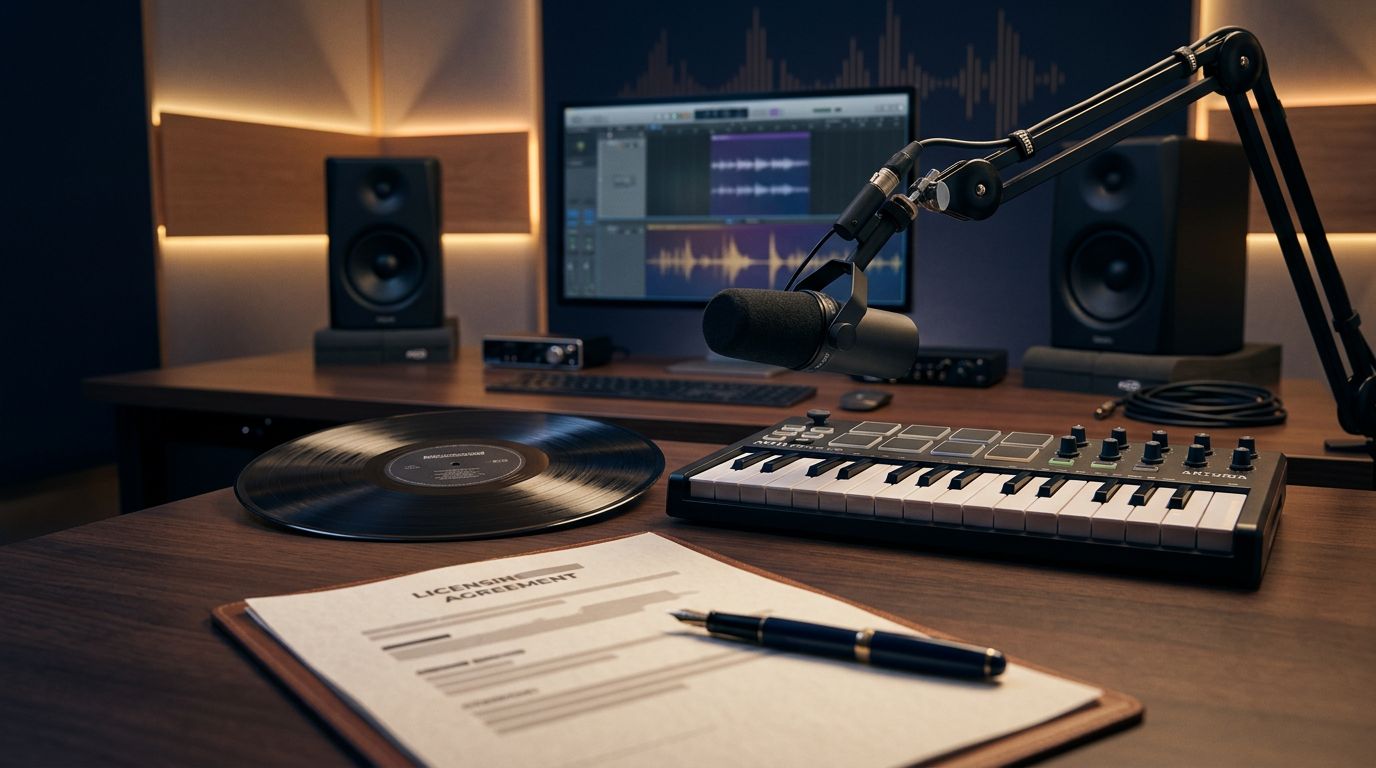
Interpolation License Requirements Before Your Song Drops
A recognizable lyric, melody, or musical phrase can make a new release feel familiar in seconds. It can also create a copyright problem before the song reaches streaming services. Interpolation license requirements matter whenever you re-perform protected parts of an earlier song rather than using the original audio.
Independent musicians often treat an interpolation as a safer substitute for sampling. When you rely on a fresh re-recording instead of direct audio, it can reduce the number of rights you must clear, but it doesn’t eliminate the need for permission. The right release plan starts with identifying exactly what your new track borrowed.
Table of Contents
ToggleKey Takeaways
- An interpolation usually re-records part of an existing music composition, such as a lyric or melody, without using its original master recording.
- You generally need legal permission from the composition owner or publisher before releasing a protected interpolation.
- A mechanical license for a straightforward cover doesn’t automatically authorize new lyrics, a changed melody, or another derivative adaptation.
- Sampling actual audio normally requires both composition clearance and a master use license, while a true interpolation generally does not require the master owner’s permission.
- Written approval should address songwriting splits, credit, royalties, territory, media, and promotional use before distribution begins.
Sampling and Interpolation Are Different Rights Problems
A sample uses actual audio from an existing sound recording. That could be a drum break, vocal phrase, guitar riff, or even a tiny fragment lifted from the original master. Because a sample uses both the recorded performance and the song itself, it commonly involves two separate copyrights: the sound recording and the musical composition.
An interpolation takes a different path in modern music production. You create new audio while incorporating part of a prior song’s composition. A singer may re-perform a famous lyric. A producer may replay a distinctive melody with new instruments. The new master belongs to whoever owns the original recording, subject to any artist, producer, or label agreements. Yet the underlying borrowed composition may still belong to the earlier songwriters and publishers.
The U.S. Copyright Office explains that independently recorded sound-alike material does not copy the sound recording itself, even if the new performance resembles the old one. However, the replayed melody, lyric, or other protectable musical element may still infringe the composition without authorization.
| Use in the new song | Rights commonly implicated | Typical permission needed |
|---|---|---|
| Replay a protected melody | Musical composition | Publisher or composition owner approval |
| Re-sing an earlier lyric | Musical composition | Publisher or composition owner approval |
| Use actual audio from an old record | Composition and sound recording | Publisher clearance and master-use license |
| Record a faithful cover | Musical composition | Mechanical license, if statutory conditions apply |
| Rewrite lyrics or change a melody | Musical composition, derivative-work rights | Direct permission from the rights holder |
The practical distinction is simple, but it must be accurate. Calling a sample an interpolation won’t change what the audio contains. If even one piece of the original master appears in the final recording, treat it as a sample until the rights review proves otherwise.
Re-recording the music may remove the need for a master-use license, but it does not grant permission to borrow the earlier song’s protected composition.
That distinction also affects budgets. Traditional sample clearance often involves two negotiations. An interpolation often starts with one side, the composition owners, although several publishers may control different shares.
Interpolation License Requirements Under U.S. Copyright Law
Under copyright law, the owners of musical compositions hold exclusive rights to reproduce, distribute, publicly perform, and prepare derivative works based on their songs. A new record that adapts an earlier melody or lyric can implicate several of those rights at once.
For that reason, interpolation license requirements usually begin with one question: Does the new song use a protectable element of an earlier composition? Copyright doesn’t protect general mood, genre, chord progressions that are commonplace, or an unoriginal musical idea. It can protect original lyrics, melody, and particular expressive combinations of music and words.
There is no safe percentage rule. Using four notes isn’t automatically permitted, and using eight notes isn’t automatically infringement. Courts examine what was copied, whether the material is original, and whether an ordinary listener could find substantial similarity in protectable expression. Context matters. A brief but highly recognizable vocal line may carry more risk than a longer, generic chord pattern.
If your chorus intentionally quotes another song, don’t rely on a claim that the portion is too short to matter. Intentional use can be plain from studio files, marketing copy, social posts, or songwriter notes. In addition, a distributor may reject the release if its metadata, lyrics, or audio review raises a clearance question.
Permission should come from every owner with authority over the relevant composition share. A song may have several writers, a publisher, and various administrators. One publisher’s approval does not authorize a 100 percent use unless that entity controls the full work or has authority to grant the permission for all owners.
A license should be signed before you deliver the master to a distributor, announce the release date, or send the record to radio programmers. A verbal “go ahead” from a writer, producer, or copyright holder isn’t a dependable release authorization. The person you spoke with may not own the publishing rights.
Find the Composition Owners Before You Ask for Terms
Start by documenting the exact borrowed material. Save the reference track, timestamp, lyric excerpt, lead sheet, and a clean copy of your new recording. Identify whether you used lyrics, melody, a melodic hook, a distinctive arrangement, or a combination of them. This record gives your lawyer and the publisher a clear basis for the request.
Next, research the song’s ownership. Public performance organization repertories, publisher websites, songwriter credits, and music databases can help locate publishers and administrators. ASCAP, BMI, SESAC, and GMR data can point toward ownership, although their listings do not replace a legal chain-of-title review.
Ownership changes over time. Original songwriters may assign catalog rights, publishers may merge, and administrators may handle licensing without owning the work. For older songs, estate representatives or successor entities may control the relevant interest. A fast internet search can send a request to the wrong party and delay a planned release.
Include enough information to allow an informed response:
- The proposed song title, artists, primary songwriters, label, and expected release date.
- A private streaming link or audio file, plus lyrics and timestamps for the interpolation.
- The territories, platforms, formats, and planned promotional uses.
- Your proposed credit, ownership split, split sheets, upfront fee, royalty treatment, and whether you seek exclusivity.
A complete request makes negotiation easier because the publisher can assess both business value and creative context. It also prevents misunderstandings about whether you are requesting a narrow audio release or broader rights for video, social media, and advertising.
For help tracing rights and shaping the request, Chase Lawyers provides music rights and licensing counsel for artists, producers, publishers, and labels. Early review costs less than revising a finished release campaign.
Why a Mechanical License May Not Cover an Interpolation
Many artists know that they can obtain a mechanical license for a cover song after the copyright owner has authorized the song’s first U.S. distribution. Section 115 of the Copyright Act creates a compulsory license for making and distributing phonorecords of certain nondramatic musical works.
That rule has limits. A compulsory mechanical license allows a new recording of the existing song. It does not give an artist open-ended authority to rewrite lyrics, alter the basic melody, or change the underlying music composition. The statute permits only the musical arrangement needed to adapt the work to the performer’s style or manner of interpretation.
An interpolation often uses only a section of the earlier song inside a new work. It may add new lyrics, place an old hook in a different musical setting, or combine it with a new chorus. Those choices can create a derivative-work issue that requires direct approval from the publisher rather than standard mechanical rights.
The Mechanical Licensing Collective administers blanket mechanical licenses for eligible digital audio uses in the United States. Still, its system doesn’t grant permission to make a derivative adaptation. A distributor’s cover-song licensing option also doesn’t settle an interpolation question merely because it can secure mechanical clearance or pass through royalties.
A mechanical license can support a faithful cover, but a rewritten hook or altered lyric needs the publisher’s express written consent.
Do not assume a song’s presence on Spotify, Apple Music, YouTube, or TikTok makes it available for interpolation. Public availability is not an invitation to create a new derivative version.
Negotiate the License and Songwriting Split
Publishers handle interpolation requests in different ways. Some ask for a one-time fee. Others require a percentage of the new composition, a share of publisher income, approval of lyrics, or a combination of these terms. A recognizable interpolation that drives the new song’s hook can lead to a substantial ownership request, and a record label will often want these terms locked before funding a promotional push.
The parties should match the split to the actual creative and commercial use. If the earlier composition supplies the central chorus or lyrical identity, the original writers may seek a large share. A brief melodic reference could support a smaller share or a fee-based deal. There is no statutory chart that fixes the result.
Do not treat a percentage as a casual credit decision. A songwriting share affects mechanical income, public-performance royalties, synchronization revenue, print rights, foreign income, and future catalog value. It also impacts how ongoing royalties are divided among all creators involved in the project.
A strong clearance agreement addresses the issues that tend to cause disputes:
- The agreement identifies the original work, the new work, and the exact elements authorized for use.
- It states the approved lyric, melody, arrangement, and title, including whether the publisher can review final lyrics or the finished master.
- It sets writer and publisher credits, ownership percentages, royalty accounting, and registration obligations.
- It covers the permitted media, territory, duration, platforms, audiovisual uses, promotional clips, and any brand or advertising uses.
- It states whether future remixes, alternate versions, translations, live albums, and film or television placements need separate approval.
If a release includes a music video, film placement, or advertising campaign, audio clearance may not be enough. A composition owner can limit permission to the audio record or require a separate sync license for audiovisual uses. Review sync license terms for music before assuming a release license covers visual content.
Build Clearance Into the Release Schedule
Clearance is a release task, not paperwork for the night before distribution. A publisher may take weeks to review an interpolation request. Multiple publishers can take longer, especially when writers have different representatives or international shares. Navigating the modern music industry requires careful planning well in advance of your drop date.
Begin with a written clearance memo. List each borrowed element, every suspected rights holder, the contact status, and the proposed terms. Keep emails, drafts, approvals, payment records, and the final signed clearance agreement in one deal file. If the label, distributor, manager, producer, and artist all work from different assumptions, mistakes become likely.
Once the license is complete, register the new work accurately. The songwriter and publishing splits in the agreement should match registrations with performance rights organizations, the Mechanical Licensing Collective when applicable, SoundExchange for the new master, and distributor metadata. A mismatch can delay royalties or create a conflict long after the release date.
Pay attention to marketing. A teaser that uses an uncleared lyric or openly promotes a famous sample clearance can create exposure before the official record arrives. The same concern applies to stems sent to remixers, influencer campaigns, lyric videos, and pre-save clips. License scope should cover the planned uses, not only the full-length audio file.
For U.S. and international campaigns, check whether the agreement grants worldwide rights. A publisher may approve the United States but reserve other territories. A global distributor can deliver music broadly, so territory limits must be reflected in the delivery plan.
Court Decisions Show Why Clearance Cannot Wait
Music copyright disputes can turn on technical facts, but they can also become expensive public conflicts. In Grand Upright Music, Ltd. v. Warner Bros. Records Inc., a federal court confronted an unauthorized sample and issued a sharply worded decision that helped establish a strict business norm around sample clearance.
The Sixth Circuit’s decision in Bridgeport Music, Inc. v. Dimension Films took a strict position on sound-recording sampling, often summarized as “get a license or do not sample.” That decision concerns actual master recordings, not independently created interpolations. Still, it shows why the sample-versus-interpolation distinction must be documented rather than assumed under modern copyright law.
Composition claims can present a different analysis. The Williams v. Gaye dispute over “Blurred Lines” brought attention to how melody, musical features, and similarity arguments can create serious exposure even when an artist did not copy the original recording. A useful academic discussion of the unsettled boundaries appears in Interpolation, Litigation, and Copyright Confusion.
Delay does not always end the risk. Copyright claims generally have a three-year limitations period, but timing issues can depend on when the owner discovered or reasonably should have discovered the alleged infringement. The discussion in Lost in Interpolation shows why artists should not mistake an uneventful release for permanent clearance.
A dispute may lead to an injunction request, damages claims, retroactive credit demands, accounting costs, and a disrupted distribution plan. The commercial effect can be immediate when a distributor, label partner, or brand pauses a campaign while the parties argue over ownership.
Frequently Asked Questions
What is the difference between sampling and interpolation?
Sampling involves using the actual recorded audio from an existing master, which implicates both the sound recording and the composition copyrights. Interpolation means re-recording a musical element like a melody or lyric with new audio, which typically only requires permission from the composition owners.
Can I use a standard mechanical license for an interpolation?
A standard mechanical license generally covers a straightforward, faithful cover song and does not automatically authorize you to rewrite lyrics, alter the melody, or create derivative adaptations. Interpolating a protected hook or changing elements usually requires direct, express written permission from the publisher.
What happens if I release an uncleared interpolation?
Releasing an uncleared interpolation can expose you to copyright infringement claims, demands for retroactive songwriting splits, financial damages, and potential injunctions. Additionally, distributors or platforms may block or take down your release if clearance questions arise.
Work With Chase Lawyers Before the Release Is Locked
Chase Lawyers helps creative clients protect their work while moving releases forward. Its music practice supports artists, producers, managers, a record label, and publishers with rights reviews, permission requests, interpolation agreements, producer deals, catalog matters, and royalty terms.
The firm’s Miami and New York teams can assess whether a proposed use is a sample, an interpolation, a cover, or an original composition that needs no clearance. They can also identify rights holders, negotiate a license that fits the music production plan, and align credits and splits with the signed agreement.
A clear agreement protects more than one release. It creates a reliable record for distributors, collaborators, future buyers, and potential sync partners.
Final Thoughts
The safest approach to interpolation license requirements is to identify the borrowed composition early, obtain written approval from the correct rights holders, and document the terms before distribution. Navigating these rules successfully protects your work throughout the modern music industry.
An independently recorded replay may avoid a master-use license, but it can still require composition clearance and a negotiated ownership split. Clear the work before the song becomes a release problem instead of a rights dispute.

- 21 SE 1st Ave, Suite 700, Miami, FL 33131
- 305-373-7665
- 305-373-7668
- info@chaselawyers.com
- 1345 Avenue of the Americas, 2nd Floor, New York, NY 10105
- 212-601-2762
- info@chaselawyers.com
Get a response within 24 hours. We’ll clearly explain how we can support and protect your brand while staying within your budget.