


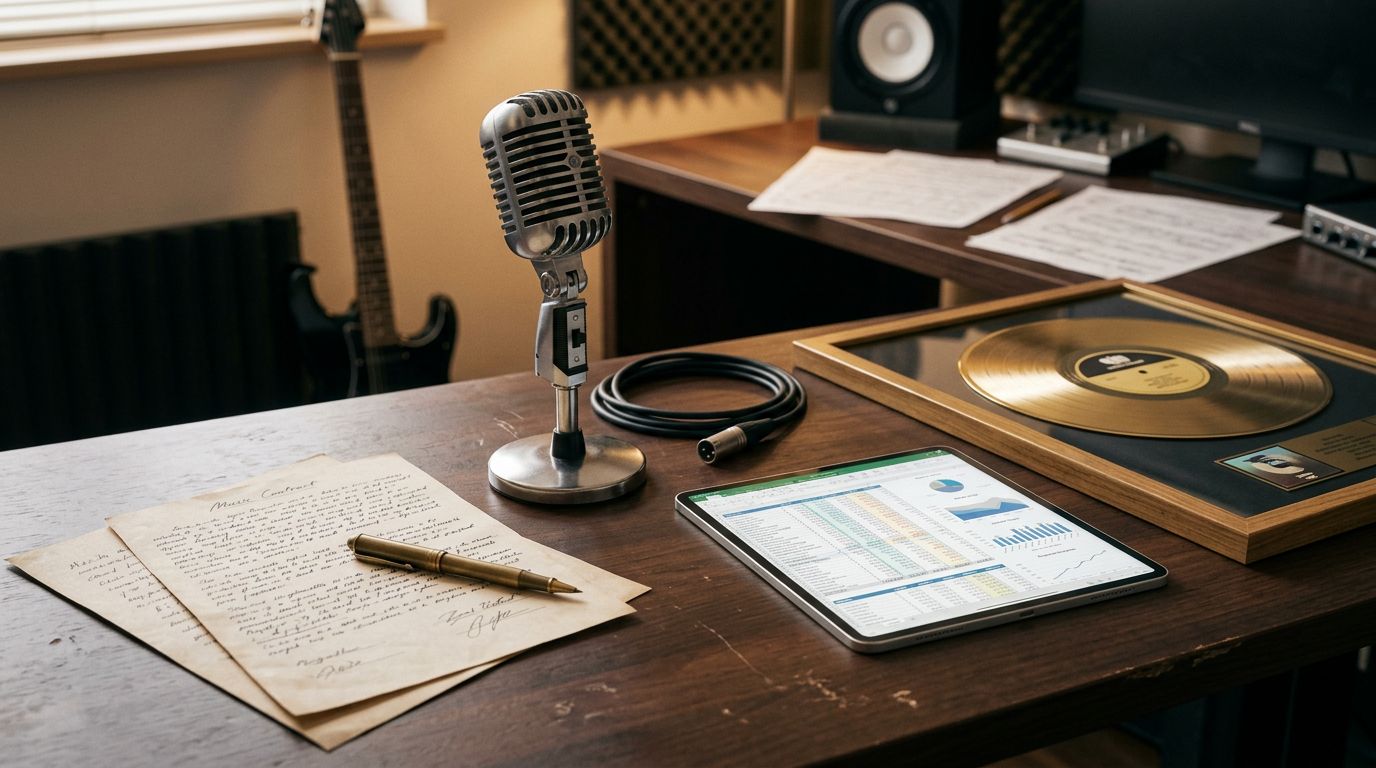
Artist Loan Agreement Terms That Can Cut Royalty Income
A cash advance can keep a recording project moving, but the repayment terms may follow your royalties for years. An artist loan agreement can affect far more than your monthly budget. It can determine which income streams repay the lender, how long recoupment lasts, and whether you see royalty statements you can verify.
The loan’s headline amount matters. However, the definitions, collateral language, and accounting rules usually decide the real cost. Before accepting funds, artists and managers should understand where royalty income goes first and when it can return.
Table of Contents
ToggleKey Takeaways
- A loan may be repaid from master royalties, publishing income, merchandise revenue, touring proceeds, or other income if the contract allows cross-collateralization.
- Recoupment clauses can keep an artist unpaid even when recordings generate meaningful revenue.
- Interest, fees, reserves, and lender expenses can increase the repayment balance beyond the stated advance.
- Security interests may give a lender rights in copyrights, masters, receivables, and contract payments after a default.
- Clear statements, audit rights, and narrowly defined collateral give artists more control over royalty income.
How an Artist Loan Agreement Changes the Royalty Picture
An artist loan is often presented as a simple exchange: the artist receives funds now and repays them later. In music, repayment rarely works like a standard monthly bank loan. Instead, the lender may collect from royalty income before the artist receives a distribution.
That structure matters because artists earn through separate rights and agreements. Master recording royalties, music publishing income, performance royalties, sync fees, neighboring-rights income, brand payments, and live revenue may all sit in different accounts. A broad loan agreement can pull several of those sources into one repayment pool.
For example, a label advance is often recoupable from the artist’s share of master-recording income. A third-party lender may demand more. It may ask for a percentage of all entertainment income, a share of royalty receivables, or a security interest in copyrights and contracts.
The key question isn’t only, “How much am I borrowing?” It is also, “Which money pays it back, in what order, and for how long?”
A properly drafted agreement should identify each affected revenue source. It should separate income tied to existing masters from income tied to future recordings. It should also state whether publishing income remains outside the lender’s reach.
Artists should be careful with broad terms such as “all income,” “all proceeds,” “all entertainment-related receipts,” or “all rights now known or later developed.” Those phrases can reach further than the deal discussion suggested.
A loan can be affordable on paper yet expensive in practice when repayment attaches to income the artist expected to keep.
Chase Lawyers works with artists, producers, managers, and creative businesses on music agreements where the financial language needs to match the actual business plan. Early review can identify whether a proposed advance is a manageable recoupment arrangement or a long-term claim on multiple royalty streams.
Recoupment Terms Decide When You Get Paid
Recoupment means the company recovers defined costs from an artist’s royalties before paying the artist. It is common in recording agreements, but the details vary widely. A loan should state which expenses count toward recoupment and whether the lender can add costs after funding closes.
Recording costs are often the obvious category. Studio time, producer fees, mixing, mastering, artwork, video production, marketing, and tour support may also become recoupable. The risk increases when the agreement allows the lender or label to characterize nearly any project expense as “recoupable.”
An artist may assume that a $100,000 loan creates a $100,000 repayment obligation. Yet the balance can grow when the deal adds interest, legal fees, collection costs, administrative charges, or reimbursable expenses. Some agreements also permit the lender to recoup money paid to third parties, even if the artist never approved the charge.
The contract should answer several practical questions:
- Does recoupment come only from the funded project, or from the artist’s whole catalog?
- Are marketing and overhead charges recoupable?
- Can the lender recover its legal, accounting, or collection expenses?
- Does interest accrue before the artist receives any royalty payment?
- Does the balance reduce only after the lender receives cleared funds?
Artists also need to look for a recoupment waterfall. This provision sets the payment order. A distributor may deduct platform fees first. A label may then deduct its distribution charge, reserves, and recoupable expenses. Only afterward might the artist’s royalty share apply against the loan balance.
That sequence can make a royalty rate look better than it is. A 20 percent royalty means little if the percentage applies after extensive deductions and the remaining amount first pays down debt.
The agreement should include a full list of approved recoupable costs, a spending cap, and written approval rights for major expenses. Without those limits, the lender controls both the debt balance and the invoices that increase it.
Cross-Collateralization Can Reach Beyond One Release
Cross-collateralization allows one income source to repay obligations connected to another project. Labels use it when they apply earnings from a successful release against losses from an earlier release. A loan agreement can extend the same concept across far more valuable rights.
A lender may seek the right to recoup a recording loan from publishing royalties, sync fees, merchandise income, tour guarantees, or social-media brand deals. This approach is especially risky for an independent artist whose income comes from several businesses rather than a single label account.
Suppose an artist’s master royalties are slow, but a song lands in a television placement. If the contract sweeps all music-related income into repayment, the sync fee may go to the lender. The same problem can arise when a songwriter receives an advance from a publisher or collects performance royalties through a performing rights organization.
Publishing income deserves separate attention. Songwriting rights and master rights are different assets. The copyright in a sound recording is distinct from the copyright in the underlying musical composition. An artist who writes songs may own or control both, but a recording loan should not automatically capture both.
Many artists prefer a structure where repayment is limited to:
- The lender’s defined share of royalties from named masters
- Income generated by the project funded through the loan
- A stated percentage of net receipts after agreed deductions
This approach is often called project-specific or single-collateral recoupment. It doesn’t eliminate risk, but it prevents a weak project from consuming revenue from unrelated work.
The agreement should also address pre-existing catalog income. A lender funding a new EP should have no automatic claim to royalties from a prior album, older publishing catalog, or separate producer work. Those assets may already be subject to distribution agreements, publishing deals, or royalty assignments.
If cross-collateralization is unavoidable, narrow it. Limit it to specific recordings, set a maximum repayment amount, exclude publishing and live income, and require the lender to release its claim once the balance reaches zero.
Interest, Fees, and Reserves Can Inflate the Balance
The stated interest rate is only one part of the cost. Artist loans sometimes include origination fees, administrative fees, monitoring fees, collection costs, attorney fees, and default interest. Each charge can increase the amount recovered from royalties.
A borrower should ask for an amortization schedule or a clear payoff formula. If repayment depends on fluctuating royalties, the lender may not be able to provide exact dates. Still, it can show how interest accrues, when it capitalizes, and whether payments reduce principal before interest.
Compounding deserves attention. Under one structure, accrued interest becomes part of principal at regular intervals. Future interest then applies to the larger balance. A loan can remain outstanding longer than expected even when royalties are coming in.
Reserve provisions create another issue. Labels and distributors often hold reserves against anticipated returns, chargebacks, disputed claims, or uncollected revenue. For physical product, some reserve may be commercially understandable. However, vague reserves tied to digital income can delay payment without a clear end date.
A useful reserve clause identifies the reason for the holdback, the percentage, and the release date. It should also require the company to account for the reserve separately. An indefinite right to withhold “reasonable reserves” gives the payor too much discretion.
Artists should also examine default interest. A modest rate may jump sharply after a late payment or alleged contract breach. In addition, some contracts treat a missed reporting obligation, a disputed ownership claim, or a failure to deliver materials as a default. That can trigger penalties even when the artist has enough royalties to repay the original balance.
A negotiated agreement often caps reimbursable costs and requires invoices or reasonable supporting documentation. It may also prohibit duplicate recovery. A lender shouldn’t collect the same expense through a fee, a royalty deduction, and a separate reimbursement claim.
Collateral and Security Interests May Include Copyrights
A lender that wants collateral may ask the artist to grant a security interest. This means the lender has a legal claim against identified property if the artist defaults. In music deals, the collateral can include masters, copyrights, royalty receivables, distribution payments, equipment, trademarks, and contractual rights.
The language may sound routine: “all assets,” “all proceeds,” and “after-acquired property.” Those terms can create serious exposure. After-acquired property language may include masters created after the loan date, future royalty income, or contracts the artist has not signed yet.
Under Article 9 of the Uniform Commercial Code, lenders commonly perfect a security interest in many business assets by filing a UCC-1 financing statement. Copyright interests raise additional issues. In In re Peregrine Entertainment, Ltd., a federal bankruptcy court held that a creditor needed to record its security interest in registered copyrights with the U.S. Copyright Office, rather than rely only on a UCC filing.
Courts have not treated every copyright-related financing question the same way. Still, the case shows why artists should treat copyright collateral as a specialized issue. A filing may affect priority between creditors, and a default can create disputes over who controls licensing or receives royalties.
An agreement should separate ownership from collateral. The artist may retain copyright ownership while granting a limited security interest. Yet that distinction has little comfort if a default allows the lender to foreclose, sell rights, collect royalties directly, or appoint a representative to administer the catalog.
Artists should push for a narrow collateral description. It should identify named masters or specific receivables, rather than all intellectual property. The agreement should also require the lender to file a termination statement and release recorded interests promptly after repayment.
Collateral should match the financed asset. A loan for one project should not become a blanket lien on an artist’s career.
Royalty Statements and Audit Rights Protect the Numbers
A royalty payment is only as reliable as the accounting behind it. Artist loan agreements should require regular statements that show gross receipts, deductions, reserves, recoupable expenses, interest, payments received, and the remaining balance.
Without detail, an artist cannot tell whether the lender applied money correctly. A statement that says “net revenue” and “outstanding balance” is not enough. The artist needs the calculation behind both figures.
Payment schedules matter, too. Digital distributors may report monthly or quarterly. Labels often account semiannually. The contract should state when the lender receives funds, when it prepares statements, and when it pays any surplus after recoupment.
An audit clause gives the artist or an accountant the right to inspect relevant books and records. It should provide a reasonable inspection period, often at least two or three years after a statement date. The clause should not make an audit impossible by imposing excessive fees, short notice periods, or restrictive confidentiality terms.
The agreement can also allocate the cost of an audit. A common structure requires the artist to pay initially, but shifts the cost to the payor when the audit finds an underpayment above an agreed percentage. The threshold should be realistic. A company that underreports $15,000 should not escape responsibility because the error falls below an inflated percentage.
Digital income creates more data sources than older royalty systems. Spotify, Apple Music, YouTube, TikTok, SoundExchange, distributors, publishers, collection societies, and sync agents may each report differently. Therefore, the agreement should identify which accounts the lender can access and whether it can redirect payments.
Artists should avoid unrestricted powers of attorney. A limited collection authorization may be appropriate for a defined royalty account. However, it should expire when the debt is repaid and should not allow the lender to sign unrelated licenses or transfer copyrights.
Default Clauses Can Shift Control of Income
Default provisions often receive less attention than the advance amount. That is a mistake. They define what happens when the lender claims the artist has failed to perform.
Payment default is straightforward when the borrower misses a required cash payment. Royalty-based agreements can be more complicated. A lender may label the artist in default for failing to deliver a release, provide financial records, maintain insurance, avoid a lawsuit, or obtain lender consent before signing another deal.
Some of those obligations may be reasonable. Others can interfere with a working artist’s ability to earn income. A broad consent right may prevent the artist from taking a distribution offer, sync opportunity, publishing deal, or sponsorship that could help repay the loan.
The agreement should include written notice and a meaningful cure period. A minor paperwork error should not give the lender immediate rights to collect every royalty, accelerate the full balance, or seize collateral.
Acceleration clauses deserve particular care. They allow the lender to declare the entire debt due after default. If the agreement adds future interest, projected fees, or unearned royalties to the accelerated amount, the artist may face a demand far beyond the original advance.
Federal and state law can affect enforcement, but contract language drives many disputes. Courts generally enforce clear commercial agreements, especially when both sides had counsel. For that reason, artists shouldn’t assume a harsh clause will disappear because it feels unfair after a dispute starts.
The lender’s remedies should be limited to collecting defined collateral and proven amounts due. A fairer clause also prevents the lender from taking control of unrelated creative decisions or exploiting copyrights beyond what repayment requires.
What U.S. Law and Music Cases Teach Artists
Music loans sit at the intersection of contract law, copyright law, and secured-transactions law. State law usually governs the contract and UCC filing rules. Federal law controls copyright ownership, transfers, and termination rights.
Copyright transfers generally must be in writing under 17 U.S.C. Section 204(a). That requirement matters when a lender’s remedy language appears to assign copyrights after default. The agreement should state exactly whether the artist grants a security interest, an assignment, a license, or collection rights. Those are not interchangeable.
Federal copyright law also provides termination rights for certain grants under 17 U.S.C. Sections 203 and 304. The timing and eligibility rules are technical, and a loan can complicate the analysis if it includes a rights transfer. Artists should not assume a contract label determines the legal effect. Calling a document a “loan” doesn’t resolve whether it grants rights in a copyright.
The Ninth Circuit’s decision in F.B.T. Productions, LLC v. Aftermath Records illustrates how royalty wording can change economic results. The dispute involved Eminem’s production company and whether digital downloads fell under a royalty provision for record sales or a provision for licensed masters. The court’s reading of the agreement favored the broader licensed-master royalty treatment. The case turned on contractual language, not general assumptions about industry practice.
Similarly, Boosey & Hawkes Music Publishers, Ltd. v. The Walt Disney Co. involved the scope of rights granted under older copyright agreements. The Second Circuit treated broad language as capable of covering later-developed media uses. For artists, the lesson is plain: broad grants can reach future uses and revenue channels that the parties did not discuss in detail.
Those decisions don’t decide every artist loan dispute. They do show why definitions matter. “Net receipts,” “proceeds,” “masters,” “all media,” and “income derived from rights” can move substantial money between parties.
Terms Worth Negotiating Before You Sign
An artist has more negotiating room before funds are wired than after royalties begin flowing. Even when the lender won’t change the amount, it may accept changes that limit royalty exposure.
Start with the debt itself. The principal amount, interest calculation, payment priority, and maturity date should be easy to identify. If the document requires recoupment from royalties, the contract should state the maximum amount the lender can collect.
Next, narrow collateral. Tie it to listed masters, defined receivables, or a specific project. Exclude pre-existing works, songwriting copyrights, publishing income, live performance revenue, merchandise income, and unrelated business assets unless the artist knowingly agrees otherwise.
The agreement should also include:
- A cap on recoupable costs and a written approval process for major expenditures
- Clear royalty statements and an audit right with a practical review period
- Limits on reserves, fees, default interest, and collection expenses
- Notice and cure rights before acceleration or enforcement
- A required release of liens and collection authority after full repayment
The artist’s manager, business manager, accountant, and entertainment lawyer should review the same version of the agreement. Side emails and verbal promises rarely provide the protection of a signed amendment.
Chase Lawyers is a boutique firm with offices in Miami and New York City that advises creative professionals on entertainment, music, media, and intellectual-property matters. For an artist considering a loan, legal review can connect the finance terms to existing recording, publishing, distribution, and brand agreements before new repayment obligations create conflicts.
Final Thoughts
An artist loan agreement can support a release plan, but its repayment structure can also redirect years of royalty income. The biggest risks often sit in recoupment definitions, cross-collateralization, collateral grants, fees, and default remedies.
A carefully limited agreement keeps the lender’s claim tied to the funded project and gives the artist a clear path back to full royalty participation. Royalty income should remain visible, verifiable, and protected by terms you understand before signing.


- 21 SE 1st Ave, Suite 700, Miami, FL 33131
- 305-373-7665
- 305-373-7668
- info@chaselawyers.com
- 1345 Avenue of the Americas, 2nd Floor, New York, NY 10105
- 212-601-2762
- info@chaselawyers.com
Get a response within 24 hours. We’ll clearly explain how we can support and protect your brand while staying within your budget.