


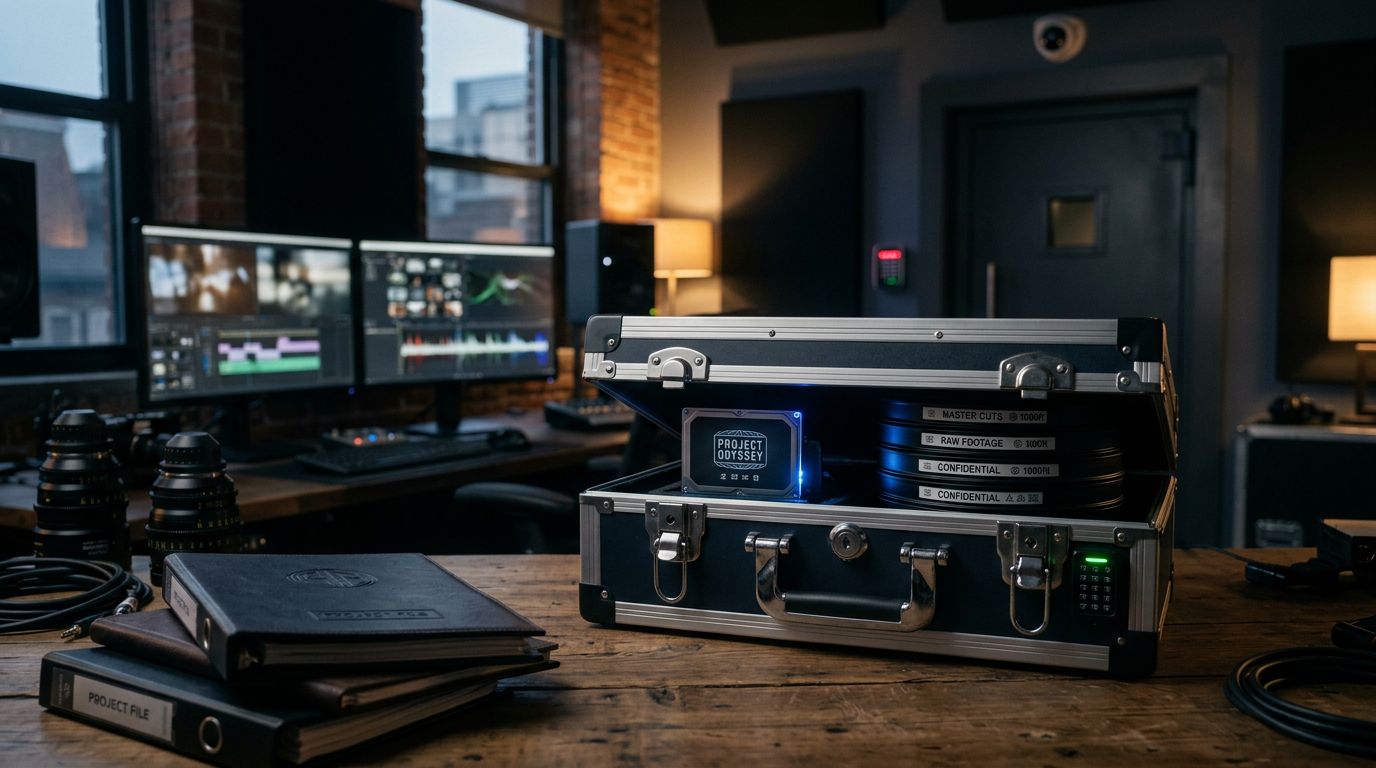
Trade Secret Protection for Creative Productions
A leaked cut, casting spreadsheet, or unreleased music stem can erase months of competitive advantage in a single afternoon.
Trade secret protection gives creative companies a legal path to protect valuable non-public information, but only if the company treats that information as secret before a dispute begins. An NDA alone rarely carries that burden.
For studios, agencies, and production teams, protection starts with knowing what deserves restricted access and building practical habits around it.
Table of Contents
ToggleWhat can qualify as a trade secret?
A trade secret is more than an idea discussed in a development meeting. Under U.S. law, it is information with independent economic value because it is not generally known or readily ascertainable, and the owner takes reasonable measures to keep it confidential.
The legal category can include business, financial, technical, and creative-production information. The Cornell Legal Information Institute’s trade-secret overview explains the core requirement: value and secrecy must exist together.
Apply a practical test before labeling material confidential
Ask whether the information would help a competitor, buyer, or departing collaborator if they obtained it early. Then ask whether the company can show it restricted access to that material.
A draft pitch deck that has circulated to 80 people through public links is harder to protect than a version-controlled deck shared with named recipients under confidentiality terms. The document itself matters, but the path it traveled matters too.
Novelty is not the test. A production’s confidential combination of talent strategy, budgets, workflow details, and launch timing may hold value even when individual elements are familiar.
Copyright and trade secrets cover different risks
Copyright protects original expression fixed in a tangible form, such as a screenplay, score, footage, or production design. Trade-secret law can protect confidential information surrounding that work before public release.
For example, a script may have copyright protection once written. Its unreleased draft, internal coverage, casting targets, financing assumptions, and planned revisions may also warrant confidential treatment. Copyright does not replace careful control of pre-release access.
The confidential assets creative teams often overlook
Production teams tend to focus on scripts and cuts. Yet valuable confidential material also lives in shared drives, text messages, edit notes, and vendor portals.
A strong information map may include a franchise bible, episode arcs, character notes, pitch research, casting availability, bid comparisons, rate cards, financing models, unreleased masters, cue sheets, post-production workflows, and distribution data. As a trade-secret developments review explains, protected information can take many forms if it has commercial value and the owner protects its secrecy.
Value often sits in the combination
A single casting name may not be a trade secret. However, a confidential grid linking cast availability, deal terms, audience data, backup choices, and production dates may have real market value.
The same principle applies to a television format. A broad premise such as a dating competition is unlikely to belong to one producer. A non-public package of recurring segment rules, casting architecture, production methods, research, sponsor plans, and rollout materials may be far more defensible if the team keeps it controlled.
A file does not become a trade secret because it carries a “Confidential” label. The label helps only when access practices support it.
How trade secret protection works under U.S. law
The federal Defend Trade Secrets Act, or DTSA, created a civil federal claim for qualifying trade-secret misappropriation. It sits alongside state-law remedies rather than replacing them.
The statute applies when the secret relates to a product or service used, or intended for use, in interstate or foreign commerce. Film, television, music, advertising, digital content, production services, and distribution businesses commonly meet that commercial connection.
The DTSA offers a federal civil claim
Under Chapter 90 of Title 18, an owner can bring a federal civil action for misappropriation. The usual filing deadline is three years after discovery of the misuse, or when the owner reasonably should have discovered it.
The DTSA allows courts to award damages, unjust enrichment, reasonable royalties in appropriate cases, injunctions, exemplary damages for willful and malicious conduct, and attorney fees in limited circumstances. It also has a narrow ex parte seizure remedy for extraordinary situations where someone may spread or destroy a secret before a court can act.
An injunction cannot simply block a person from taking a new job because they possess knowledge. The requested relief must rest on evidence of threatened misuse, not speculation.
State law still matters
Most states use some version of the Uniform Trade Secrets Act, although details differ by jurisdiction. A plaintiff may assert federal and state claims together when the facts support both.
The American Bar Association’s explanation of the DTSA describes why the federal cause of action matters, particularly where a company needs one forum for a dispute that crosses state lines. Choice-of-law clauses, venue terms, and local employment restrictions still deserve close review.
Build an information inventory before trouble starts
A trade secret protection plan begins with an inventory, not a lawsuit. A producer or in-house counsel should know which materials carry commercial value, where they live, who owns them, and who can access them.
Start with the development slate and work through pre-production, principal photography, post, marketing, licensing, and delivery. Include information held by freelancers and outside vendors, not only files on company-owned systems.
Assign owners and access levels
Each protected asset needs a business owner. That person does not have to be a lawyer, but they should approve access and flag when the asset becomes public.
A useful register records:
- The material, its location, and the project or entity that owns it.
- The reason it has commercial value and when it is expected to become public.
- The people, vendors, and platforms authorized to receive it.
- The contract or policy that controls disclosure, return, or deletion.
Classification should be workable. Reserve a high-security category for the files that could damage a project, negotiation, or release strategy if disclosed. Marking every email “confidential” makes the label less meaningful.
Put confidentiality into production contracts
Confidentiality terms work best when they match the recipient’s job. A director reviewing a script needs different access than a VFX vendor receiving selected plates, and both need different access than a sales agent reviewing a package.
A tailored agreement should define protected information, limit use to the approved purpose, prohibit unauthorized disclosure, require reasonable security, and address return or deletion at the end of the relationship. It should also state which party owns drafts, materials, feedback, and deliverables.
Use NDAs for the actual deal at hand
A one-page NDA may suit an early conversation with a prospective financier. A production agreement should go further because it must address work product, ownership, access, subcontractors, credit, payment, and breach remedies.
Teams can strengthen their paperwork by structuring a production agreement that protects the project. The agreement should require written approval before a vendor shares materials with its own staff or subcontractors.
Confidentiality provisions should survive delivery when the information remains non-public. They should also avoid overreaching definitions that attempt to claim ownership of a collaborator’s prior tools or general skills.
Include the DTSA whistleblower notice
Section 1833(b) of the DTSA protects certain confidential disclosures made to government officials or attorneys to report or investigate suspected legal violations. The statute requires employers to give notice of that immunity in agreements governing trade-secret or confidential information, or to cross-reference a policy that contains the notice.
This rule reaches employees, contractors, and consultants. That matters for assistant editors, writers’ assistants, freelance designers, sound engineers, post houses, and other project-based personnel.
Failure to provide the notice does not erase every available claim. However, it can prevent an employer from recovering exemplary damages or attorney fees under the DTSA from the individual who did not receive compliant notice. Chase Lawyers can review confidentiality language across employment, contractor, producer, and vendor agreements before a production expands.
Control access across the production workflow
Reasonable secrecy measures do not require a fortress. They require consistent control that fits the value and sensitivity of the material.
Grant access on a need-to-know basis. A production coordinator may need call sheets but not financing decks. A colorist may need picture files but not cast negotiations. Access should end when a contract, episode, or delivery window ends.
Use named accounts and traceable sharing
Shared passwords and open links create obvious proof problems. Use individual accounts, multi-factor authentication, permissions that expire, and download restrictions where the platform supports them.
Frame.io, Google Drive, Dropbox, Slack, Avid, and similar tools can help teams work quickly. However, a platform’s convenience settings may expose files through public links, broad team permissions, or uncontrolled downloads. Review those settings at the project level.
Watermark scripts, screeners, cuts, and sensitive pitch materials with the recipient’s name where practical. Version histories and access logs can later show what left the system, when it left, and who received it.
Protect physical handoffs and informal conversations
Security also applies outside the shared drive. Lock hard drives, maintain sign-out records for screeners, collect credentials at wrap, and avoid discussing confidential casting or deal terms in open production areas.
A rushed text chain can cause as much damage as a hacked account. Clear protocols give crew members a way to raise questions before forwarding a file or answering an inquiry from a reporter, buyer, or former colleague.
Share projects carefully with buyers and outside partners
Pitching requires disclosure, but disclosure does not have to mean giving every recipient the full package. Start with the material needed for the conversation, then expand access as the relationship advances.
Networks and studios may decline unsolicited materials or broad NDAs because they receive many similar submissions. In those situations, keep detailed records of what you shared, with whom, on what date, and under what submission terms.
Treat format materials as a package
A format pitch needs more than a short concept. It may include a production bible, sample episodes, casting approach, research, recurring segments, visual identity, and commercial plan.
Copyright may protect original written and visual elements. Yet contracts and confidentiality controls often provide stronger practical protection for the non-public operational package. Television rights agreements for producers can address contributor ownership, confidentiality, approvals, and format-related rights before materials reach a buyer.
Vet vendors and AI tools before uploading files
A vendor’s technical capability does not answer the legal questions. Before sending sensitive materials, ask where files are stored, who can access them, whether subcontractors participate, how long data remains available, and how the vendor reports a breach.
The same care applies to generative AI tools. Do not upload unreleased scripts, story bibles, rough cuts, client data, or deal terms into a public-facing tool without reviewing its current data-use terms and account controls. An enterprise account may offer stronger settings, but the production team must still confirm them.
Respond to a suspected leak with discipline
Speed matters after a suspected disclosure, but careless reactions can destroy useful evidence. First, contain access without wiping devices, deleting messages, or altering files.
Preserve relevant emails, chat messages, access logs, source files, version history, download records, and contracts. Record when the company learned of the problem and what material may be involved.
Identify the information with precision
A viable claim needs more than “our project information was taken.” The company must identify the particular information it considers secret and explain why it had value and how it stayed confidential.
That task is easier when the team kept an inventory, version history, watermarked copies, and clear access records. It is harder when the company mixed sensitive materials with public assets or allowed broad uncontrolled sharing.
Seek relief that fits the immediate risk
Counsel may send a preservation demand, request return or deletion, seek a temporary restraining order, or pursue an injunction when misuse appears imminent. The right step depends on the recipient, the material, the evidence, and whether a third party has received the information.
Courts can use protective orders and sealed filings to limit exposure during litigation. Still, sealing is not automatic, so the party seeking protection needs to describe the secret material carefully without revealing it in the process.
Chase Lawyers helps creative clients assess the facts, preserve evidence, pursue contract remedies, and develop a focused response when confidential production information appears at risk.
Court lessons for production companies
Trade-secret disputes often turn on ordinary conduct that happened long before the lawsuit: a departing employee’s downloads, an overlooked vendor account, a missing NDA, or an unclear ownership clause.
In Ruckelshaus v. Monsanto Co. (1984), the U.S. Supreme Court recognized trade secrets as property interests for Fifth Amendment analysis. The case involved pesticide data rather than entertainment, but its basic point applies across industries: legal protection depends on the owner’s legitimate expectation that disclosure will remain restricted.
The Waymo settlement shows the cost of weak controls
The Waymo and Uber dispute centered on allegations involving confidential self-driving technology. It settled in February 2018, with Reuters reporting the agreement’s $245 million value.
The settlement was not a court ruling on the merits. Yet it remains a useful warning for creative businesses because valuable information can move through people, devices, vendors, and new ventures faster than a company can react.
The strongest trade-secret case traces a clear line between the protected asset, the people who accessed it, the safeguards in place, and the unauthorized use that followed.
Protect the work before the release date
A production’s most valuable information is often most exposed while it is unfinished. The legal question is not whether every draft or internal spreadsheet deserves trade-secret status. The question is whether the company can identify and protect the information that gives it a real commercial edge.
Trade secret protection works when contracts, access controls, documentation, and response plans reinforce each other. Chase Lawyers helps creative companies turn those practices into practical agreements and defensible protection for the work behind the finished product.



- 21 SE 1st Ave, Suite 700, Miami, FL 33131
- 305-373-7665
- 305-373-7668
- info@chaselawyers.com
- 1345 Avenue of the Americas, 2nd Floor, New York, NY 10105
- 212-601-2762
- info@chaselawyers.com
Get a response within 24 hours. We’ll clearly explain how we can support and protect your brand while staying within your budget.