


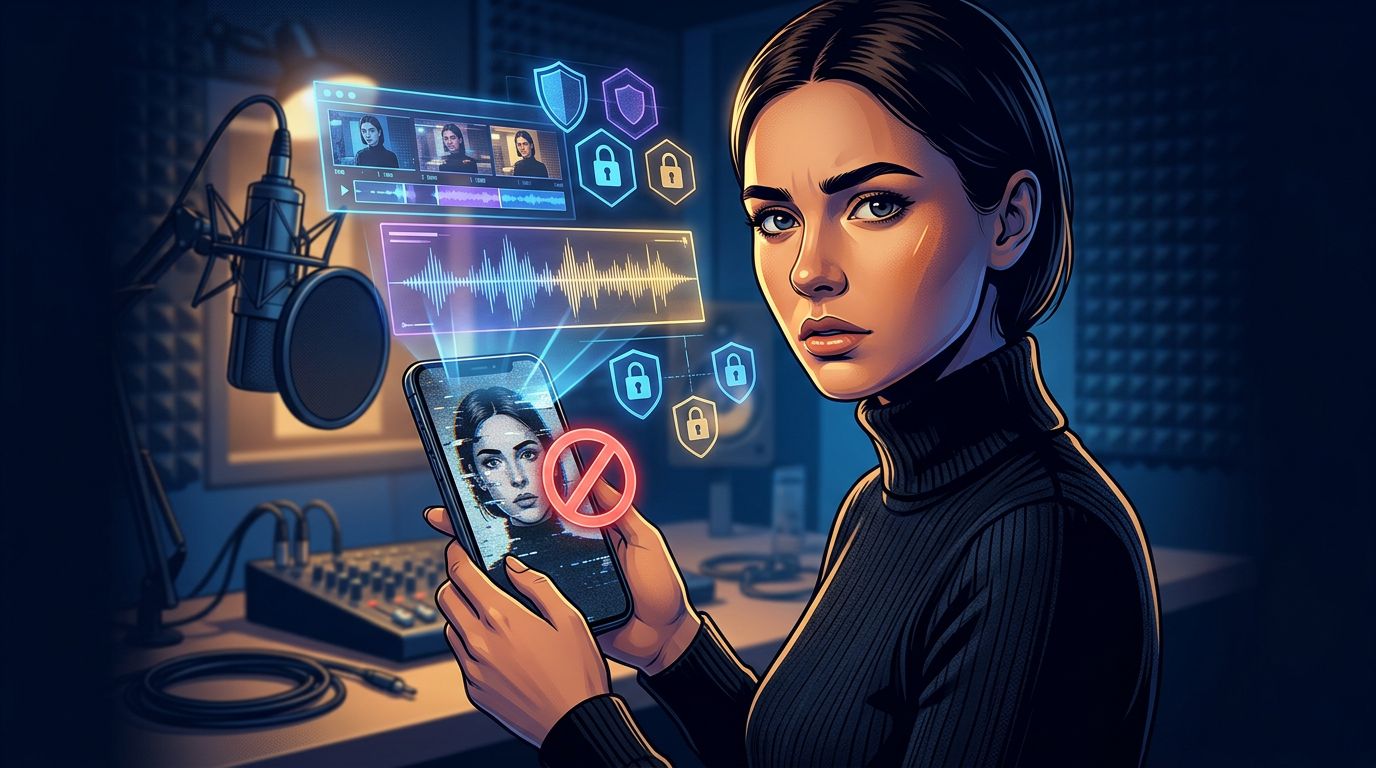
Deepfake Takedown Rights for Artists and Influencers
A convincing fake video can cost a creator an endorsement, confuse fans, and spread before anyone verifies it. Deepfake takedown rights give artists and influencers several ways to respond, but no single notice removes every synthetic clip.
The strongest path depends on what the fake uses and how it harms you. It may involve stolen footage, a cloned voice, a false product endorsement, nonconsensual intimate imagery, or a breach of a signed agreement.
Fast action starts with identifying the right claim, preserving proof, and reporting the content through the correct channel.
Table of Contents
ToggleHow Deepfake Takedown Rights Work in the United States
U.S. law does not treat every AI-generated impersonation as the same problem. A parody clip, a fake commercial, a voice clone in a scam, and an explicit face swap can trigger very different rules.
Deepfake takedown rights are therefore a group of legal tools, rather than one universal right. Copyright, privacy, publicity rights, contract law, false endorsement claims, and platform policies can all matter.
A fake can violate several different rights
A deepfake may copy your copyrighted music video while also using your recognizable face. In that situation, a DMCA notice may address the copied footage, while a right of publicity claim addresses the unauthorized commercial use of your identity.
Context matters. A misleading sponsored post that makes it appear you endorse a crypto project has a stronger commercial-use argument than an obvious joke shared by a small account. Still, parody labels do not excuse fraud, intimate-image abuse, or the misuse of copyrighted material.
A report that says only “this is fake” often gives a platform too little to act on. Identify the protected right, the account, and every location where the content appears.
Creators dealing with this overlap can review the broader deepfake legal risks in entertainment before choosing an enforcement route.
Choose the Legal Claim Before You Report
The first step is to identify exactly what the uploader used. Did they copy a music track, a photograph, a video clip, your voice, your name, or all of them? Each item may have a different owner and remedy.
A rushed complaint can fail when it relies on the wrong right. It can also create problems if it makes unsupported statements about ownership.
Copyright protects creative work, not your identity
Copyright protects original photos, videos, sound recordings, songs, artwork, and written material. It does not automatically give someone ownership of their face, name, or natural voice.
For example, a singer may own a master recording, while a label owns a separate video. An influencer may appear in a campaign photo, while the photographer owns the copyright. Contracts, assignments, work-for-hire terms, and licenses decide who can send a copyright notice.
The U.S. Copyright Office’s AI materials treat digital replicas as a distinct policy issue. That distinction matters because a convincing clone can harm a person even where no copyrighted file was copied.
Identity-based claims protect commercial value
State right of publicity laws can protect the commercial value of a person’s name, image, likeness, voice, and persona. Privacy, false light, defamation, and unfair competition claims may also apply, depending on the facts and the state.
As of August 2026, the United States still has no enacted nationwide digital-replica right that covers every nonconsensual deepfake. The NO FAKES Act text introduced in Congress proposes federal protection for unauthorized digital replicas of voice and visual likeness, but a proposed bill does not create a current takedown right.
Federal Protection for Intimate Deepfakes
Sexually explicit deepfakes require immediate attention. The damage can spread through reposts, private channels, search results, and impersonation accounts within hours.
The TAKE IT DOWN Act, signed in 2025, covers real and AI-generated nonconsensual intimate visual depictions. Covered online platforms had until May 19, 2026, to provide compliant notice-and-removal systems.
The 48-hour removal rule has a narrow reach
After receiving a valid request, covered platforms must remove covered nonconsensual intimate imagery within 48 hours. They must also make reasonable efforts to locate and remove identical copies. The FTC’s notice on the 48-hour requirement reflects the rule now in effect.
Report the original post and every known repost. Include direct links, account handles, screenshots, a statement that you did not consent, and any identification the platform requests.
This federal route does not cover every harmful fake. A nonsexual voice clone, a fabricated political statement, or a false brand endorsement usually requires a different claim and reporting category.
Right of Publicity Claims Carry Much of the Load
For artists and influencers, a right of publicity claim often provides the clearest answer when a fake uses identity to sell something. State laws vary widely, so the creator’s domicile, the location of the publication, and the commercial campaign can affect the claim.
Tennessee’s ELVIS Act expanded protection for voice against AI-based imitation. Washington law now recognizes rights in a “forged digital likeness.” California and New York also have established statutory publicity protections, though their requirements differ.
A Supreme Court case draws a useful line
In Zacchini v. Scripps-Howard Broadcasting Co., the U.S. Supreme Court held that the First Amendment did not shield a broadcaster that aired a performer’s entire human-cannonball act without compensation. The case did not involve AI, but it recognized that publicity rights can protect the economic value of a performance.
That decision does not give public figures ownership of every mention, joke, news report, or expressive work about them. Courts must still weigh speech interests. However, a realistic ad that falsely suggests a musician promoted a product is far easier to challenge than commentary that clearly identifies itself as parody.
Commercial use, consumer confusion, and proof of lost opportunities often strengthen the case.
Use the DMCA When the Fake Copies Your Work
A DMCA notice can be one of the fastest removal tools when a deepfake includes copyrighted material you own or control. It is especially useful when the video copies your song, film footage, press photo, album art, livestream recording, or paid course material.
Yet copyright cannot remove content merely because it recreates your appearance. The notice must identify an actual copyrighted work and an unauthorized use of it.
Confirm who owns the source material
Before filing, check the chain of title. A photographer may own the image used to train or build a face swap. A producer, label, publisher, or distributor may control the music. If a manager or attorney files, they need authorization from the rightsholder.
A compliant notice under 17 U.S.C. Section 512 identifies the original work, the infringing material, contact information, a good-faith statement, and a signature. The uploader can submit a counter-notice, which may start the process for restoring the content unless the claimant takes timely legal action.
For creators with split ownership or older work, copyright takedown procedures for artists can help clarify who has authority to act. Do not send a DMCA notice for material you do not own.
Match the Platform Complaint to the Harm
Platforms apply their own policies, forms, review standards, and escalation paths. Filing through every available form without a consistent legal theory can delay the response.
Instead, send parallel reports that each match the violation. A copyright claim should identify copied work. An impersonation complaint should explain why viewers would believe the account or content is authentic.
YouTube reviews identifiable synthetic likenesses
YouTube allows people to report synthetic or altered content that looks or sounds like them through its privacy process. The YouTube identity-reporting process focuses on whether the content is altered or synthetic, identifies a person, and could be mistaken for a real depiction.
Provide the video link, timestamps, screenshots, and a short explanation of the false implication. If the video also uses copyrighted music or footage, submit a separate copyright complaint rather than trying to force both issues into one report.
Meta reports need the right category
Meta prohibits nonconsensual intimate imagery and provides a dedicated intimate image reporting path. For non-intimate fakes on Instagram or Facebook, impersonation, harassment, privacy, copyright, fraud, or deceptive commercial conduct may be more accurate categories.
Save every confirmation number and automated reply. If a report is denied, that record can support an appeal or a later demand letter.
Preserve Evidence Before Content Disappears
Removal is the goal, but evidence often disappears with the post. A deleted account can make it harder to identify the uploader, prove the scope of publication, or show the commercial purpose behind a fake endorsement.
Capture the material before reporting it, provided doing so does not expose you or your team to further harm.
Create a record another party can verify
A useful evidence file includes:
- Screen recordings that show the video, account handle, caption, comments, and engagement figures.
- Screenshots showing the full web address, date, time, platform, and any paid promotion label.
- Copies of the original photo, audio, video, or artwork used in the fake.
- Contracts, registrations, licenses, and correspondence that establish ownership or lack of consent.
- Records of lost sponsorships, fan confusion, advertiser involvement, or scam transactions.
Keep the original files unchanged. A lawyer may later request preservation of account data, upload logs, and communications from a platform, host, advertiser, or payment processor. Those records may require a subpoena or court order, so early preservation requests matter.
A Lawyer’s Demand Letter Can Stop a Commercial Campaign
Platform reports can remove a single post. A targeted legal demand can reach the person who made the fake, the agency that placed the ad, the brand benefiting from it, and the website hosting it.
Deepfake takedown rights become more effective when the notice names the real commercial problem. A seller using a cloned artist voice to move merchandise creates a different risk than a teenager reposting a meme.
Ask for more than the post’s deletion
A strong demand should identify the content, explain the legal basis, and state the remedy sought. Depending on the facts, that may include removal of all controlled copies, cancellation of paid media, a halt to future use, disclosure of where the files were sent, and written confirmation of compliance.
Chase Lawyers is a boutique entertainment, media, arts, sports, and intellectual property firm with offices in Miami and New York City. The firm helps artists, influencers, musicians, athletes, and creative brands assess claims, send focused demands, negotiate resolutions, and pursue litigation when needed. Its work on personality rights for entertainers and influencers is particularly relevant when identity becomes the asset being exploited.
Do not demand copyright removal unless you hold the copyright. A precise letter has more force than an inflated list of claims.
Contract Terms That Reduce Future AI Misuse
Many damaging deepfakes start with material that a creator voluntarily supplied to a brand, producer, agency, platform, or collaborator. A broad release can give a counterparty more room than the talent expected.
Contracts cannot stop a malicious stranger. However, they can set firm limits on companies that have legitimate access to your content, voice samples, motion capture, or campaign footage.
Write permission with a clear boundary
AI and likeness clauses should state:
- Which files, recordings, or performances the other party may use.
- Whether synthetic voice, face, body, or performance generation is permitted at all.
- The approved purpose, media, territory, term, and audience for any authorized use.
- Whether the material can train a model, be sublicensed, or be shared with vendors.
- When approval, payment, deletion, audit rights, or indemnity obligations apply.
Consent to film a campaign should not automatically authorize voice cloning or model training. The agreement should also address edits that materially change the meaning of the original performance.
For sponsored content and brand work, AI likeness protections for influencers can help turn those boundaries into workable deal terms.
When Court Action Becomes Necessary
Most disputes end through platform reports, direct negotiation, or a demand letter. Court action becomes more likely when the content continues after notice, drives a fraudulent campaign, damages a major deal, or appears across many accounts.
Available claims may include right of publicity, copyright infringement, false endorsement, breach of contract, defamation, invasion of privacy, and state consumer-protection claims.
Seek relief that fits the immediate problem
An injunction can be more useful than damages when a fake advertisement is still running. A lawsuit can also support subpoenas to identify an anonymous uploader or obtain records from an ad network, domain host, or payment provider.
The requested relief should match the evidence. A creator may seek removal, a ban on further distribution, profits tied to the misuse, actual damages, statutory damages where available, and attorney’s fees when the governing law allows them.
Avoid making public accusations before confirming the source and the claim. A calm public statement, paired with private enforcement, often limits fan confusion without amplifying the fake.
Conclusion
A convincing deepfake does not leave artists and influencers powerless. Deepfake takedown rights work best when the response connects the content to a real legal harm, such as copied work, commercial identity misuse, intimate-image abuse, or a broken contract.
Preserve proof first, report through the correct policy channel, and escalate when the content creates business or reputational damage. Your name, voice, image, and creative work deserve the same protection as any other valuable career asset.



- 21 SE 1st Ave, Suite 700, Miami, FL 33131
- 305-373-7665
- 305-373-7668
- info@chaselawyers.com
- 1345 Avenue of the Americas, 2nd Floor, New York, NY 10105
- 212-601-2762
- info@chaselawyers.com
Get a response within 24 hours. We’ll clearly explain how we can support and protect your brand while staying within your budget.