A stolen clip can rack up views before your coffee gets cold. When someone reposts your song, photo, or video without permission, speed matters, but accuracy matters just as much.
A weak DMCA takedown notice can be ignored or rejected. A strong one identifies the right work, the exact infringing URL, and the legal basis for removal under U.S. copyright law.
If you want content taken down fast, start with proof and follow the process carefully.
Key Takeaways
- A valid DMCA notice must include six required elements under 17 U.S.C. Section 512(c)(3), and platforms often reject notices with missing URLs or missing declarations.
- You do not need copyright registration to send a takedown notice, but registration usually matters if the dispute turns into a federal lawsuit.
- Music claims can involve more than one right, including the sound recording and the composition, so ownership needs to be clear before you file.
- Platforms keep DMCA safe harbor protection only if they respond properly to valid notices and maintain a counter-notice process.
- Chase Lawyers helps creators, photographers, musicians, and media brands move from online infringement reports to stronger enforcement when a takedown alone is not enough.
What a DMCA takedown can remove, and what it can’t
The Digital Millennium Copyright Act gives copyright owners a practical way to ask online platforms to remove infringing material. The notice-and-takedown system appears in Section 512 of the Copyright Act, and the U.S. Copyright Office’s Section 512 resources lay out the basics. In plain terms, if a platform hosts user content and wants safe harbor protection from copyright liability, it must respond to valid notices promptly.
That matters for creators because most theft happens on third-party platforms. A ripped music video on YouTube, a stolen event photo on a blog, or an unlicensed clip on a social account usually falls into the kind of online use the DMCA was built to address.
Still, a DMCA takedown has limits. It is aimed at online service providers, not every person who copied your work. It usually won’t solve offline infringement, contract disputes, or fights over who actually owns the copyright. It also does not guarantee money damages. It gets material removed, or at least starts that process.
Ownership is the first gate. Only the copyright owner or an authorized agent can send the notice. If you are a photographer who shot the image, that is often straightforward. If you are a musician, it can be more layered because one upload may infringe the sound recording, the underlying composition, or both. If you are a videographer working for a client, the contract may control who owns the footage.
Registration is different from takedown rights. You can usually send a notice without a federal registration. However, if the dispute grows into a lawsuit, registration becomes a much bigger issue. That is why quick online removal and long-term enforcement often need separate planning.
Build your evidence before you send anything
Before you draft a notice, preserve the facts. A takedown request works best when it reads like a clean paper trail, not a frustrated message fired off at midnight.
Start with the exact location of the stolen content. Save the full URL for each page, post, reel, channel, or file location. If the material appears in search results, click through to the actual page and save that URL too. Platforms often reject notices that point only to a profile page or homepage.
Next, capture proof. Take screenshots that show the infringing content, the account name, the date, and any visible captions or view counts. For video and audio, save short screen recordings if the platform allows it under your own evidence protocol. If the post is live and drawing traffic, note the time and date. That record can matter later if you need to show commercial harm or repeated misuse.
Photo by Miguel Á. Padriñán
You should also gather proof of ownership. For photos, keep the original RAW files, exported originals, metadata, publication history, and any licensing records. For music, keep release dates, registration records, session agreements, split sheets, distributor data, and links to your official upload. For video, save project files, camera originals, delivery records, and client agreements if the work was commissioned.
The most common reason a notice fails is simple: it does not identify the exact infringing URL.
Be careful with gray areas. Commentary, criticism, news reporting, and some parody can raise fair use issues. If someone used only a short excerpt in a review, a takedown may not be the right first move. False or reckless claims can create problems of their own under Section 512(f), which deals with misrepresentations in DMCA notices.
When ownership, licensing, or fair use is unclear, legal review saves time. That is where many creators call counsel instead of guessing.
The six parts every valid DMCA notice needs
A valid notice is a signed written communication, and U.S. law requires six core elements. Miss one, and the platform may reject the request or delay action.
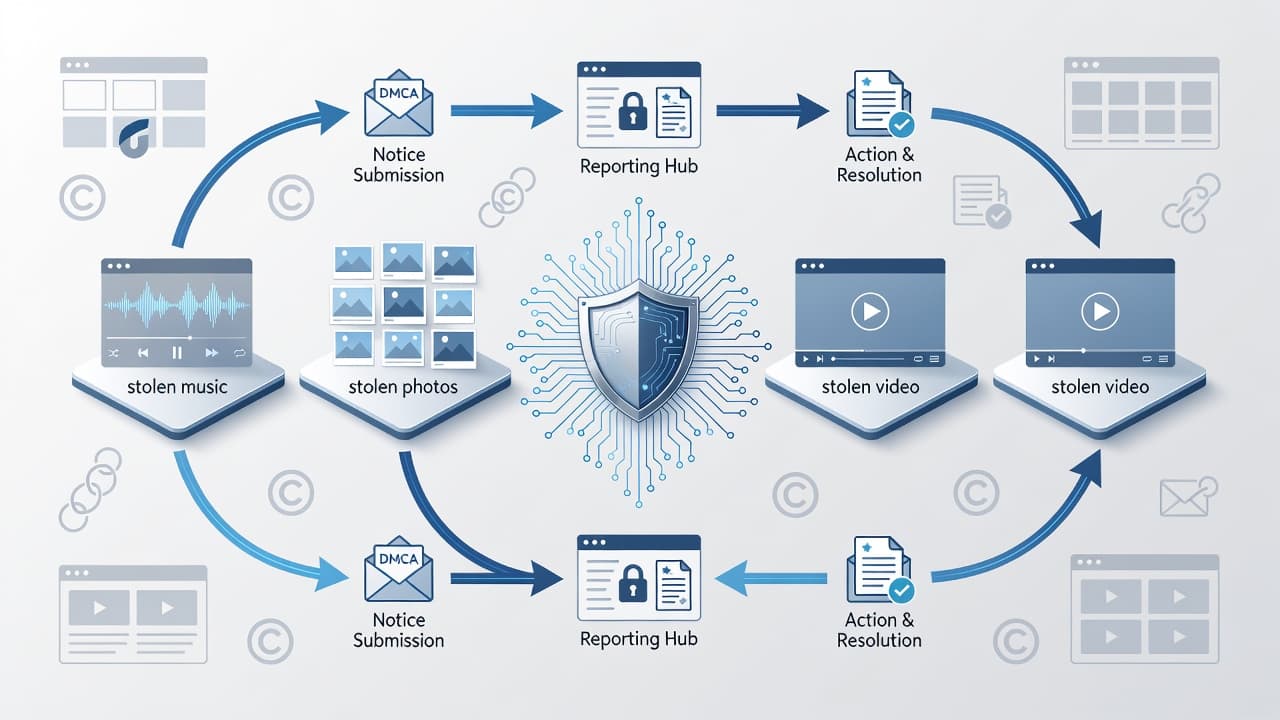
Use this checklist when preparing a DMCA takedown notice:
| Required element | What to include | Common mistake |
|---|---|---|
| Signature | Your physical or electronic signature, often a typed name | Leaving the notice unsigned |
| Copyrighted work | Title, description, and original source link if available | Describing the work too vaguely |
| Infringing material location | Exact URLs for each unauthorized copy | Linking only to a homepage or profile |
| Contact information | Full name, mailing address, phone, and email | Omitting phone or mailing address |
| Good-faith statement | A statement that you believe the use is unauthorized | Using casual language without the required legal statement |
| Accuracy and authority statement | A statement under penalty of perjury that the notice is accurate and you are the owner or authorized agent | Forgetting the perjury language |
The six elements come from 17 U.S.C. Section 512(c)(3). The exact wording can vary, but the substance needs to be there. A typed signature is generally accepted for electronic submissions. If several works were copied, identify each one clearly. If several URLs are involved, list every link separately.
Music claims deserve extra attention. If a user uploaded your track with your album art and your video, one post may touch multiple copyrights. You may need to identify the sound recording, the composition, the cover image, and the audiovisual work. When a distributor, label, publisher, or manager controls one piece of the rights stack, confirm who should sign.
Keep your language factual. State what was copied, where it appears, and why the use is unauthorized. Do not exaggerate, threaten criminal liability, or add claims you have not checked. A clean notice gets reviewed faster than a dramatic one.
Send the notice to the right platform contact
A perfect notice sent to the wrong inbox is still a slow notice. Each platform has its own reporting path, and many large services require you to use a web form instead of a general support email.
For YouTube, use YouTube’s copyright removal request page, which accepts claims for videos and some non-video content, including certain channel images. Meta platforms, TikTok, X, Reddit, Vimeo, WordPress.com, Etsy, and others also maintain copyright complaint channels. If you are dealing with a smaller site, look for its copyright policy, legal page, or DMCA agent listing.
The DMCA matters here because platforms keep safe harbor protection only if they designate an agent, publish contact information, and respond to proper notices. If the site looks sketchy, check whether it has a copyright policy at all. A missing or broken process may signal a deeper enforcement problem.
Sometimes the platform is only part of the chain. A stolen music file might sit on a blog hosted by one company, embedded from another service, and promoted on social media. A copied photo may appear on a marketplace listing, then in a seller’s ads. In those cases, you may need parallel notices to the platform, the host, and the marketplace.
Keep records as you go. Save the submitted form, confirmation email, ticket number, and timestamp. If the platform asks for more detail, respond quickly and stick to the same factual record.
This is also where experience pays off. A lawyer who handles creative rights claims regularly can identify whether the real pressure point is the platform, the hosting layer, the payment channel, or the account holder behind the post.
What happens after the platform receives it
Once a platform gets a valid notice, it is supposed to act expeditiously. That does not always mean instantly, but it usually means prompt review and removal or disabling of access if the claim checks out.
After removal, the platform often notifies the user who posted the content. That user can respond with a counter-notice if they claim the material was removed by mistake or misidentification. If the counter-notice is valid, the platform may restore the content unless the copyright owner files a lawsuit within the statutory window, usually 10 to 14 business days after the platform forwards the counter-notice.
This back-and-forth is part of why accuracy matters so much at the start. If your first notice is sloppy, the other side gets room to push back. If your ownership chain is weak, the dispute may shift from takedown procedure to a larger fight over rights.
Courts have shaped how this system works. In Viacom International v. YouTube, the Second Circuit addressed when platforms keep DMCA safe harbor protection. The case helped confirm that generalized knowledge that infringement exists on a platform is not enough by itself. The sharper questions are whether the platform had knowledge of particular infringements and whether it responded properly when notified.
For creators, the lesson is practical. The more exact your notice is, the harder it is for a platform to shrug and say it lacked specific information.
Repeat uploads are another common problem. One removed post may reappear on mirror accounts, compilation pages, or clipped reposts. Musicians often face this on lyric videos, fan edits, and unauthorized uploads of leaks or demos. Photographers see the same pattern when an image spreads from one account to dozens of others. You may need repeated enforcement, monitoring, and a broader legal plan.
When stolen media keeps coming back
A single DMCA notice works well for one obvious infringement. It works less well when theft is systematic, commercial, or tied to a bigger dispute.
If your content keeps reappearing, the first issue is scale. One account may be copying your work across multiple platforms. A marketplace seller may be using your photos to move counterfeit or gray-market products. A former collaborator may be exploiting unreleased music or unreleased footage after a business breakup. In those cases, you need more than form submissions.
You also need to think about ownership proof that will hold up in court. Registration is a major part of that. While you do not need registration to send a takedown notice, you usually do need it to file an infringement suit over a U.S. work. In Fourth Estate v. Wall-Street.com, the U.S. Supreme Court held that a claimant generally must have a registration from the Copyright Office before filing suit, not just a pending application.
For creators who want a stronger enforcement position, registration should happen early. Chase Lawyers offers copyright registration and enforcement services built around that long-term protection, including online infringement response and follow-up action when notices are not enough.
Music disputes often need an even tighter strategy because the same upload can affect royalties, licensing, brand value, and release plans. For artists and rights holders dealing with recurring theft, Chase Lawyers also shares guidance on fighting music copyright infringement.
Fair use remains the one area where caution matters most. A review channel, documentary excerpt, or commentary post may call for a closer legal read before you send a takedown. On the other hand, full-song uploads, unlicensed image reposts, bootleg clips, and monetized reuploads usually present a much cleaner case.
How Chase Lawyers helps creators move faster
When infringement hits your release, campaign, or brand, delay costs money. Creators often lose momentum first, then licensing opportunities, then control over how the work is seen online.
Chase Lawyers is a boutique entertainment and intellectual property firm with offices in Miami and New York City. The firm works with artists, musicians, photographers, videographers, influencers, producers, athletes, and creative brands, so the advice is shaped around how media rights work in practice, not only in theory.
That matters because a stolen song is not the same as a stolen event photo, and neither one looks like a ripped production clip from a film set. Ownership can turn on split sheets, work-for-hire language, publishing rights, release forms, or distribution agreements. Chase Lawyers helps sort that out, then turns it into a clear enforcement plan.
For creators who publish constantly, the firm also provides legal representation for content creators, including protection for online content, takedown work, contract review, and broader intellectual property support. That is useful when the problem is larger than one infringing post and starts affecting sponsorships, licensing, impersonation, or platform relationships.
A lawyer can also step in when the platform stalls, the other side files a counter-notice, or the infringement connects to a former partner, label dispute, or business fallout. At that point, a DMCA form is only one tool. Cease-and-desist letters, settlement talks, and litigation planning may do far more to stop the damage.
Conclusion
Stolen media spreads fast, but the legal path to removal is not random. A strong DMCA takedown starts with proof, uses the six statutory elements, and goes to the right platform contact.
If the content comes down, great. If it comes back, triggers a counter-notice, or ties into a larger ownership fight, the next move needs more than a template.
Creators who protect their rights early usually have better options later, and Chase Lawyers is built to help them act before the loss gets bigger.