


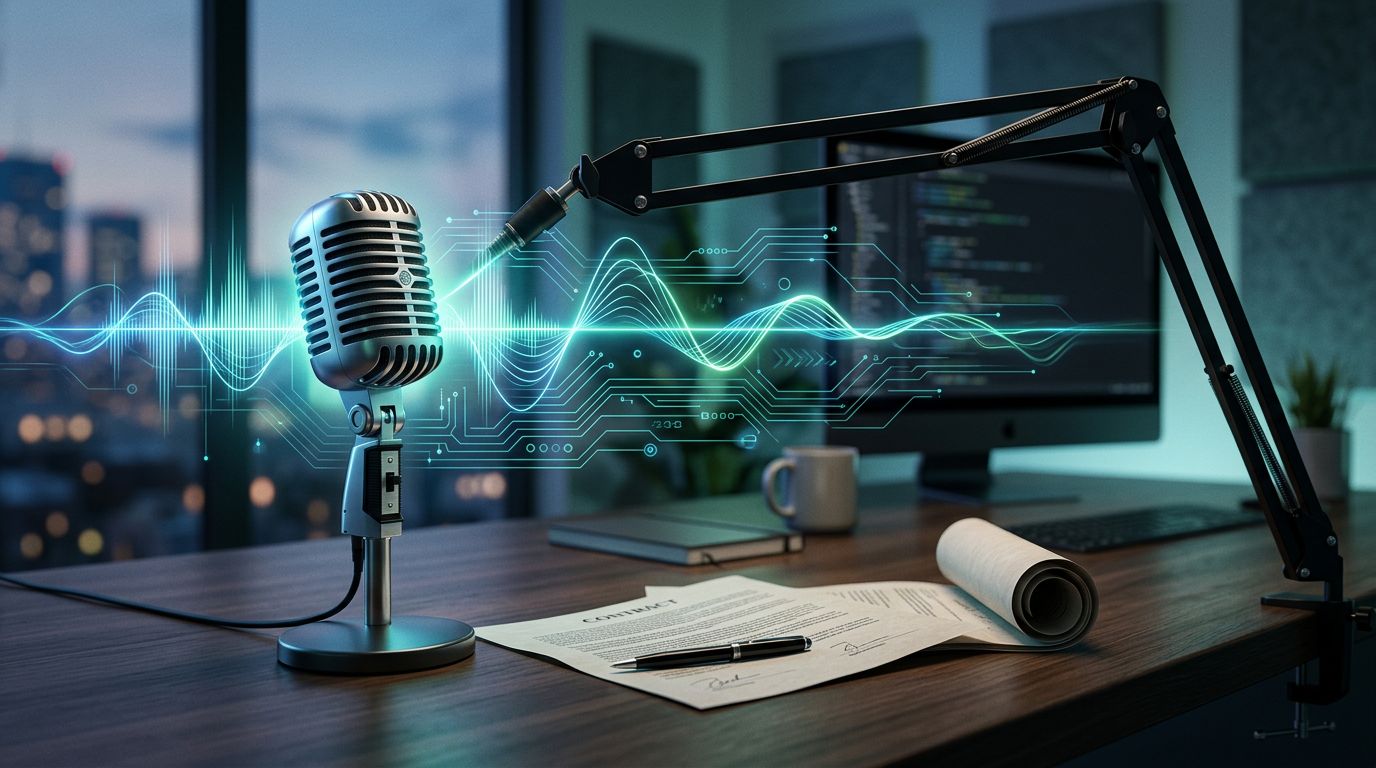
AI Voice Clone Clauses Artists Must Negotiate
One dry sentence in a contract can let someone sing, speak, or sell in your voice long after the session ends.
For artists, voice actors, musicians, and creators, AI voice cloning contracts now sit beside master rights, publishing, and image rights. Labels, studios, ad agencies, app companies, and platforms increasingly ask for “digital replica” or “synthetic voice” language inside recording, endorsement, and user terms.
If the paper gives away training rights, broad sublicensing, or perpetual use, fixing the problem later gets expensive. The safest time to control the clone is before anyone builds it.
Table of Contents
ToggleKey Takeaways
- Your contract should define the voice asset with care, including recordings, stems, voiceprints, models, and synthetic outputs.
- Narrow the permission by project, term, media, territory, and approved uses, then require approval for scripts, edits, and sensitive contexts.
- Don’t accept a one-time fee for open-ended clone rights when the company may create unlimited future performances.
- Put data rules in writing, including consent, storage, vendor access, retention, deletion, and breach notice.
- State law often does more work than federal IP law here, so contract language matters even more.
Why voice-clone language now belongs in every artist deal
AI voice cloning moved from novelty to routine business use. Companies now want synthetic pickups for songs, translated dialogue for games, alternate ad reads, audiobook corrections, fan messages, and virtual assistants. Because the tech is cheap to scale, a single session can feed years of output.
That shift matters because U.S. law still leaves gaps. As of 2026, there is no single federal law that cleanly covers voice cloning across entertainment deals. Enforcement comes from a patchwork of FTC deception rules, FCC robocall rules, criminal fraud laws, and state publicity or biometric statutes. Copyright usually protects the recording, not the sound of your voice by itself.
A 2025 federal decision in New York made that point plain. The court rejected federal copyright and trademark theories tied to AI voice imitation, while letting state publicity claims continue under New York’s digital replica rules. In other words, artists cannot assume federal IP law will rescue a bad contract after the fact. Recent industry coverage, including IAPP’s overview of voice actor protections, shows how quickly performers are pushing for stronger terms.
That is why broad language such as “all rights in all media now known or later developed” deserves extra attention when voice data is involved. If a company can train a reusable model from your stems or session files, it may never need to book you again for similar work. The economic hit can outlast the original project by years.
Define exactly what the company may copy
Most contract fights start with a fuzzy definition. “Voice,” “digital replica,” “synthetic media,” and “AI output” sound interchangeable, but they are not. A careful clause separates the source material from the model and the model from the finished uses.
These terms are easy to blur, so put them on paper.
| Contract term | What it should mean |
|---|---|
| Recorded performance | The actual takes you recorded for the project |
| Isolated vocal files | Dry stems, outtakes, warm-ups, and alternate takes |
| Voiceprint data | Biometric markers derived from your voice |
| Voice model or digital replica | The trained system that can generate new speech or singing |
| Synthetic output | The audio files the model later produces |
Once those definitions exist, tie them to the deal. If you approved one audiobook title, the contract should not spread into game characters, ad spots, or branded social clips. If you recorded one hook, the buyer should not be free to build a reusable singing model from every scrap of audio captured that day.
It also helps to separate voice rights from other music rights. Permission to use a recording does not automatically transfer your publishing interest, performance income, or broader control over derivative exploitation. Artists working through that overlap often need a clear grasp of legal rights for songwriters and publishers.
Push for exclusions, too. A good clause can say the company may not use your name, likeness, signature phrases, or identifiable persona with the clone unless the contract grants that right in a separate paragraph. It can also bar style mimicry outside the approved project, which matters when the company says it wants only your “tone” or “delivery.”
Put hard limits on use and approval
Once the asset is defined, the next fight is scope. Many contracts ask for open-ended rights because companies do not yet know every future use they might want. That uncertainty is their business problem, not yours.
A strong clause limits use by project, media, territory, and time. It should name the exact production, campaign, or platform feature. It should also say whether the clone may appear in commercial ads, film and television, games, social media, live events, dubbing, or training materials. If the contract says “promotional use,” ask what that covers. A teaser trailer is different from a paid political ad.
Approval rights matter just as much. Require written approval for scripts, lyrics, prompts, translated lines, edits, and the final output before release. Add a ban on uses tied to politics, religion, health claims, adult content, defamation, or fake endorsements. If the company wants pickup lines or alternate versions, make those subject to the same approval rule.
If the contract says “in perpetuity” and “all media now known or later developed,” slow down. That phrase can swallow uses nobody described.
This is familiar territory for music lawyers because the same discipline shows up in film, TV, and ad placements. If a cloned vocal may be paired with video, artists should borrow the same caution used in understanding sync license terms, including limits on edits, context, and implied endorsement.
Sublicensing needs its own sentence. If a company can hand your clone to affiliates, vendors, brand partners, or future acquirers without consent, you have lost practical control. Approval is far more meaningful when the contract bars assignment or sublicensing unless you sign off in writing.
Tie payment to each use, not vague future rights
Broad AI clauses often ride inside a flat-fee session deal. That is a bad trade when the buyer may create endless future performances from one recording day.
Payment works better when it matches each stage of exploitation. A contract can separate the fee for recording source material, the fee for building a model, the fee for approved outputs, and the fee for renewals or expanded uses. If the clone appears in ads, games, dubbing, fan engagement tools, or paid subscriptions, each category should trigger its own compensation.
A practical pay structure often covers four buckets:
- Initial session pay for the actual recording work
- A separate model-training fee, if you agree to training at all
- Use-based payments or royalties for each approved release
- Renewal fees when the term, territory, or media expands
Audit rights belong here as well. If a company can render new lines on demand, you need statements, reporting deadlines, and the right to inspect records. Otherwise, the deal turns into a black box.
This is where entertainment counsel often earns their keep. The same instincts used when negotiating music licensing agreements apply to synthetic voice rights, because both issues turn on scope, approval, accounting, and downstream exploitation.
California law adds pressure on the buyer side. Under AB 2602, contract terms for digital replicas can be unenforceable if they are too broad and fail to describe the use clearly, if the performer lacked union or legal representation, or if the worker is not fully paid for the AI-created work category. Even so, artists should not rely on a later court fight to fix bad economics. Price the future use now.
Control training data, storage, and deletion
Once a model is trained, your leverage drops fast. Because of that, the contract should treat voice data like sensitive property, not ordinary session debris.
Start with consent. The agreement should say whether the company may collect voiceprints, retain dry stems, or use old recordings as training data. It should identify the purpose, who gets access, where the files are stored, how long they stay there, and whether third-party AI vendors can touch them. If outside vendors are involved, name them or require advance approval before any transfer.
Retention and deletion terms matter more than many artists realize. Require a deletion date, a destruction certificate, and language that covers backups, cached copies, and vendor systems. Also ban the use of your recordings to improve unrelated models, future products, or datasets built for other clients.
Several state laws make these demands easier to justify. Illinois’ Biometric Information Privacy Act treats voiceprints as biometric identifiers and requires written consent before collection, along with disclosure of purpose and retention. California privacy law also treats biometric data as sensitive, and children under 13 now get added protection because the FTC’s updated COPPA rule classifies voiceprints as personal information.
Disclosure rules are growing, too. California’s AB 2905 requires disclosure in certain prerecorded AI voice messages, and the California AI Transparency Act, effective August 2, 2026, requires generative AI providers to include content indicators and latent disclosures. By January 1, 2027, California plans to bar platforms from hosting generative AI content without those disclosures.
If a company cannot explain how it stores, labels, and deletes your voice data, the safe answer is usually no.
Know which laws back up your clause
Contract language is the first shield, but the legal backdrop still shapes leverage. Right now, state law is doing much of the work.
New York gives artists a stronger position than many assume. Civil Rights Law sections 50 and 51 cover digital replicas, including voice, which means unauthorized commercial use can trigger a publicity claim even when no visual likeness appears. That mattered in the 2025 federal case where copyright and trademark theories fell short, but state publicity claims survived.
California is even more active. AB 2602, effective January 1, 2025, limits the enforceability of contract provisions that grant digital replica rights without a clear description of use, legal or union representation, and full payment for the AI-created work. AB 1836 protects against unauthorized digital voice replicas of deceased personalities in expressive audiovisual works and sound recordings. Together, those laws signal that a performer’s voice cannot be swept into a vague future-rights paragraph and forgotten.
Tennessee’s ELVIS Act also deserves attention because it treats voice as part of a protected publicity right. That gives performers another path when commercial users imitate a recognizable voice without permission. Meanwhile, Illinois BIPA remains one of the strongest data-based statutes because it regulates voiceprints before the publicity fight even begins.
Federal agencies still matter around the edges. The FTC can treat deceptive impersonation and misuse of biometric data as unfair or deceptive acts. The FCC has said AI voice robocalls count as artificial or prerecorded calls under the TCPA, which means statutory damages can run from $500 to $1,500 per call. The Department of Justice can also pursue fraud and identity theft when cloned voices are used to steal money or mislead victims. Coverage of voice-cloning claims that survived early court review shows how contract and publicity theories are becoming the main battlefield.
The lesson is simple. Federal IP law may not fully protect a voice clone, so the paper you sign has to do more work.
Watch for hidden voice-clone language in ordinary deals
AI rights do not always show up under a heading called “AI.” They often hide inside standard forms.
Recording agreements may bury them under “new technologies.” Producer deals may tuck them into editing or pickup rights. Brand deals may call them promotional materials or derivative content. Platform terms often use softer labels such as service improvement, quality testing, safety review, personalization, or internal research. A dubbing or game agreement may ask for alternate lines and then add reuse rights broad enough to support a permanent model.
Read these phrases with extra care: digital replica, synthetic media, voice model, machine learning, text-to-speech, derivative works, future technologies, internal tools, sublicensable, assignable, universal media, perpetual archive, and irrevocable consent. Each one can widen the grant.
That is why many artists bring in counsel before the signature, not after the release. Chase Lawyers is a boutique firm with offices in Miami and New York that focuses on entertainment, sports, media, and arts law. The firm works with artists, athletes, influencers, musicians, producers, and creative brands, and its work centers on protecting creative talent, intellectual property, and long-term career value. When an agreement mixes music rights, publicity rights, and AI terms, Chase Lawyers can narrow overbroad language, line up payment with actual use, and lock in guardrails before a company trains the model.
A short review can catch the sentence that turns a one-day session into years of unpaid synthetic performances. Once the clone exists, the bargaining position usually shifts.
Conclusion
A voice is more than a sound file. It carries identity, reputation, and future income.
The strongest protection in AI voice cloning contracts comes from tight definitions, narrow use rights, real approval control, fair compensation, and hard rules for storage and deletion. State publicity and biometric laws can help, but they work best when the contract already says what the buyer may and may not do.
Artists who slow down before signing usually keep options they cannot buy back later. When your voice can be copied at scale, the signature page is where control starts.


- 21 SE 1st Ave, Suite 700, Miami, FL 33131
- 305-373-7665
- 305-373-7668
- info@chaselawyers.com
- 1345 Avenue of the Americas, 2nd Floor, New York, NY 10105
- 212-601-2762
- info@chaselawyers.com
Get a response within 24 hours. We’ll clearly explain how we can support and protect your brand while staying within your budget.