


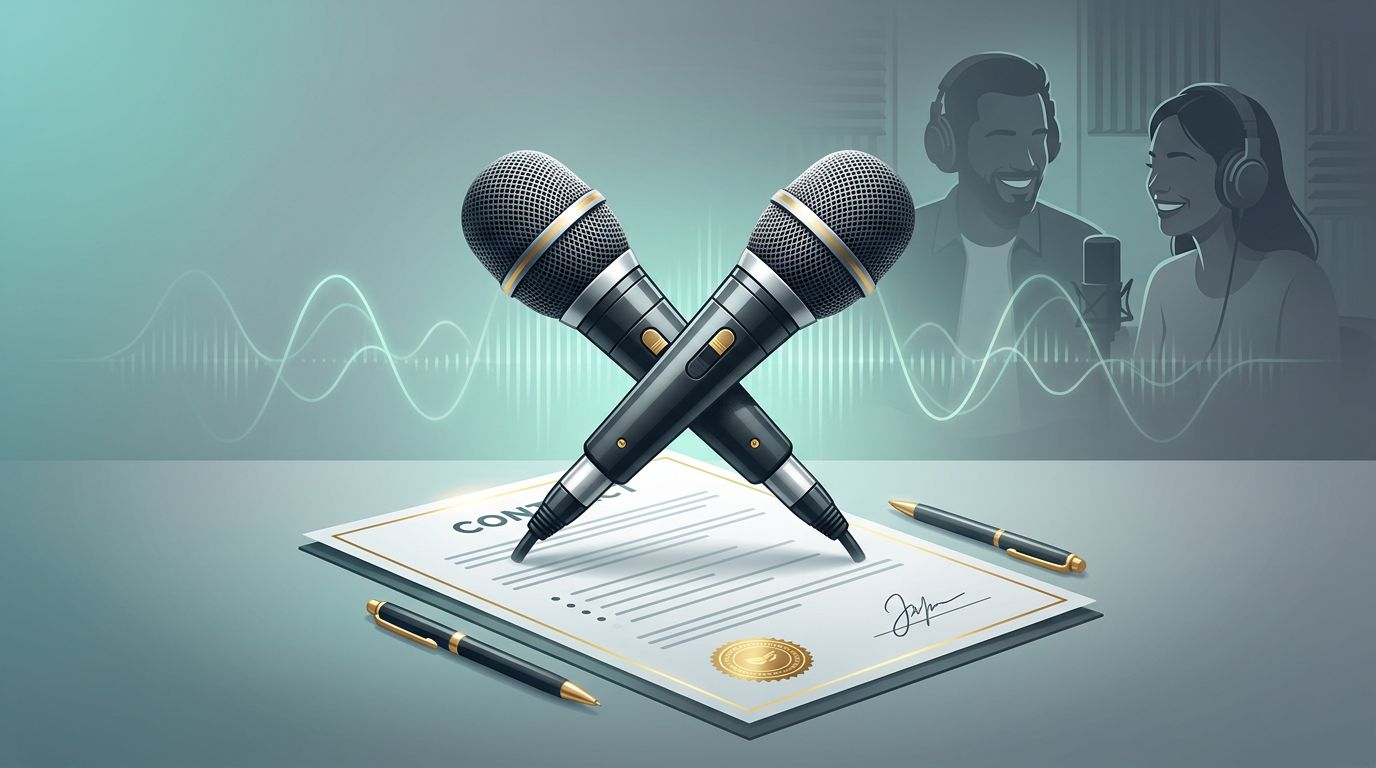
Podcast Co-Host Agreements for Ownership and Revenue
Many podcast fights don’t start with a microphone problem. They start when the show gets money, attention, or a buyout offer.
If you share a show with another host, a podcast co-host agreement is one of the first business documents you need. Without it, the law may fill in blanks you never meant to leave open.
That matters even more once sponsors, video clips, subscriptions, and live events enter the picture, so it’s smart to settle the deal before success makes every sentence harder to negotiate.
Table of Contents
ToggleWhy a podcast needs a real co-host contract
A lot of shows begin on trust. Two friends record a pilot, split the cost of a mic, and promise to “figure it out later.” Later is when trouble starts.
In 2026, there still isn’t a special US law that sets podcast ownership or revenue rights by default. Courts usually fall back on copyright law, contract law, and state business rules. If two people create a show together and never sign anything, the law may treat them as joint owners or business partners. That can mean shared control and an equal split of money, even when one person does more work.
For copyright, joint creators often hold equal, undivided interests unless they agreed otherwise in writing. For business profits, many state partnership rules also default to equal sharing when people operate together without clear terms. In plain English, silence often looks like 50/50.
If your contract doesn’t say who owns the show, the archive, and the ad money, someone else may decide later.
That “someone else” may be a judge, an arbitrator, or a platform responding to a takedown demand.
A good co-host agreement changes that. It states who owns the podcast, who can approve deals, how expenses get paid, and what happens if one host leaves. It also covers things creators often miss, such as who controls the RSS feed, who keeps the social accounts, and who can license clips to third parties.
Chase Lawyers helps podcasters, producers, and creative businesses turn those open questions into clear terms. That work fits the firm’s focus on media, entertainment, and intellectual property, where ownership fights can damage both revenue and reputation.
Start with ownership, not money
Money gets the attention, but ownership decides who can make money in the first place. That’s why the first pages of a co-host agreement should define the property at issue.
For a podcast, that property is usually more than the finished audio. It can include the show title, logo, artwork, tagline, domain name, website, RSS feed, raw recordings, edited episodes, transcripts, short-form clips, email list, video versions, and social handles. If you have a membership community or paid newsletter tied to the show, include those too.
Then decide who owns all of it. Some teams choose direct split ownership, such as 50/50 or 70/30. Others put the whole show inside an LLC and let the company own the IP. That second option often works better because the LLC operating agreement can set management and payout rules in one place.
Ownership also needs to cover future rights. Can the show become a book, a documentary, a live tour, or a streaming series? If the brand grows, those spin-off rights matter.
Just as important, your agreement should separate hosts from outside contributors. Guests do not become owners because they appeared on an episode. A freelance editor does not automatically own the final show, but you still need clean paperwork. The Supreme Court’s decision in Community for Creative Non-Violence v. Reid made clear that independent contractors are not automatically “work made for hire” under US law. If a freelancer creates theme music, cover art, or edited video without a proper contract, ownership can get messy fast.
That is why podcasters should use the same discipline seen in film and branded content. Chase Lawyers often helps creative teams with how to define IP ownership in production contracts, and the same principles apply to a show with multiple hosts.
One more point often gets missed. Copyright and trademark protect different things. The episodes may have copyright protection, but your show name and branding usually raise trademark issues. A co-host agreement should say who can keep using the name if the relationship ends.
Write revenue splits like math, not feelings
A clean deal does not say “we’ll split profits fairly.” Fair is an argument waiting to happen. Your contract should use numbers, formulas, dates, and categories.
Start with every revenue stream the show may earn. That includes sponsorships, baked-in ads, host-read ads, programmatic ad revenue, YouTube income, subscription revenue, paid communities, affiliate commissions, merchandise, live events, appearance fees, licensing, clip syndication, and brand partnerships. A short overview of common categories appears in this podcast agreements guide, and it shows how fast the income picture can widen.
Next, decide whether the split applies to gross revenue or net revenue. Gross is simple, because money gets divided before expenses. Net can be fairer when the show has real costs, but only if “net” is tightly defined.
This quick comparison helps:
| Model | How it works | Best fit | Main risk |
|---|---|---|---|
| Equal gross split | Divide every dollar before costs | Small shows with low overhead | One host may carry most expenses |
| Net split after approved costs | Deduct listed costs, then split the rest | Shows with editing, ads, and travel | Fights over what counts as an expense |
| Fixed fee plus split | One person gets a set producer or host fee, then the balance is shared | Small media businesses with uneven labor | Cash flow pressure in slow months |
Most disputes happen in the details. Which expenses are pre-approved? Is there a monthly cap? Can one host expense travel, studio rental, legal review, or outsourced editing without consent? If one host lands a sponsor through personal contacts, does that host get a commission before the split?
Payment timing matters too. State when revenue gets deposited, who handles the books, when statements go out, and when payouts happen. Also say who handles tax forms. If the show runs through an LLC, members may receive K-1s. If one host pays another directly, 1099 issues may follow.
Creators in music learned long ago that split sheets stop resentment before it hardens. The same logic applies here, just as it does with co-writer split sheets and revenue distribution. A podcast becomes a real business once the money rules are written down.
Control rights decide who can say yes
Two hosts may agree on ownership and still fight over control. One wants sharper guests. The other wants safer topics. A sponsor offers money, but the ad copy feels off-brand. The core issue is not personality. It is decision-making power.
Your agreement should divide decisions into categories. Day-to-day matters can go to one person or follow a simple majority if there are more than two owners. Big decisions should need both signatures, or a weighted vote tied to ownership percentages.
Major decisions usually include these items:
- Signing sponsorships, network deals, or platform exclusives
- Selling the show, licensing the back catalog, or granting adaptation rights
- Rebranding the title, logo, or show format
- Hiring editors, producers, or outside agencies above a set budget
- Settling legal claims or issuing public statements after a serious dispute
Daily matters need rules too. Who approves final cuts? Who writes episode descriptions? Who can post clips? Who keeps passwords for the hosting account, YouTube channel, banking tools, and social media? If only one host controls access, that person has real power even if the contract says ownership is equal.
Deadlock clauses are also smart. If both hosts disagree on a major issue, the contract can require mediation first. It can appoint a neutral industry advisor for certain calls. In some deals, one host gets tie-breaking authority on editorial issues while the other gets it on operations and sales.
US court decisions show why this matters. In Aalmuhammed v. Lee, the Ninth Circuit said a major creative contributor was not a joint author of the film Malcolm X because he lacked the control and shared intent that joint authorship requires. Podcasts are different works, but the lesson carries over. Creative input alone does not settle authorship or control. Your contract should.
Chase Lawyers often helps creators sort these governance issues before they turn into platform lockouts, sponsor losses, or public blowups.
Your exit clause protects the show when life changes
Most co-hosts negotiate as if the show will last forever. Few do. People move, burn out, change jobs, miss recordings, or end up in a dispute that makes the partnership impossible.
A strong exit clause plans for ordinary problems, not just dramatic ones. Start with voluntary departure. How much notice must a host give before leaving? Thirty days, sixty days, or until a season wraps? Then cover removal for cause. That can include repeated no-shows, harassment, fraud, criminal conduct that harms the brand, or breach of confidentiality.
Next, address the buyout. If one host leaves, how do you value that person’s interest? You can tie it to a multiple of trailing revenue, a set formula, an appraisal, or a pre-agreed price table that updates each year. Pick one method and write it clearly.
The back catalog may be the hardest issue. Can old episodes stay online if a former host wants out? Can the remaining host cut highlight clips from those episodes? May the departing host use excerpts in a reel or on a personal site? Your contract should answer each question.
This is also the place to address voice and likeness rights. If the show uses AI tools for editing, dubbing, or promo clips, state that no host’s voice may be synthetically cloned or re-used after departure without written consent. That point matters more each year.
Templates can help you spot issues. For example, this sample podcast agreement shows the common subjects parties usually cover. Still, a template can’t weigh your brand value, your audience, or the way your team actually works.
A practical exit section also says who keeps the name, who can launch a successor show, and whether the departing host faces a short non-compete or only a limit on using confusingly similar branding. Chase Lawyers can tailor those terms so a breakup does not erase the business you built.
What US law and court decisions mean for podcast disputes
Podcasters do not operate in a legal vacuum. They work under the same copyright, contract, and business rules that apply to other media projects.
On the copyright side, joint authorship depends on more than contribution. The Second Circuit in Childress v. Taylor said courts look for an intent to be co-authors, not just shared effort. That means a guest, researcher, or producer may add real value without becoming a co-owner. The Ninth Circuit made a similar point in Aalmuhammed v. Lee, where strong creative input still did not create joint authorship without the right kind of control and intent.
Those cases matter because many podcast teams blur roles. One person hosts, another outlines the show, a contractor edits, and a manager books guests. Without contracts, each person may tell a different ownership story later.
If two hosts are joint copyright owners, another rule kicks in. In many cases, each co-owner can grant a non-exclusive license without the other’s consent, but must account for profits. That can create chaos if one host cuts a clip deal, signs a sponsor using archive content, or licenses episodes to a third-party platform.
Business law adds another layer. If hosts act like partners and never form a company, state partnership rules may divide profits equally by default. Florida and New York both have business statutes that can supply missing terms when people operate together informally. Those default rules are useful for courts, but they are rarely the deal creators thought they had.
This is why many serious shows put the podcast inside an LLC, assign all show IP to that entity, and then use a co-host agreement plus an operating agreement to control economics and voting. Chase Lawyers helps creators build that structure early, when the cost is low and the relationships are still intact.
How Chase Lawyers helps podcasters lock this down
A podcast co-host agreement works best when it is drafted around the actual show, not copied from a random template. A comedy interview podcast has different risks than a news show, a branded series, or a video-first creator business.
Chase Lawyers is a boutique firm with a strong focus on entertainment, media, arts, and intellectual property work. That makes a difference for podcasters because the problems are rarely “just contract” problems. They usually mix copyright, trademarks, licensing, personality rights, platform rules, sponsorship language, and business structure.
For a new show, Chase Lawyers can set up the LLC, define ownership, draft the co-host agreement, and clean up third-party contracts for editors, designers, and composers. For an existing show, the firm can review a messy arrangement, reset revenue rights, and fix account access before a dispute erupts. That is especially useful when a podcast expands into live shows, merchandise, premium subscriptions, or brand-funded episodes.
The firm’s work with artists, producers, influencers, and other creative businesses also helps when the podcast is part of a bigger media brand. If the show feeds short-form content, course sales, or endorsement deals, those connected rights need to line up across all contracts.
Good legal drafting does not kill chemistry. It protects it. When both hosts know who owns what, who gets paid what, and who decides what, they can spend less time second-guessing and more time making a better show.
Conclusion
A successful podcast can turn into a company faster than most hosts expect. If the ownership and revenue rules stay vague, that growth puts pressure on every relationship around the show.
The smartest move is simple: set the rights before the stakes rise. A written co-host agreement should cover ownership, money, control, and exit terms in plain language that still holds up in court.
Chase Lawyers can help podcasters and creative businesses put that structure in place, so the show’s future does not depend on memory, goodwill, or who controls the login.

- 21 SE 1st Ave, Suite 700, Miami, FL 33131
- 305-373-7665
- 305-373-7668
- info@chaselawyers.com
- 1345 Avenue of the Americas, 2nd Floor, New York, NY 10105
- 212-601-2762
- info@chaselawyers.com
Get a response within 24 hours. We’ll clearly explain how we can support and protect your brand while staying within your budget.